Get Full Government Meeting Transcripts, Videos, & Alerts Forever!
Get email alerts on the Cultural Preservation topic
No spam. Unsubscribe anytime.
Residents urge preservation of Osaka Way design, propose renaming for Ruth Asawa
Summary
Public commenters asked the commission to intervene or connect them to appropriate agencies after a planned renovation of Osaka Way (Buchanan Mall) in Japantown appeared to replace several original Ruth Asawa benches with concrete planters that commenters say diminish the site’s cultural character.
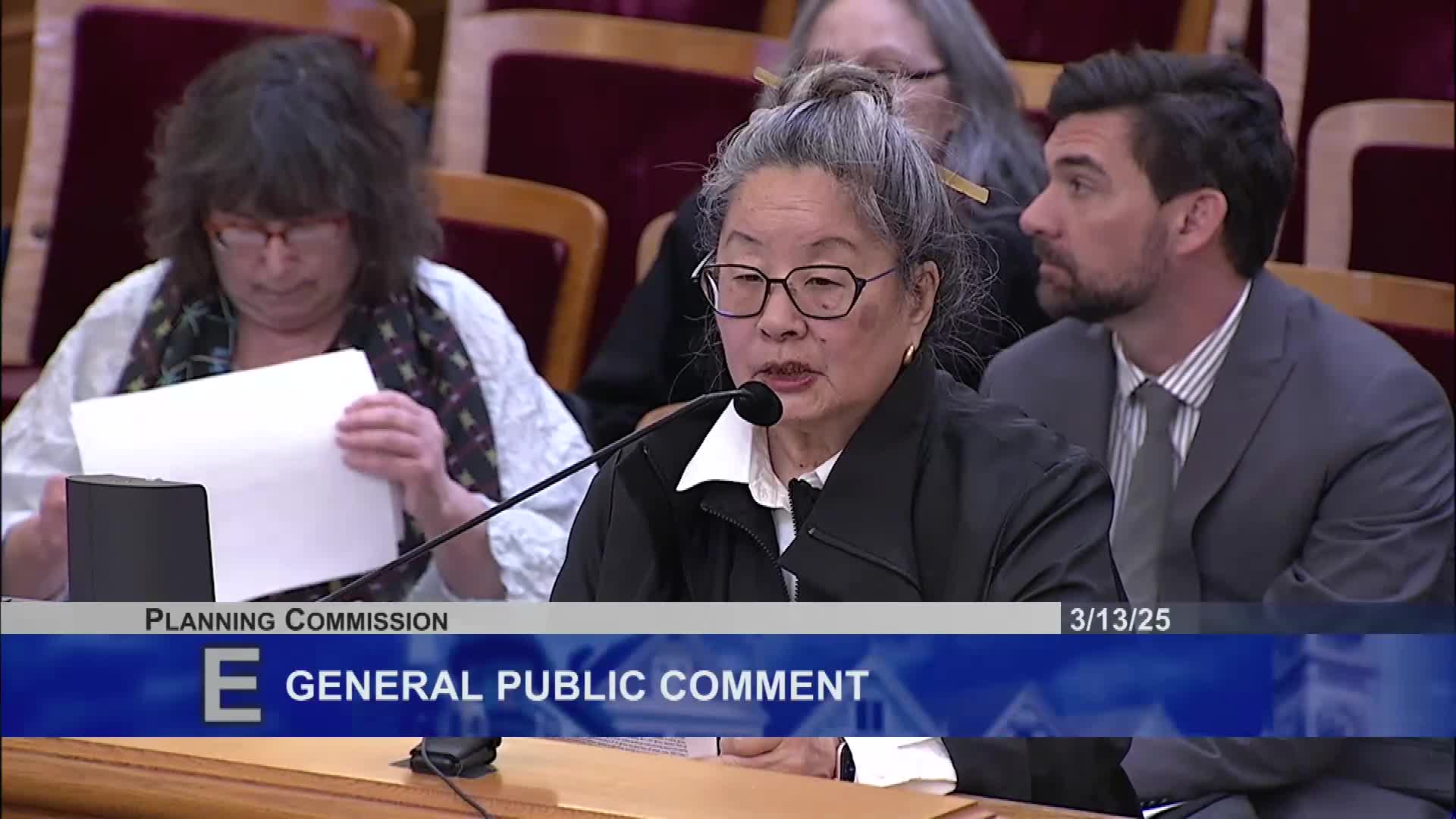
During general public comment on March 13, residents asked the Planning Commission to help protect Osaka Way (Buchanan Mall) in Japantown and to preserve the original design elements by artist Ruth Asawa.
Masako Takahashi, whose family has owned property in the city since the post‑war era and who said they were friends of Ruth Asawa, said a project intended to repair fountains and improve accessibility has expanded into a broader redesign that, in her view, would “destroy the artwork of world famous Ruth Asawa.” She showed the commission the city’s proposed plan, saying the design replaces the artist’s portable benches with immovable, “peanut‑shaped cement planter boxes” lacking Japanese architectural touches. Takahashi asked the commission to consider restoration and to rename the corridor “Ruth Asawa Way.”
Planning staff responded that the project appears to be led by Public Works and that Planning’s role is tangential; staff offered to connect Takahashi and other community members with the appropriate city contacts. Director Rich Hillis (Planning Department) told commissioners staff would follow up by email to connect residents with the responsible departments.
No formal action was taken by the commission at the March 13 hearing. The commission’s staff encouraged community members to follow up with project managers in Public Works and the relevant supervisor’s office for design and historic‑preservation questions.