Get Full Government Meeting Transcripts, Videos, & Alerts Forever!
Get email alerts on the Housing Rezoning Notice topic
No spam. Unsubscribe anytime.
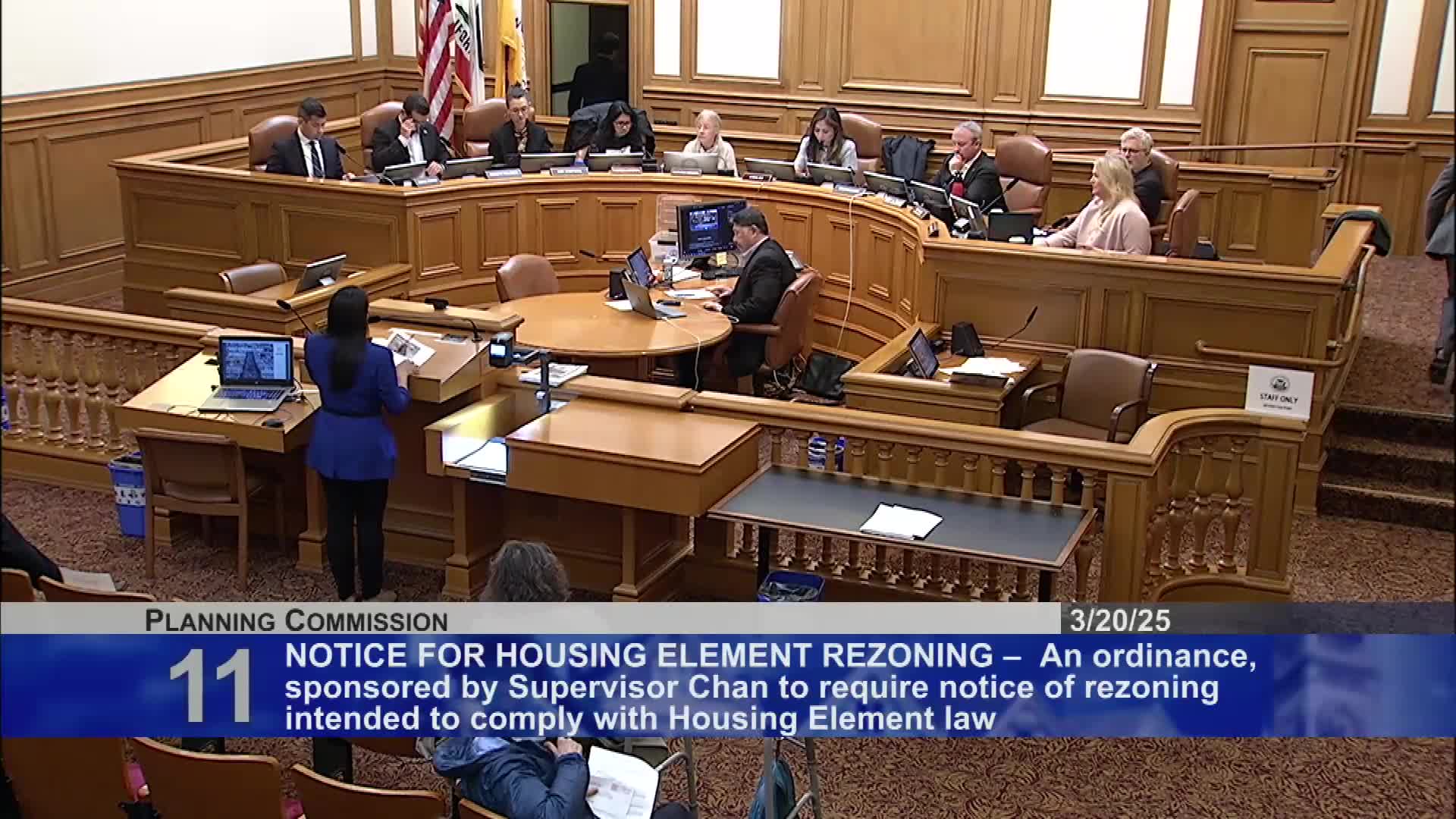
Planning Commission backs Supervisor Chan’s rezoning notice ordinance with staff modifications
Summary
The commission voted 5–2 to recommend approval of an ordinance requiring mailed notice and web postings when the city adopts housing-element rezoning, while asking staff and the supervisor to refine scope, cost and language. The hearing included hours of public comment urging broad notice, renderings and clarity about who will be notified.
The San Francisco Planning Commission on March 20 recommended approval of an ordinance introduced by Supervisor Connie Chan that would require mailed notice and enhanced online materials when the city adopts housing-element rezoning, while asking staff and the supervisor to continue refining the draft language and funding approach.
The commission voted 5 to 2 to recommend approval with staff modifications. Commissioners Campbell and McGarry voted No. The ordinance would require a 30‑day mailed notice to property owners, residents and commercial lessees within proposed rezoning areas and within a 300‑foot radius; an interactive departmental web page with maps and renderings; and minimum formatting requirements for mailed notices. Planning staff supported the goals of increased engagement but asked for changes to narrow mailing scope, reduce prescriptive language and clarify rendering requirements because the draft rezoning map covers thousands of acres and would impose substantial new costs and staff time.
Supervisor Connie Chan introduced the proposal as a “right to know” measure. “For everyday residents it’s very difficult to track…what is happening to their homes,” she told the commission, and said the ordinance is intended to notify residents, commercial tenants and property owners of proposed changes near them. Chan said she worked with planning staff to produce a substitute draft that reduced cost and logistical burden while keeping the core notice requirement.
Planning staff briefed the commission on differences between current law and the proposed ordinance. Veronica Flores and Director Hillis explained that under the planning code, mailed notice is only required for zoning map amendments affecting 30 acres or less with a 150‑foot radius; the draft rezoning map the department used for cost estimates covers roughly 13,000 acres. Staff said a mailed postcard would be the most cost‑effective format, noted language‑access and format tradeoffs (font size, QR code, translations), and estimated conservative mailing costs, including translated cards and renderings, could reach into the low hundreds of thousands of dollars. Staff recommended clarifying that notices should go to properties that would be proposed to receive increased height or density and to adjacent properties within 300 feet, and to limit renderings to representative corridors rather than every affected block.
Public commenters overwhelmingly urged broad notice, accessible design, and renderings that show before‑and‑after impacts. Neighborhood groups, tenants’ advocates and residents said postcard and web notice should reach residents who lack online access, should include renderings to illustrate shadows and bulk, and should not be narrowed in ways that would exclude residents who will experience impacts. Several speakers said the mailing cost was small compared with the scale of change—staff cited estimates for a 6-by-9 postcard format and alternatives, and asked for funding clarity.
Commissioners debated tradeoffs among outreach cost, breadth of notice, and clarity. Commissioner Braun supported the ordinance in principle but stressed the importance of earmarked funding: “I would emphasize the Department recommended modification number 1, which is about strong advocacy…to ensure additional funding is provided and earmarked for this effort,” Braun said. Vice President Moore moved to recommend approval with staff modifications and invited continued collaboration between the supervisor’s office and the planning department on cost‑effective design and outreach; the motion was seconded and passed 5–2.
The commission’s recommendation goes to the Board of Supervisors as part of the public‑process sequence for rezoning related to the housing element. Staff recommended the commission’s vote include the department’s proposed clarifications on mailing lists, non‑prescriptive language for card content and limiting the scope of renderings; the sponsor signaled willingness to continue working with staff on those edits.
If the Board of Supervisors adopts a version of the ordinance, staff said notices would be mailed 30 days before any rezoning adoption hearing and the planning department would maintain web pages and sample renderings for public review. Planning staff asked the commission to note the city must balance notification scope against staffing and existing budget limits; staff said additional funding would be required to fully implement broad mailings and renderings at the scale of the draft rezoning map.
The planning commission’s recommendation (5–2) includes staff’s modifications; the measure proceeds to the Board of Supervisors for further consideration. Commissioners asked staff to return with a brief implementation roadmap and budget options so the department and the Board can identify funding sources and final mailing scope before notices are produced.