Get Full Government Meeting Transcripts, Videos, & Alerts Forever!
Get email alerts on the Wireless Telecom topic
No spam. Unsubscribe anytime.
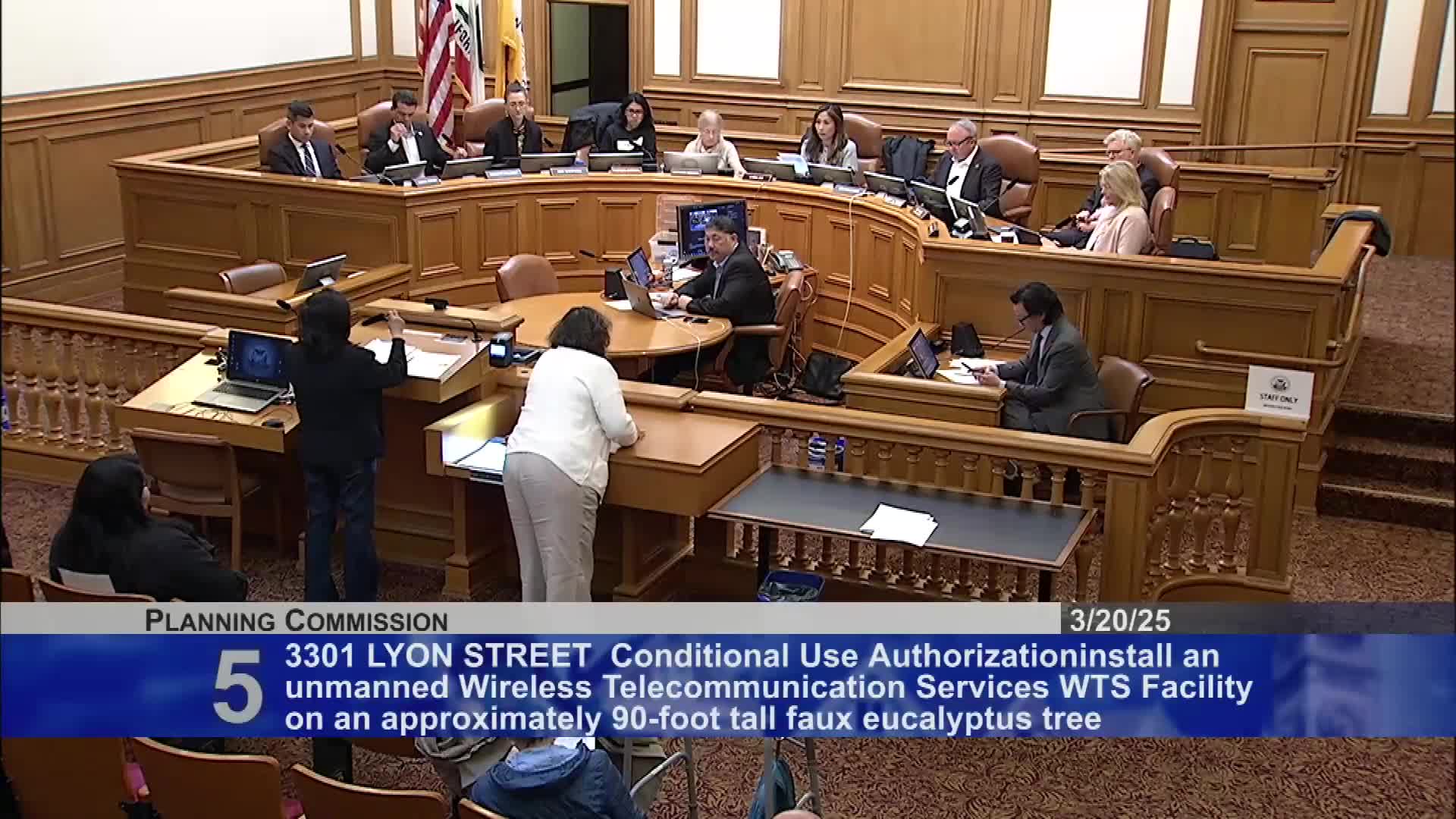
Planning Commission approves faux-eucalyptus cell tower at Palace of Fine Arts over community objections
Summary
The San Francisco Planning Commission on March 20 approved a conditional use authorization to allow AT&T to install a disguised wireless monopole shaped as a eucalyptus tree in the Palace of Fine Arts parking lot to improve coverage and first-responder communications.
The San Francisco Planning Commission on March 20 approved a conditional use authorization for new wireless telecommunications facilities at the Palace of Fine Arts, permitting a disguised monopole styled as a eucalyptus tree in the parking lot.
The commission voted 6 to 1 to approve the application with conditions, with Commissioner Williams casting the lone No vote. The project sponsor and department staff said the location best meets public-safety and coverage needs and that other rooftop or rooftop-adjacent locations were evaluated and rejected.
Mary Woods, Department of City Planning staff, told the commission the Palace of Fine Arts building is a designated city landmark and that Recreation and Park and Department of Public Health had reviewed and approved the proposal as part of certificate-of-appropriateness coordination. “The Recreation and Parks Department owns the land, and the Recreation and Parks Department has been working with the project sponsor AT&T regarding the proposed new wireless telecommunication facilities for many years,” Woods said.
AT&T’s project team described the site-choice process as lengthy. “We’ve been working on this for 10 years,” said Eric Lentz, the AT&T project sponsor. Lentz said the proposed pole in the parking lot would serve coverage dead zones around the Palace and Marina Green and support first-responder communications. AT&T engineers described selecting a faux eucalyptus design because its branching form better conceals antenna installations at the necessary heights compared with a single‑pole pine design.
Commissioners and staff acknowledged community concern over visual impacts and neighborhood notification. Planning staff said wireless conditional-use authorizations have a larger notification radius than typical CUAs—500 feet in this case—and that staff had documentation showing mailings for the pre‑application meeting. The Marina Community Association had submitted a letter saying it had not been notified of an earlier pre‑application meeting; project staff said the association was listed in the outreach records and staff provided that list to the commission during the hearing.
Vice President Moore asked for clearer visual simulations and asked the sponsor to provide additional renderings and to address what would happen if the planted/installed tree failed. AT&T’s technical representative described existing eucalyptus trees in the area and provided examples of successful faux-eucalyptus installations elsewhere in the Bay Area, noting design choices that make the faux tree visually compatible with the site’s tree canopy.
Commissioner Williams, who had pulled the item from the consent calendar, said he was “concerned about the community participation” and the Marina Community Association’s assertion that it had not been notified. Staff said they would provide the outreach documentation and that additional visual simulations could be added to the record. Commissioner McGarry, who moved approval, argued the area needs improved emergency communications coverage and that the proposed location better serves public-safety needs than other options.
The commission’s action permits the applicant to proceed under the conditions approved by the commission. The approval requires the applicant to comply with the certificate-of-appropriateness findings and the conditions described in the staff report; staff and the sponsor said they will refine visual materials and continue dialogue with Rec and Park and nearby community groups.
The permit includes conditions described in the staff report; staff said they will circulate any updated renderings and lease discussions with Rec and Park as the applicant finalizes details. The commission’s approval places the project under the planning department’s conditions and future compliance checks that apply to landmark properties and wireless facilities.
The Planning Commission’s approval means the project may move forward subject to the conditions in the staff report and any permits required by Recreation and Park or other agencies. The project sponsor and staff said they would continue to work with the Marina Community Association and Rec and Park to address outstanding concerns and to produce additional visual simulations for the public record.