Get Full Government Meeting Transcripts, Videos, & Alerts Forever!
Get email alerts on the Early Literacy Act 20 topic
No spam. Unsubscribe anytime.
Janesville reports about 40% of K–3 students placed on reading plans under new Act 20 screening
Summary
District staff outlined statewide Act 20 K–3 literacy screening results, saying Janesville’s fall/winter administration placed roughly 40% of students on reading plans, described required parent notifications and monitoring, and flagged timelines for 10‑week progress reports, summer school and a July 1, 2025 third‑grade promotion policy.
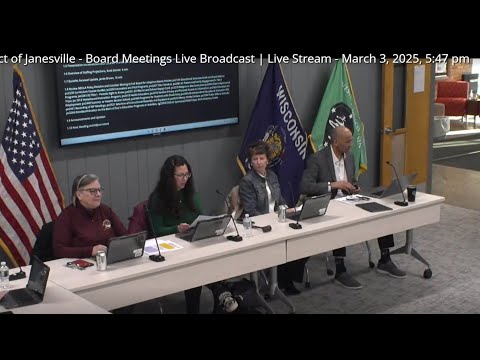
Dr. Lisonbee de Graff told the Janesville School District Policy, Personnel & Curriculum Committee on March 3 that statewide Act 20 K–3 screening placed about 40% of Janesville students on a required reading plan.
The update matters because Act 20, the state law that requires K–3 early literacy screening, prescribes timelines and interventions. Dr. Lisonbee de Graff said the district used the AIMSweb Plus screener (Pearson) and that “any student who fell below the 25th percentile has received a reading plan.” Parents received initial assessment results within the 10‑day state window and were given a separate link to view specific reading plans via NextPath, the district’s data management partner.
Dr. Lisonbee de Graff described what the screening measured — timed letter naming, letter‑sound tasks, phonemic awareness items and a one‑minute oral reading fluency passage for grades 1–3 — and said only the oral reading fluency component counts toward the reading‑plan percentile threshold in grades 1–3. She noted that first grade statewide percentages of students placed on plans were higher, in part because many districts do not normally administer fluency probes that early in the year. “It makes sense why so many first graders across the state have more reading plans than in the other grade levels,” she said.
The district’s implementation steps include weekly progress monitoring for students on a plan, a required 10‑week progress report to parents, and summer reading programs at all 12 sites for third graders on plans; the district hopes to expand summer offerings to second and first graders depending on numbers. Dr. Lisonbee de Graff said reading plans specify the percentile rank, the setting of support (for example, small‑group reading specialist, Title I), the targeted skill (diagnosed with a short diagnostic), and how progress will be checked and reported.
Board members asked about the decision to include a timed oral fluency measure in first grade and the district’s resource capacity. Allison (board member) asked whether the fluency component was a state requirement; Dr. Lisonbee de Graff confirmed it was, and said the district has submitted feedback for future reflection. A board member asked whether the district had enough Title I teachers and reading specialists; Dr. Lisonbee de Graff said staffing and resource allocation remain priorities and that early intervention is critical because gaps become harder to close after third grade.
The district also described parent notification and follow‑up: results were sent and parents who had not acknowledged receipt were reached at parent–teacher conferences (elementary parent conference attendance was reported as roughly 95–100%). Next steps include a spring assessment window (state requires the spring screen to be at least 45 days before the school year ends), posting Act 20 explanatory resources and videos on the district website, and drafting a third‑grade promotion policy to meet the July 1, 2025 requirement.
Dr. Lisonbee de Graff thanked classroom teachers and specialists for administering the one‑on‑one assessments and said the district found most students flagged were already receiving some form of support. She closed by noting the district will send 10‑week progress updates in the coming weeks and continue to refine parent resources and outreach.