Get Full Government Meeting Transcripts, Videos, & Alerts Forever!
Get email alerts on the Land Use Legal Training topic
No spam. Unsubscribe anytime.
Deputy city attorney briefs Oregon City planning commissioners on land-use procedures, burden of proof and housing rules
Summary
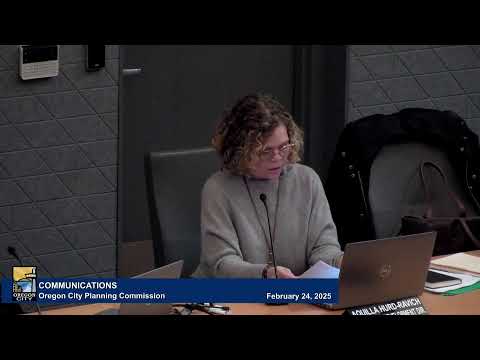
Deputy City Attorney Carrie Richter gave the planning commission its annual legal training on Feb. 24, reviewing Oregon’s statewide land-use framework and key procedural rules for hearings and applications.
Deputy City Attorney Carrie Richter gave the planning commission its annual legal training on Feb. 24, reviewing Oregon’s statewide land-use framework, the difference between legislative and quasi-judicial decision-making, and several procedural rules that apply to development applications.
Richter summarized the state framework and its local implementation: “In Oregon, we have a statewide planning program,” she said, and noted Senate Bill 100 and the Oregon Revised Statutes set the requirement that local governments adopt comprehensive plans and implement statewide planning goals. She described Metro’s role as the regional government that establishes the urban growth boundary and noted how layers of federal, state and regional rules feed into local code and decision-making.
Richter outlined the two broad decision types commissioners will encounter: legislative (long-range planning, city-initiated code or plan changes — final decision by the City Commission) and quasi-judicial (applicant-initiated development review, decided under adopted approval criteria, with public notice/hearing and appeal rights). She explained the common procedural sequence for discretionary (Type 3) reviews: pre-application and neighborhood meetings (when required), a completeness review (staff has 30 days to decide), the 120-day decision clock that begins once an application is deemed complete, notice and a staff report available seven days before the hearing, a public hearing where the applicant and opponents present evidence, and post-hearing procedures for leaving the record open.
On the application timeline and deadlines, Richter said the local government generally has 120 days to take final action after an application is deemed complete; a failure to act can expose the city to a mandamus action in circuit court. The transcript records Richter’s explanation that the city has 30 days to determine completeness, applicants have 180 days to respond to an incompleteness notice, and applicants control the decision timeline (they may extend the 120-day clock or elect not to). Commissioners also clarified time limits in local code: staff noted that land-use approvals expire in three years if no building permit has been issued, and a related building-permit issuance requirement is five years.
Richter emphasized key hearing rules: the applicant bears the burden of proof and gets the first and last word in presentation; decision-makers must base decisions only on evidence in the record and must disclose any ex parte contacts, conflicts of interest or bias at the hearing. She said ex parte contacts with planning staff are not treated the same as private ex parte contacts, and recommended commissioners forward any outside materials they encountered to staff so the materials can be added to the record.
On standards and criteria, Richter explained the “fixed goalpost” rule: when an application is filed and deemed complete under the statutory timelines, only the standards in effect at that time generally apply to that application, even if the city later changes its code. She also reviewed housing-specific rules coming from state law: standards, conditions and procedures affecting housing must be “clear and objective” where required; local standards that have the effect (in themselves or cumulatively) of discouraging needed housing by imposing unreasonable cost or delay can be challenged; and the new Housing Accountability and Production Office (HAPO) provides a state enforcement path for disputes about how jurisdictions process housing applications.
Commissioners asked clarifying questions about the fixed goalpost rule, the completeness review clock (starts when the application fee is paid), ex parte contacts and the limits on conditions of approval (rough proportionality for exactions). Richter advised commissioners to ask questions during hearings — not only during deliberations — so that interpretations of discretionary criteria are raised while the record is open and the applicant has an opportunity to respond.
The training closed with practical reminders about government ethics, public records and public meetings law; Richter reminded commissioners that meeting-related notes and communications about city business can be public records and to direct official communications through city systems to preserve records.