Get Full Government Meeting Transcripts, Videos, & Alerts Forever!
Get email alerts on the Education School Choice Transfers topic
No spam. Unsubscribe anytime.
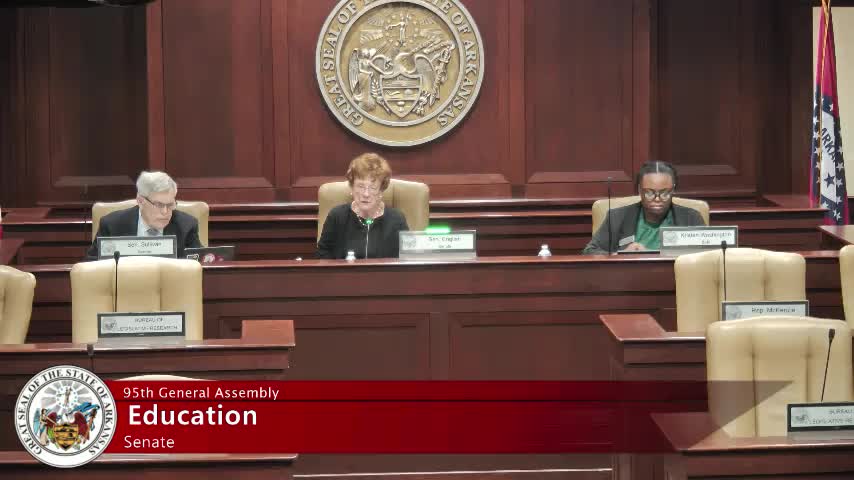
Senate education hearing on HB 1633: sponsors seek uniform transfer rules for school athletics; motion not seconded
Summary
The bill's sponsor introduced House Bill 1633 to the Senate Education Committee, saying the measure "simply just equalizes the transfer rules relative to athletics in both public and non public schools" by allowing transfers without athletic penalty up until June 1 before a student enters 10th grade and imposing a 365‑day sit‑out period after that date.
The bill's sponsor introduced House Bill 1633 to the Senate Education Committee, saying the measure "simply just equalizes the transfer rules relative to athletics in both public and non public schools" by allowing transfers without athletic penalty up until June 1 before a student enters 10th grade and imposing a 365‑day sit‑out period after that date.
The bill's sponsor told the committee the goal is to create a single, consistent rule for transfers involving athletics across public and nonpublic schools and to avoid a transfer portal in high‑school athletics similar to recent developments in college sports. Lance Taylor, executive director of the Arkansas High School Activities Association (AAA), told senators AAA conducted a spring survey of superintendents and principals and that "84.1% of their schools were in favor of this." Taylor also described eight hardship categories in the AAA handbook that can permit immediate athletic eligibility in certain cases with documentation.
Why it matters: Supporters say the bill would make eligibility rules uniform between public and nonpublic schools and curb athletic recruiting. Opponents and several public commenters said the change would disproportionately harm students who transfer for nonathletic reasons — including family instability, abuse, bullying, or to escape harmful peer groups — and would remove a tool families and caseworkers use to protect and stabilize students.
Public testimony and committee questions: Attorney Dusty Standridge, who represents parents in child welfare and family law cases, presented district‑level Department of Education enrollment and transfer data and said those numbers do not show a surge in transfers tied to athletics after 2023 changes to state law. Standridge warned that HB 1633 would limit options for vulnerable children, citing examples of foster care and domestic relations cases in which a school change provided oversight and structure. He said the AAA hardship categories include an "extreme and unusual circumstance" exemption for documented medical, psychiatric or abuse situations.
Gary Newton of Arkansas Learns spoke in support of school choice but urged adding students assigned to low‑performing schools (those eligible for opportunity school choice) as an additional hardship category. Senator Sullivan and other committee members asked about the source and scope of AAA's survey data; Taylor said the AAA conducts a formal spring survey of superintendents and principals and would provide further data on waiver denials and other implementation details.
Senator Allen Clark (District 7) and community advocate Antonio Moore opposed the bill. Clark said the change would effectively remove school choice for older student athletes and that it punishes students rather than targeting recruiters. Moore, who coaches and operates a statewide youth basketball program, described the mental and physical toll of a 365‑day sit‑out and recounted examples in which athletic participation provided structure that helped students graduate or avoid involvement in crime.
Committee action: At the close of debate the bill's sponsor asked the committee for a motion to pass HB 1633, but when asked for a second the chair stated no second was offered. No formal vote was taken on the bill during the hearing.
Context and next steps: Committee discussion referenced Senate Bill 400 (2023), which changed transfer rules earlier and is the subject of pending litigation in at least one case involving Fort Smith School District. Committee members and witnesses requested more detailed data on transfers, hardship waiver approvals and denials, and clarity on where a 365‑day sit‑out requirement would be codified in statute or left to AAA rule. The bill remains before the Senate Education Committee with no recorded passage at this hearing.