Get Full Government Meeting Transcripts, Videos, & Alerts Forever!
Get email alerts on the School Funding topic
No spam. Unsubscribe anytime.
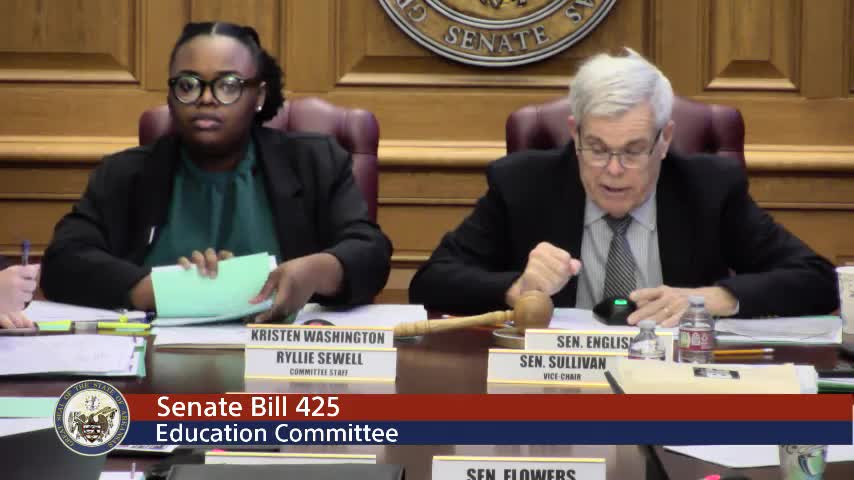
Senate education members press Bureau of Legislative Research on formula behind proposed enhanced transportation allotments
Summary
Senators questioned BLR and Department of Education staff about how a complex formula distributes a limited $8 million per year enhanced transportation fund; the committee did not approve SB 425.
Senate Bill 425, introduced by Senator Jane English, would set enhanced transportation allotments for school districts for the upcoming biennium. Committee members spent more than an hour questioning staff from the Bureau of Legislative Research (BLR) and the Department of Education about the mechanics and transparency of the formula that determines which districts receive additional funding.
What the bill would do: SB 425 would list per-district enhanced transportation amounts and set the total enhanced transportation appropriation at $8 million per year (an $8 million pot for each year of the biennium). That pot is separate from transportation funding included in the foundation matrix and other categorical funds.
Key points from testimony: Julie Holt (BLR) explained the enhanced transportation calculation originated as a member project circa 2013 and relies on a regression model that considers three primary factors: bus miles driven, number of bus riders, and average daily membership (enrollment). The model predicts a district’s transportation expenditure; that predicted need is compared to the matrix funding and prior-year expenditures to determine eligibility for enhanced funds. BLR uses the most recent available data (the committee was told it used 2024 data) and distributes the $8 million across eligible districts in a multi-step allocation, sometimes described in testimony as a “trickle down” process with proportional multipliers.
Committee concerns: Multiple senators sought a concise written formula and district-level explanations. Senators asked why some districts’ line items fell to zero while others increased substantially (examples cited in testimony: Watson Chapel, Whitehall, Star City). BLR staff said the calculation also treats other revenue sources or expenditures (such as isolated or categorical funds, or excess local revenue) as offsets; when districts use other funds for transportation, BLR’s model reduces that district’s enhanced allocation. BLR staff declined to circulate the full spreadsheet publicly during the hearing, but offered to sit down with legislators and superintendents to explain the district-level numbers. Several senators pressed whether the formula’s distribution method effectively picks “winners and losers” when need exceeds the available $8 million.
Action and outcome: Committee members debated whether to advance SB 425. A motion to pass was made but received no second; the motion failed and SB 425 did not advance. Senators agreed to schedule a follow-up meeting with BLR to review the methodology and district spreadsheets.
Why it matters: Enhanced transportation funds are intended to help districts for which the foundation matrix does not fully cover transportation costs. Because the $8 million appropriation is limited, the distribution formula determines which districts receive supplemental aid and how much. Senators expressed concern about transparency and whether the allocation process results in significant year-to-year swings that could disrupt district budgets.
Next steps: The committee chair committed to arranging a staff briefing with BLR and the Department of Education so all senators can review the allocation spreadsheets and the formula’s implementation before further action on the bill.