Get Full Government Meeting Transcripts, Videos, & Alerts Forever!
Get email alerts on the Public Safety topic
No spam. Unsubscribe anytime.
Goodyear police chief recommends city build standalone real-time crime center; council signals support for phase 1
Summary
Police Chief Brian Nissitt presented a completed study and recommended a two-phase buildout of a Goodyear real-time crime center (RTCC). Staff estimated roughly $1.4 million in ongoing annual operating costs for phase 1 and a one-time capital/CIP ask of about $500,000; council members expressed support but did not take a formal vote.
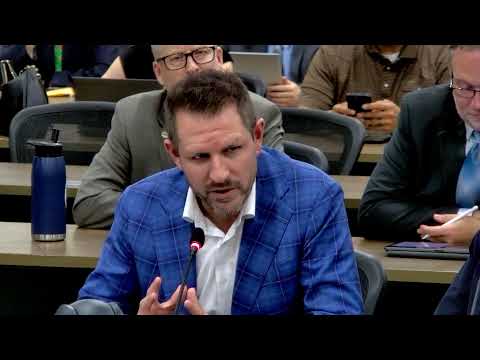
Police Chief Brian Nissitt told the Goodyear City Council on March 17 that the police department had completed a strategic-plan task to study and evaluate creation of a real-time crime center and recommended the city build a standalone center in two phases.
Nissitt said the center would gather live data from city and partner cameras, CAD and records-management feeds and commercial sources to give officers “a fuller picture of what is happening in real time” and to improve response, officer safety and case clearance. “For me, the most important question to ask when discussing any project is the why,” he said.
The chief outlined a two-phase approach. Phase 1 would colocate the real-time crime center within the city’s emergency operations/communications footprint and acquire a commercial RTCC platform, hardware (video wall, computers, monitors, radios), and integrate CAD and RMS systems, the city’s Flock and intersection cameras and other city camera feeds. Nissitt recommended staffing Phase 1 with one officer, one tactical dispatcher, one crime analyst and a systems engineer requested by IT. He said Phase 1 could be roughly an 18-month effort.
Phase 2 would add hardware and personnel to expand capabilities, including a “drone as first responder” (DFR) program and additional tactical dispatchers and analysts. Nissitt described two DFR approaches used elsewhere: one model with roughly a 45‑minute flight time and quick battery swaps, the other a beehive/rotation model with about 20‑minute flights and rapid relaunch; both, he said, can provide zoomed, high-definition views and can deliver “eyes on scene” to officers before they arrive.
On performance and need, Nissitt cited department data showing a year-over-year increase in demand: a 10.3% increase in calls for service between February 2023 and February 2024, a 3.3% increase in Priority 1 calls and an 8.9% increase in arrests in the same comparison. He also described use of the Flock system: of roughly 1,200 vehicles entered by Goodyear detectives during a year, the department logged about a dozen arrests tied to those hits—“a little less than 1% solvability rate,” he said—illustrating the potential for faster, centralized analysis.
Council members pressed on privacy, retention, security and cost. Nissitt said the department would follow record‑retention schedules “as allowed by statute” and indicated intersection camera footage had been retained at longer intervals in prior work; at the meeting the city clerk and other staff clarified that the Arizona Library’s record retention schedule for general traffic-camera footage is 14 days and that footage pulled for investigations is retained under longer schedules tied to the type of case.
IT Director Faizyan (identified in the meeting as the IT representative) said the RTCC would use segregated networks and role-based access so that only authorized PD staff could view the RTCC feeds and operations. Nissitt and staff said the RTCC would be separate from the 9‑1‑1 dispatch floor: tactical dispatchers in the RTCC would work in a separate room and would not broadcast the RTCC display directly over radio; connectors would be purchased in Phase 1 so RTCC data can be integrated with existing systems.
On cost, staff (identified in the meeting as Jared and other city staff) estimated Phase 1 operating costs of roughly $1.4 million per year, with a one‑time CIP project of about $500,000 that would appear in the recommended FY26 budget if the council supported moving forward. Staff said the $1.4 million estimate covered software, personnel and related ongoing costs and that the one‑time CIP figure covered buildout and equipment; a detailed Phase 2 cost estimate was not included in the FY26 proposal and would be developed later.
Council members voiced broad support and asked for additional detail in follow-up briefings and site visits. Several members recommended tours of existing RTCCs (Glendale and others were cited as examples) and asked for a detailed implementation timeline (a Gantt chart), privacy/community‑engagement plans and grant‑funding options. No formal motion or recorded vote was taken at the work session; staff said they would include Phase 1 details in the recommended FY26 budget if the council supported that step.
Clarifying details discussed included the proposed Phase 1 staffing levels (one officer, one tactical dispatcher, one crime analyst, one systems engineer), Phase 2 staffing additions (two tactical dispatchers, one crime analyst, one civilian supervisor), estimated Phase 1 timeline (~18 months), estimated Phase 2 timeline (~another 18 months) and the city staff estimate of roughly $1.4 million in ongoing Phase 1 operating costs plus a one‑time CIP of about $500,000. Nissitt also cited examples—Elk Grove, Albuquerque, Glendale and others—where RTCCs and DFRs were used to speed response and help clear cases.
The chief and several council members emphasized that while regional partnerships exist with neighboring agencies, Goodyear’s geography and prioritization needs led staff to recommend a city‑run center rather than a fully regionalized RTCC. Staff said they continue routine operational coordination with Buckeye, Avondale and Phoenix-area agencies when incidents cross jurisdictions.
Next steps identified by staff were to (1) include Phase 1 as a proposed CIP/operating ask in the FY26 recommended budget materials if council supported that direction, (2) provide a detailed cost breakdown and Gantt chart for implementation, (3) pursue grant opportunities where applicable, and (4) schedule follow-up briefings and site tours for council members.
No formal ordinance, resolution or budget appropriation was adopted during the meeting. The RTCC item was informational and advisory; staff said they would return with budget documents and more detailed cost and procurement options if council directed staff to include Phase 1 in the FY26 budget process.