Get Full Government Meeting Transcripts, Videos, & Alerts Forever!
Get email alerts on the Duval Doge Committee topic
No spam. Unsubscribe anytime.
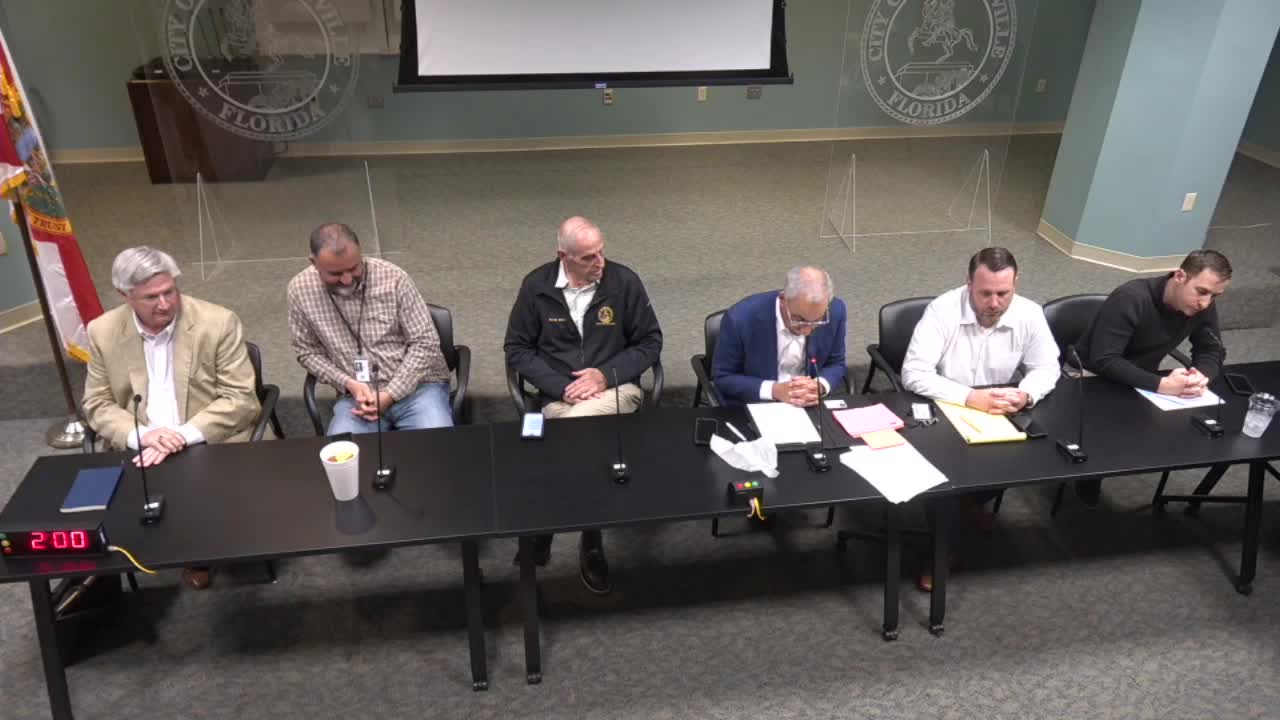
Jacksonville council members announce 'Duval DOGE' efficiency review; public speakers largely oppose committee
Summary
Councilman Ron Salem announced a city subcommittee to review operations and spending dubbed "Duval DOGE," assigning auditors to examine banking, P-cards, facility use, children’s services and dormant CIP items. The announcement drew roughly 25 public commenters, many warning the committee is partisan and could cut services.
Councilman Ron Salem, Group 2 at-large, announced the formation of a Jacksonville City Council subcommittee — labeled "Duval DOGE" in committee materials — to inventory city services and look for efficiencies, then turn recommendations to the Finance Committee.
Salem told the meeting that auditors will analyze multiple areas, including consolidated banking and credit-card processing, the city's use of purchase cards ("P cards"), utilization of facilities such as community centers and libraries, children's services, capital improvement projects with no recent financial activity, growth of departments compared with population changes, and charges the city makes to independent authorities. "We have about a 50 of those in this government," Salem said about P-cards and later noted auditors are pulling together data on usage and costs.
The committee announcement drew a sustained public response. The chair said the meeting had 25 comment cards and that the public comment period would be limited to roughly two minutes per speaker. The committee provided an email for public input: DuvalDoge@coj.net.
Why it matters
The subcommittee would not itself change policy or budgets. Salem and others described it as an information-gathering body that will make recommendations to the council's Finance Committee. Still, residents and union leaders raised concerns that the panel's work could be used to reduce services, target specific programs, or advance political goals.
What the committee will examine
Salem said auditors are already compiling seven areas for review: (1) banking and investment and credit-card processing services across city departments; (2) P-card issuance and monitoring; (3) utilization of city facilities, including parks, community centers and libraries; (4) children's services across city programs; (5) capital improvement projects with no recent financial activity; (6) department growth relative to population growth; and (7) fees charged to independent authorities for city-provided services.
Deputy Chief Administrative Officer Kelly O'Leary said the administration is considering a third-party administrator and a pilot to provide near–real-time oversight of P-card charges. "We're looking at a third party administrator... and looking at streamlining the ability to see expenses come in real time," O'Leary said.
Public reaction: partisanship, scope and service impacts
Speakers at the public-comment hearing were mostly critical of the panel's name and composition and worried about consequences for city services.
Theresa Wakefield Gamble, a Jacksonville resident, said, "This Doge Committee is redundant," and accused the panel of targeting neighborhoods represented by the mayor. Russell Harper, president of the North Florida Central Labor Council, urged opposition: "A more efficient government is a pipe dream," he said, and called the new committee "another committee that's looking at what they can take away from the working class, the needy, the elderly." Joseph Macio George, first vice president of the North Florida Central Labor Council and a former union president, warned that the Jacksonville Sheriff's Office "consumed over half of our city budget" and said voters, not a subcommittee, should weigh any decisions that substantially affect public safety funding.
Other commenters urged the panel to include department staff and subject-matter experts in its review and to assess impacts on seniors, veterans, children and federally funded programs. Brian Stokes, a South Side resident, urged the committee to investigate causes of low usage before cutting services: "If you find that the usage is low, the thing to do is find out why that usage is low," he said.
Concerns also focused on specific items mentioned during the meeting. Several speakers raised the proposed $76,000 fingerprint machine payment (speaker Theresa Wakefield Gamble) and questioned whether funding for equipment used by the Jacksonville Sheriff's Office should come from that office's budget rather than the general fund. Melissa Hausman, who identified herself as a District 4 resident, said the committee's work should not target personnel and asked for a public statement on that point.
Procedure and next steps
Salem said the committee intends to meet on Tuesdays at about 12:30 p.m. during committee week and will coordinate with Legislative Services. He emphasized the panel's role is to gather information and submit recommendations: any measures that require legislation will go to the Finance Committee and then to the full council.
No formal vote to create the committee or change city policy was recorded during the session. Auditors were given a list of topics to investigate and staff were asked to participate in the information-gathering process. The committee provided the address DuvalDoge@coj.net for public submissions.
Ending
Committee members said they will continue work through June and report findings to the Finance Committee. Salem closed the meeting by thanking attendees and saying the group would reconvene in a couple weeks. "We'll conclude today and reconvene in a couple weeks," he said.