Get Full Government Meeting Transcripts, Videos, & Alerts Forever!
Get email alerts on the Zoning topic
No spam. Unsubscribe anytime.
State College council hears accelerated timeline for comprehensive zoning rewrite
Summary
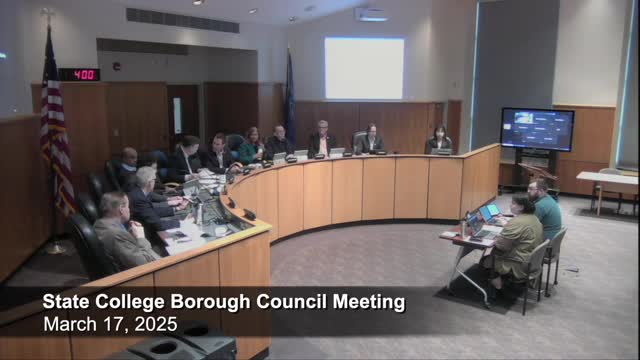
State College Borough Council heard a detailed timeline March 17 for a comprehensive zoning ordinance rewrite, with staff and the consultant aiming for introduction to the Planning Commission in May and potential council adoption by Dec. 15, 2025.
State College Borough Council members heard a detailed timeline March 17 for a comprehensive rewrite of the borough zoning ordinance, with staff and the consultant aiming for introduction to the Planning Commission in May and potential council adoption by Dec. 15, 2025.
Planning Director Ed LeClaire told council, “we are in receipt of the first 178 pages of the proposed zoning ordinance. It is only the definitions and the enforcement and admin section,” and said staff expects the full draft to be “probably” between 400 and 700 pages. He said the borough and consultant Clarion are working backward from the Dec. 15 adoption goal and that the schedule must meet statutory public-notice and review requirements.
LeClaire summarized the milestones: a complete first draft introduced at the Planning Commission’s regular meeting on May 7; a Planning Commission recommendation due July 24; introduction to council on Aug. 4; a 45-day review period beginning Oct. 16 to satisfy statutorily required inter-agency review; a public hearing on Dec. 1; and potential council action on Dec. 15. He said staff anticipates nine Planning Commission meetings (three each in May, June and July) to review the draft.
Why it matters: the rewrite affects allowed uses, dimensional standards and procedural rules for development across the borough. LeClaire said the rewrite will likely touch many sections that interact with one another and that extensive cross-references could produce unintended consequences if handled piecemeal.
Council members asked about feasibility given the length and complexity of the draft. Council member Portney asked whether Clarion had agreed that the consultant could deliver revisions within the short windows LeClaire outlined. LeClaire replied he has “a standing meeting with them pretty much on a weekly basis” and that Clarion had been asked to “clear the deck” to focus on the May deadline, but he cautioned the schedule is “incredibly aggressive.”
Several members pressed staff on how the public will be able to review and comment on a multi-hundred-page ordinance. LeClaire said staff will “chunk” the document into smaller downloadable pieces, keep written copies at the library and borough offices, and provide a public-facing website and a standardized comment spreadsheet so reviewers can reference page and section numbers. He said staff will also prepare PowerPoint summaries and highlight “hot ticket” items such as accessory dwelling units to make principal changes easier to understand.
Council members also discussed process tools for resolving disagreements. LeClaire said staff will memorialize Planning Commission comments and provide an aggregated spreadsheet of comments and suggested edits so council can see areas of consensus and items that will require a vote.
No council action was taken at the March 17 meeting. LeClaire and council agreed that additional council work sessions could be scheduled if needed to meet the deadline.