Get Full Government Meeting Transcripts, Videos, & Alerts Forever!
Get email alerts on the River Water Quality topic
No spam. Unsubscribe anytime.
St. Johns River winter water quality report: salinities, recent rainfall and manatee sightings
Summary
A university researcher summarized recent St. Johns River water temperature, salinity observations, a new JU manatee reporting website and recent manatee mortalities including a February cold‑stress death.
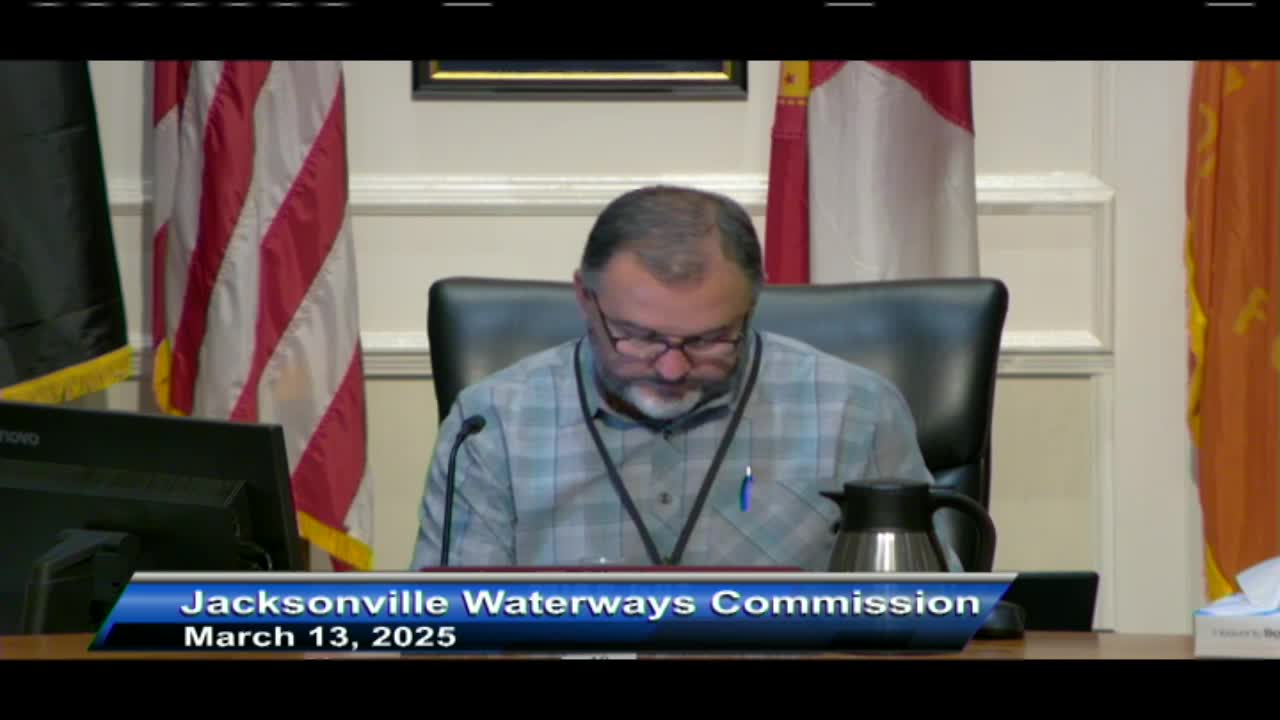
A representative described recent St. Johns River water quality and manatee observations to the Jacksonville Waterways Commission on March 13, reporting salinity ranges at monitoring stations, a new online manatee reporting form, recent rainfall and recent manatee mortalities.
The presenter (identified in the meeting as Dr. Pinta) said salinity readings during the dry season varied by location: Mayport (about 23to 30 parts per thousand), Dames (0.16 to 19 ppt), Jacksonville University monitoring locations (about 11 to 16 ppt), downtown (7 to 10 ppt) and Buckman (about 1 to 2 ppt). Water temperatures were around 60to 63degrees Fahrenheit and described as "still a little low for manatees." The presenter said JU has deployed a QR code linking to a Manatee Research Center website that allows the public to submit sightings with behavior details and photos, which staff hoped would augment aerial survey data.
The presenter noted recent rainfall of up to 4 inches at the airport and basin‑wide rains of 2 to 3 inches, causing water levels to rise roughly a half foot and to begin decreasing. Harmful algal blooms were not reported in the February sampling run. The presenter reported one manatee mortality in February attributed to cold stress, recovered in the St. Johns River, and said statewide totals included 14 watercraft‑related manatee deaths and 181 total documented manatee deaths for the season.
The speaker encouraged public use of the new JU reporting site and said JU would continue aerial surveys, maintain habitat maps and supply mortality and sightings data to city staff and partners.