Get Full Government Meeting Transcripts, Videos, & Alerts Forever!
Get email alerts on the Permitting And Environmental Regulation topic
No spam. Unsubscribe anytime.
State DEP outlines permit tiers, dock rules and sovereign‑lands authorizations for Jacksonville area
Summary
A Florida Department of Environmental Protection official told the Jacksonville Waterways Commission how the ERP program reviews dock, shoreline and submerged‑lands projects, clarifying exemptions, general permits, individual permits and proprietary (sovereign lands) authorizations.
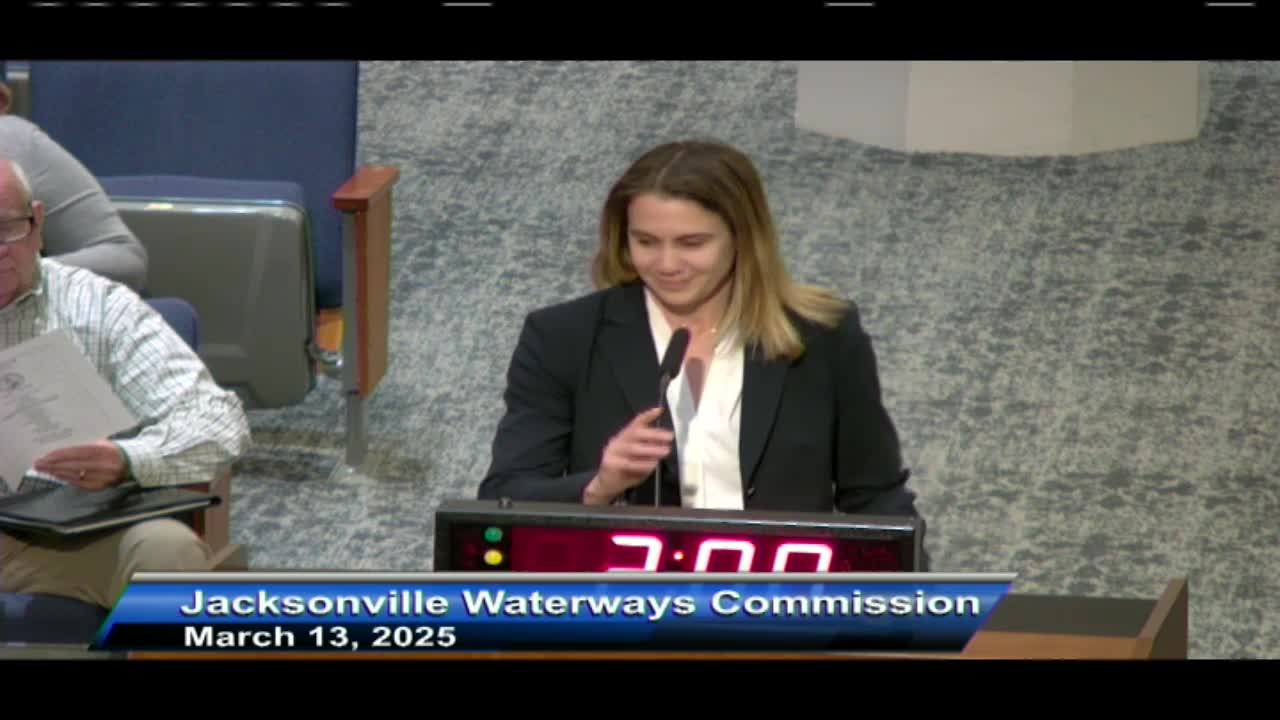
Catherine Craver, external affairs director for the Florida Department of Environmental Protection(DEP), explained the stateEnvironmental Resource Permitting (ERP) program to the Jacksonville Waterways Commission on March 13, describing when DEP, the St. Johns River Water Management District and the U.S. Army Corps of Engineers each review or authorize in‑water projects such as docks, bulkheads and dredging.
Craver said DEP applies a three‑tier review for any work in surface waters or wetlands under the ERP program: the regulatory review that applies to all projects, a proprietary review for use of sovereign submerged state lands, and a federal review (State Programmatic General Permit, SPGP) for projects that remain within delegated federal categories.
The presentation matters because waterfront homeowners, developers and city staff routinely seek guidance on whether DEP or the water management district is the permitting authority and what authorizations are needed to repair bulkheads, build docks or place structures on state lands. Clarifying delegation and permit thresholds affects project timelines and whether federal Corps review is required.
Craver said docks that qualify as exemptions are generally under 1,000 square feet, while docks in specially protected waters can have a 500 square‑foot exemption threshold. Docks larger than the general‑permit maximum (Craver described a general‑permit band ending near 2,000 square feet) require an individual ERP permit. She said size and location jointly determine whether a project receives only a regulatory review or also needs proprietary authorization and, in some cases, an SPGP review by the Army Corps.
At the proprietary level, Craver outlined two commonly used authorizations for private docks on state lands: a letter of consent for small, single‑family docks that preempt no more than 10 square feet of state land per linear foot, and a lease for larger or revenue‑generating docks. She said aquatic preserves have more restrictive design criteria (citing the Aquatic Preserve Act and an aquatic‑preserve rule) and that the DEP imposes additional permit conditions where manatees are present, such as signage and work‑timing measures.
Commissioners asked how the rules apply to bulkhead repairs and private boat ramps. Commissioner Robert Bertalan said his private canal community has been delayed — he reported an eight‑month permitting wait and asked whether DEP jurisdiction extends to bulkheads and ramps. Craver replied that jurisdiction depends on whether the project requires an individual permit (in which case federal delegation may not apply) and offered to discuss the case after the meeting and provide direct contacts for the DEP ERP permitting and compliance managers she named during the presentation.
Craver also described DEPdistrict organization: ERP permitting staff and a compliance team that conducts field inspections and complaint investigations, with contact names provided for follow‑up.
Craver closed by offering to meet project‑level stakeholders and to present the material to special districts and homeowner groups that manage private canals.
A DEP contact list and links to operating agreements with the statewater management districts were shared during the presentation for attendees who need project‑specific direction.