Get Full Government Meeting Transcripts, Videos, & Alerts Forever!
Get email alerts on the Magnet Programs topic
No spam. Unsubscribe anytime.
Salt Lake district reviews magnet enrollment, DLI phase-out and caps as class sizes shift
Summary
District staff outlined enrollment trends, testing and assignment practices for magnet and gifted programs, described a planned three-year transportation commitment after recent school closures and said dual-language immersion (DLI) seats are phasing out as neighborhood DLI programs expand.
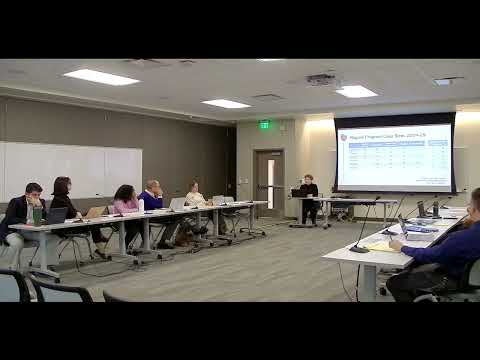
Dr. Katy Hall, superintendent of the Salt Lake City School District, told a Feb. 18 board study session the district is monitoring shifting enrollment patterns in its magnet and gifted programs and adjusting identification, placement and transportation practices as schools recover from recent closures.
“Once you’re in, you’re in,” said Dr. Katy Hall, describing the district’s policy that students who qualify and are placed in magnet programs remain eligible for continued placement without retesting. She told board members the district invited 52 students to elementary magnet openings last cycle and 43 accepted the placements.
The presentation reviewed three categories of elementary special programs: standalone magnet schools (noted at Edison, Indian Hills and Whittier), dual-language immersion (DLI) sites and an Advanced Academics and Mentoring program (AMP) offered at every elementary. Hall said Edison, Indian Hills and Whittier host magnet seats for grades 1–6; Washington’s DLI is in a phase-out and Nibley Park, Mountain View and Newman host DLI or neighborhood DLI seats.
Why it matters: Board members pressed for clarity because magnet seat counts and caps affect family transportation choices, sibling placements and district budgeting. Hall said the district is trying to reduce late-year churn that previously left bus routing, after-school care and teacher assignments unsettled until after school started.
Key enrollment and program details
- Invitations and acceptance: Hall said the district’s most recent cycle produced 52 invitations and 43 accepted placements, including 14 students tested and accepted in 2023 who deferred to start in first grade. She said the district completed January testing with “100% responses” on students’ intent to return in magnet seats and planned to send invitations and wait-list notices the week of the meeting.
- DLI and phase-out: Hall said the magnet DLI program is being phased out at one pilot site while neighborhood DLI programs are expanding; she emphasized the district limits initial DLI enrollment to the first two years of elementary because language acquisition in that program is intensive and difficult to replicate if students join later.
- AMP and screening: AMP (Advanced Academics and Mentoring) primarily targets grades 4–6 but the district conducts outreach for younger students. Hall said AMP identification has shifted from yearlong pull-out groups of 15–40 students to shorter, skill-focused 4–6 week sessions intended to include a larger number of students for targeted acceleration.
Class-size limits, area model and family continuity
Hall described the district’s move from a three-site magnet assignment model to an area-model approach with explicit caps intended to reduce late reassignments. She said the district is using an upper bound of roughly 27 students for K–3 classes and 30 students for grades 4–6 as planning guideposts and that those numbers reflect a fiscal “break-even” concept used for staffing decisions.
The superintendent reminded the board that the district committed to keep cohorts together when schools closed, saying families were promised they could “travel with that cohort.” Hall said the district will bus families for three years after an elementary closure as part of that transition commitment.
Identification, testing and appeals
Hall detailed the district’s identification steps for magnet and gifted programs:
- Universal screener: The CogAT screener is administered at the end of kindergarten (for rising first) and at the end of third grade (for rising fourth). The screener typically takes about 30–40 minutes.
- Full assessment: Students who score in the top portion of the screener pool are given the full CogAT (about 60–90 minutes) or other nonverbal measures such as the Ravens; Hall said the district purchased additional licenses to give the full CogAT to qualifying kindergarten cohorts in future years.
- Additional measures: The district uses a Universal Talented and Gifted Survey (U-TAG) as a holistic inventory that teachers or parents may complete to identify talents not fully captured by the CogAT, such as leadership or artistic strength. Hall said appeals can be initiated to review a student’s file using the U-TAG and other end-of-year academic data.
- Accommodations and appeals: AMP teachers administer the CogAT and work with special education staff to apply accommodations documented in students’ IEPs or 504 plans. The district follows a rubric to review appeal requests to ensure consistency, Hall said.
Middle-school magnet programs and acceleration
Hall described middle-school offerings at Clayton, Hillside and West. Clayton and Hillside host magnet tracks within a school that allow students to mix magnet and non-magnet classes; West is a distinct site where students can accelerate into high-school-level courses while still in middle school.
Hall said West currently had 83 seventh-graders and 111 eighth-graders in its ELP/magnet pathway and that roughly 40 of those students were out-of-district enrollees. She noted the State Online Education Program (SOEP) as one avenue many middle-schoolers use to take high-school math (via courses registered through the SEATS portal); as of the current school year, state rules now allow middle-school high-school credit to carry forward to a student’s high-school transcript.
Board questions and next steps
Board members including a member identified in the transcript as Jensen pressed staff on how caps would be applied during the multi-year transition and whether smaller magnet class sizes unfairly subsidize much larger neighborhood classes. Hall recommended revisiting cap and cost questions after another year of stabilized enrollment to see whether the new area-model yields different district averages.
Hall also encouraged further outreach to underrepresented communities and noted the district’s communications steps—emailing families whose children qualified, working with school principals to publish notices, posting materials online and offering open houses and walk-in visits.
Ending
Superintendent Hall closed the presentation after answering board questions and said district staff would continue monitoring enrollment, testing outcomes and family requests; invitations to qualified students and wait-list communications were expected to be sent the week of Feb. 18. No formal board action or vote was recorded during the study session.