Get Full Government Meeting Transcripts, Videos, & Alerts Forever!
Get email alerts on the Utilities Asset Management topic
No spam. Unsubscribe anytime.
Committee hears bill to require asset-management plans for unregulated water, wastewater utilities
Summary
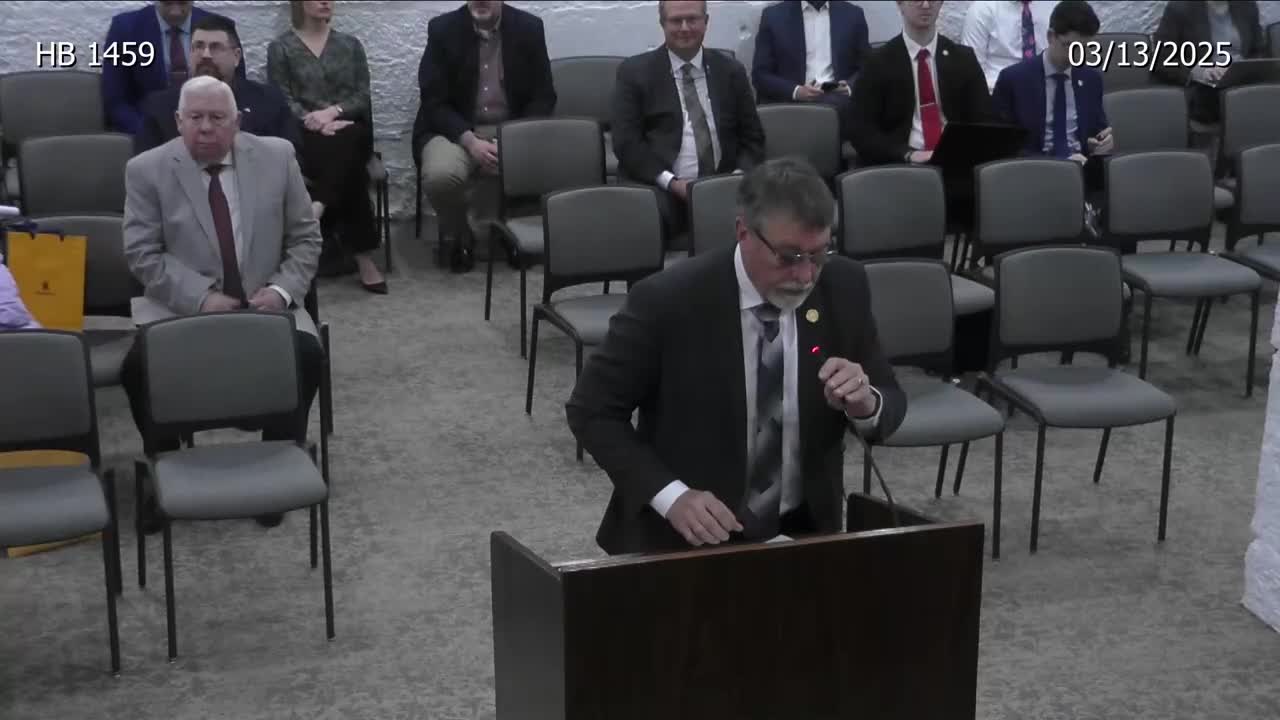
Representative Pressell introduced House Bill 1459 on behalf of utility customers and small systems, saying the measure would require unregulated water and wastewater utilities to file asset-management plans with the Indiana Utility Regulatory Commission and establish escalating enforcement for repeated violations.
Representative Pressell introduced House Bill 1459 on behalf of utility customers and small systems, saying the measure would require unregulated water and wastewater utilities to file asset-management plans with the Indiana Utility Regulatory Commission and establish escalating enforcement for repeated violations.
"It creates what I believe to be a good rate payer protection bill," Pressell said, describing a three-strike approach that would begin with required asset-management plans filed quadrennially, move to an informal IURC rate case after a second IDEM violation for the same issue and culminate in receivership after a third violation.
Supporters and neutral witnesses described technical-assistance work already underway and urged careful calibration of costs and timing. Tom Isley of Purdue described a two-year pilot with a very small utility called Switch City, saying the team produced an "interim asset management plan" after field work and flow analysis and is assembling a report and recommendations. Isley said the project identified high infiltration and inflow, a roughly 49% non‑revenue water rate and the need for condition-assessment data.
"We started on a volunteer basis," Isley said, describing collaboration with the Indiana Finance Authority and a proposal for a living-lab model that would gather field data and create a gold-standard template for small utilities. He told the committee the initial data-collection phase is complete and that his team plans to present to the Switch City board on April 7.
Several witnesses urged that technical assistance and existing state loan and review processes be used to avoid duplicative costs. Lindsey Moss of the Alliance of Indiana Rural Water said asset-management planning is a best practice but that smaller systems need assistance; she asked that plans already submitted to the Indiana Finance Authority for State Revolving Fund loans be accepted for IURC review when appropriate.
Amy Krieg, government affairs director for AIM, said her organization supports the bill's intent but raised concern about requiring municipalities to submit an additional plan when similar plans are already required to receive IFA SRF funds. Charles Gill, water utility manager for Greenfield, said his utility's plan cost about $30,000 and urged coordination across local and state programs so plans and capital programs "mesh together."
Opponents and skeptical witnesses focused on cost, scope and legal authority. Bart Giesler of the West Central Conservancy District said the statutory checklist in the draft appears designed for SRF loan applicants and could be an "overkill" if applied universally. He also pointed to existing oversight tools including audits by the State Board of Accounts and IDEM enforcement, and cited a statutory citation (recorded in testimony as "1433524") he said allows interested parties to petition courts over district actions.
IURC staff estimated the number of currently nonjurisdictional water and wastewater utilities in the state at roughly 991 and said reviewing asset-management plans would increase staff workload. "Using an estimate of about an hour and a half per utility for an initial review," Luke Wilson of the IURC said, the commission's internal estimate would amount to about 250 plans a year (on a four-year cycle) and roughly 375 staff hours annually — about 10 weeks of one staff person's time.
Committee members asked about prioritization, training and practical steps for the smallest systems. Senator Torreo and others noted many systems lack mapping and institutional knowledge and praised the idea of staged, hands-on assistance and workshops. Witnesses pointed to existing IURC small-utility workshops and Purdue's pilot work as models for scaled technical help.
No vote was taken on the bill. At the close of the hearing the chair said the committee would hold the bill to work on amendments addressing costs, timing and technical-assistance needs.