Get Full Government Meeting Transcripts, Videos, & Alerts Forever!
Get email alerts on the Roads And Infrastructure topic
No spam. Unsubscribe anytime.
Vanderburgh County outlines $3 million preliminary road plan, warns of long-term reconstruction funding gap
Summary
County engineer presented a list of resurfacing and reconstruction priorities and an estimate of roughly $3 million for this year's candidate projects, while commissioners and staff warned existing TIF and road funds will not sustain future major reconstructions such as Oak Hill or Petersburg Road.
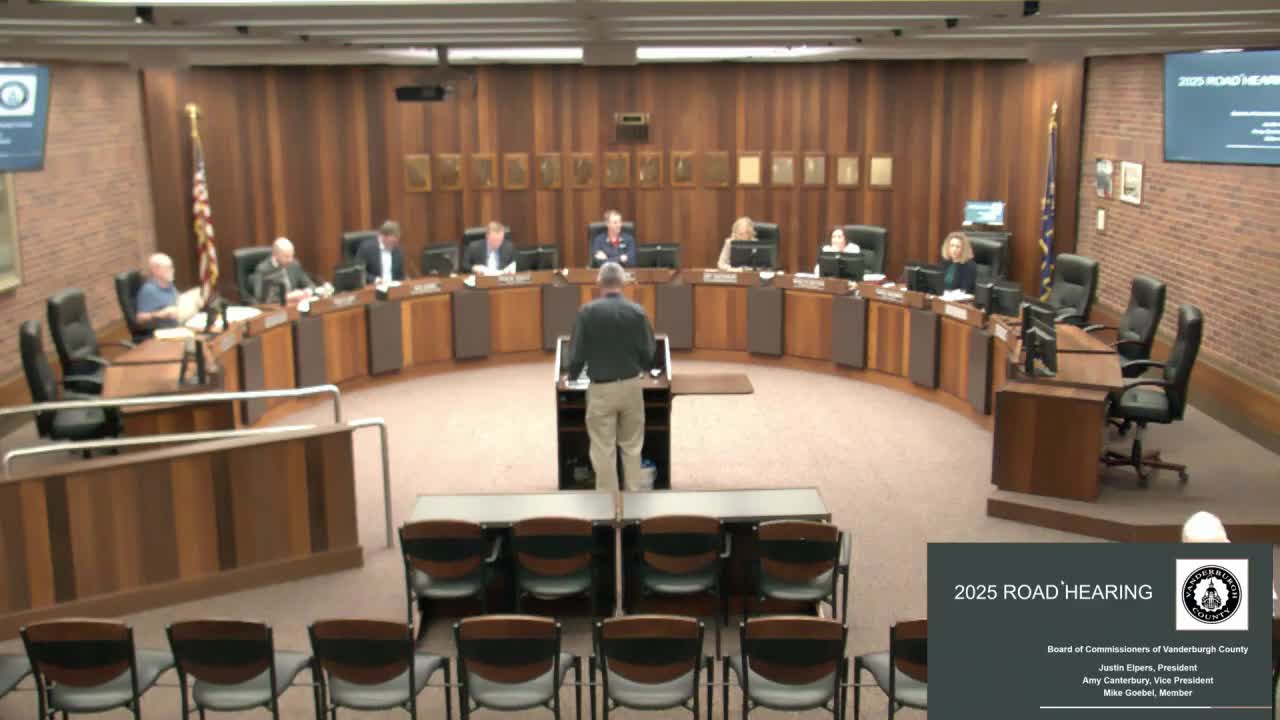
Vanderburgh County commissioners heard a detailed road hearing on March 11 that outlined last year’s paving work, this year’s candidate projects and a multi-year funding gap affecting major reconstruction projects.
County Engineer John (county engineer) told the Board of Commissioners that the county completed roughly 30 miles of asphalt paving last year and nearly $3.5 million in concrete and asphalt work. For 2025 the county’s preliminary list of candidate projects carries an estimated total cost of about $3,000,000, with many final cost and scope details still to be determined.
The engineer said the county will use a mix of county funds and a recently awarded Community Crossings grant to fund milling and resurfacing for segments of Darmstadt, Gressel, Saint Joe, Baseline and Heinlein roads. Bids for the Community Crossings paving will be opened April 1 at the commissioners’ office.
Why it matters: county staff and commissioners stressed that while pavement preservation and patching can limit deterioration, the county lacks a steady revenue source to finance major reconstruction projects. Federal-aid projects typically require local matches and right-of-way costs; the engineer used Oak Hill Road as an example in which total project costs can exceed $10 million and local shares approach $3.9 million for a single phase.
The engineer said long-term reconstruction funding is constrained because the four existing TIF districts do not generate sufficient revenue to support both ongoing maintenance and major reconstruction work. He estimated the county would likely need on the order of $1 million in local funds per year to pursue recurring reconstruction projects at a meaningful pace.
The presentation reviewed planned work and priorities: an $800,000 concrete patching contract to finish Old Petersburg Place, Clear Creek and Oakview subdivisions; patch-and-resurface work in Spring Lake Valley, Bridlewood and Stonecrest (recently bid); and asset-management activities coordinated with the Evansville MPO, including pavement-condition ratings required for Community Crossings eligibility. Staff also described a preservation pilot using a rejuvenator spray on recently resurfaced roads — a lower-cost preventive treatment intended to extend pavement life.
Commissioners and staff discussed subdivision street longevity and the possibility of revising local construction standards. The engineer said county standards are among the less robust in the region and that increasing pavement section thickness could potentially extend service life; he cautioned that he had not yet calculated a precise lifecycle estimate for thicker sections.
Public comment: resident Gerald Jones spoke during the road hearing to urge attention to Lyle Road. Jones later confirmed to staff that a half-mile southern segment could be paved with roughly $65,000 in county highway–based pricing. The engineer said that figure was based on placing about 3 inches of asphalt over the described half-mile segment and that detailed inspection would determine whether full mill-and-resurface or patching was required.
Actions and next steps: commissioners approved taking the recently opened bids for Spring Lake Valley, Bridlewood and Stonecrest under advisement and directed staff to return with refined recommendations after field inspections and bid checks. The engineer said staff would refine the project list and present prioritized contract recommendations to the commissioners for final approval.
The board did not adopt any new countywide funding mechanism at the hearing; commissioners asked staff to return with prioritized recommendations and cost estimates. The engineer warned that if the county underfunds routine maintenance, catching up will be significantly more expensive.
Ending: Commissioners indicated they will work with county highway staff to develop a recommended prioritized list for 2025 work and return to the board with contract and crew assignments once inspections and bid verifications are complete.