Get Full Government Meeting Transcripts, Videos, & Alerts Forever!
Get email alerts on the Elections topic
No spam. Unsubscribe anytime.
Committee hears broad election-security and registration bill; advocates warn of burdens on naturalized voters
Summary
House Bill 16 80 would require counties to provide IT-vendor contacts, expand who may challenge voters in primaries, restrict some voter-registration assistance, require proof of citizenship in some cases and make certain absentee affidavits subject to rejection without a cure process; Common Cause, League of Women Voters and election officials |
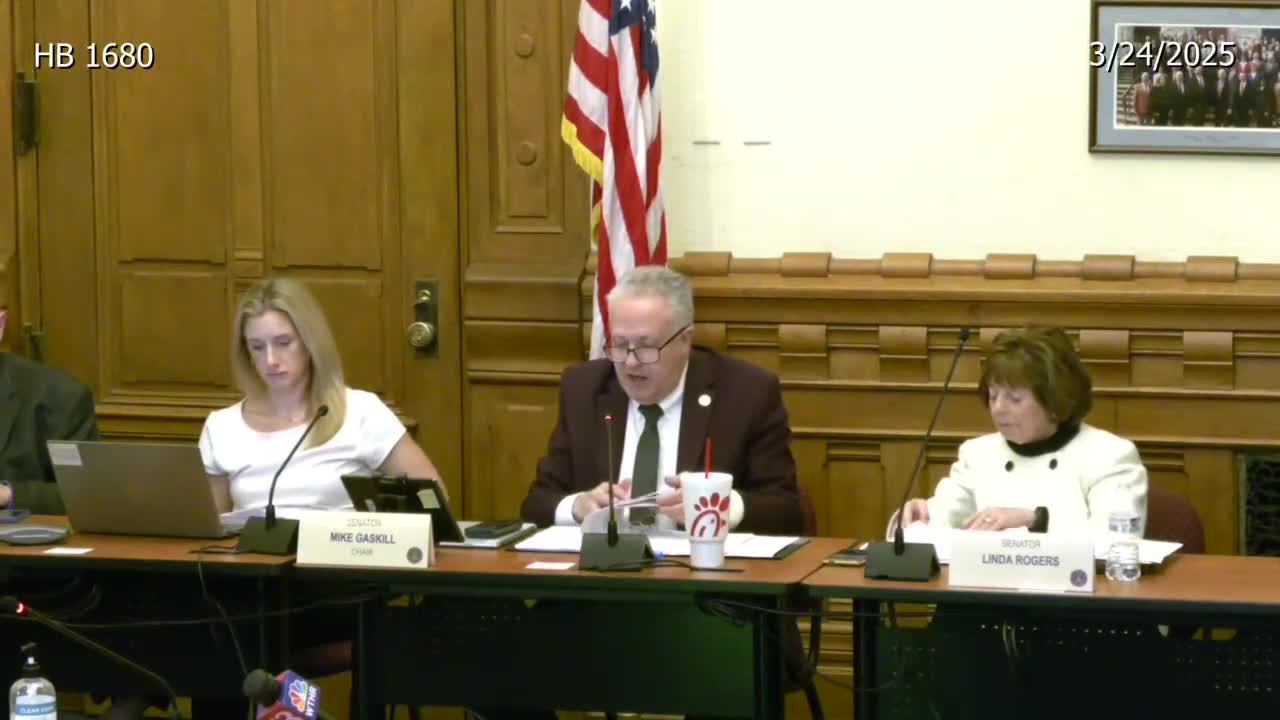
The Senate Elections Committee heard testimony on House Bill 1680, "Election Security and Transparency," a multi-part measure the sponsor described as covering county IT-provider reporting, poll-book and challenger mobility at vote centers, treatment of temporary credentials in voter registration, restrictions on addresses and on assistance filling registration forms, expanded information-sharing MOUs with other states, rules for petitions and absentee affidavits, and new procedural-audit authority for the Secretary of State.
Advocates for voting rights opposed several provisions. Julia Vaughn of Common Cause Indiana said sections that would require additional proof-of-citizenship checks for registrants using temporary credentials would likely violate federal law, disproportionately burden naturalized citizens and create additional administrative work without evidence of noncitizen registration. Vaughn also said the bill’s restrictions on registration assistance (section 7) could violate federal protections for voters with disabilities or limited English proficiency unless clarified to permit assistance for those groups. She urged a cure process where absentee-envelope signature dates are missing rather than automatic rejection.
Barbara Tully of the League of Women Voters echoed those objections and added that prohibiting commercially available mailing boxes or P.O. boxes as residence addresses could disenfranchise unhoused voters who rely on such services. She also questioned the proposed interstate data-sharing MOUs and whether guardrails would prevent misuse of voter information.
From the administration side, Angie Nussmeier, Democratic co-director of the Indiana Election Division, said she had concerns with several sections (notably sections 5, 7, 9, 11, 12 and 13–15). Nussmeier objected to a lack of a cure process for absentee-envelope signature dates and to a broad expansion of the Secretary of State’s ability to order procedural audits of counties without clear standards. She also warned that mandating counties to identify potential nonresidential addresses on a fixed schedule and to run frequent list-maintenance activities could amount to micromanagement and produce errors, especially if based on hearsay.
Keegan Prentice and Brad King, representing the Secretary of State's office and the Republican co-director of the Indiana Election Division respectively, testified in support of many provisions. Prentice said the Secretary’s office needs county IT-provider contact information to coordinate cybersecurity protections for the statewide voter registration system. King emphasized clarifications for vote-center-era poll-book holders and challengers (allowing reentry to multiple polling places), and he argued that rules for reporting materially false petitions or registrations were important for enforcement. King said the provision on absentee-signature dates reflected a policy question for the General Assembly to decide.
Committee members repeatedly asked how the bill would protect voters with temporary credentials, whether assistance restrictions would cause practical problems, what guardrails would limit interstate data-sharing, and whether a cure process for absentee-envelope signature dates should be added. The committee held the bill for amendment and a vote next week.
Ending: The hearing left multiple substantive issues unresolved: whether proof-of-citizenship notices tied to temporary credentials are lawful, whether registration-assistance restrictions need exemptions, how interstate MOUs would be scoped, and whether absentee-envelope date rejections should include a cure process. The committee did not vote; the bill is scheduled for amendment and a vote next week.