Get Full Government Meeting Transcripts, Videos, & Alerts Forever!
Get email alerts on the Elections topic
No spam. Unsubscribe anytime.
Bill would standardize caucus eligibility and create removal process for county commissioners
Summary
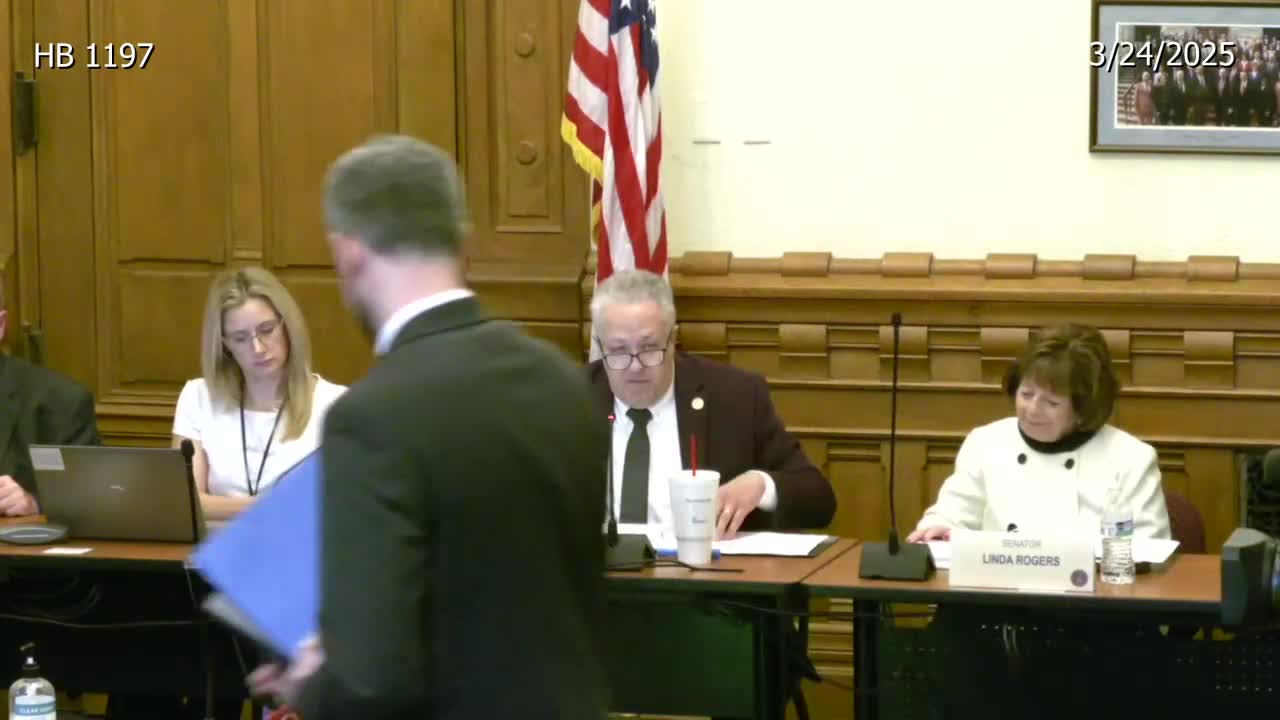
Representative Lawson asked the Senate Elections Committee to consider House Bill 1197, saying the measure "adds consistency to state law" by clarifying candidate eligibility in caucuses and by creating a removal mechanism for county commissioners.
Representative Lawson asked the Senate Elections Committee to consider House Bill 1197, saying the measure "adds consistency to state law" by clarifying candidate eligibility in caucuses and by creating a removal mechanism for county commissioners.
Lawson introduced the bill as a two-part change: requiring candidates selected by party caucuses for county, city, town and township offices to meet the same eligibility and party-affiliation rules that apply to primary-ballot candidates, and copying an existing 1980 statute that allows county councils to remove members for "violation of an official duty" or for inability to perform duties to create a parallel removal route for three-member county commissions.
The bill would give caucus chairs or appointing authorities authority to remove a candidate from caucus consideration if the candidate does not satisfy legal requirements for the office or party affiliation. On removal of commissioners, Lawson said the statute would require two-thirds approval in both the county commissioners and the county council "to ensure that a commissioner cannot be removed without cause or without the votes of at least 7 other elected officials across 2 separate bodies." He framed the change as a consistency measure so that commissioners would have the same statutory removal path other county and state officers already have.
Witnesses who testified raised both support and concern. David Bauer of the Association of Indiana Counties told the committee the association supports a high standard for removal and stressed that judicial review (Indiana Code 5-8-11) has long provided a remedy; Bauer said the 2021 statute addressing extreme absenteeism had provided clarity for certain county officers and that the judiciary is an important neutral arbiter. Jake German, representing the Indiana County Commissioners via Barnes & Thornburg, said the commissioners' association opposes the bill in its current form because it lacks an independent-review safeguard and could be used as a political tool without judicial review. Elkhart County Commissioner Susie Wyrick urged the committee to add due-process protections or an independent review step and said county officials she represents favor accountability that includes impartial review.
Several citizens from Hancock County testified in favor of the bill, naming a 2024 incident of prolonged absenteeism by an elected official that they said disrupted local operations and left taxpayers paying salary for months without participation. Brad King, Republican co-director of the Indiana Election Division, supported section 1 (caucus eligibility) as a clarification that caucus candidates should meet the same party-affiliation standards as primary candidates and noted that counties lack a clear challenge process today for caucus-appointees.
Committee members asked about specifics: whether the bill mirrors the county council language exactly (Lawson said it does), whether an item described as a single "violation of official duty" could trigger removal (members pressed on how local councils would define duties), and whether an appeal process exists (witnesses suggested court action could be filed, but the bill as drafted does not add a formal judicial appeal step).
The committee treated House Bill 1197 as testimony only and held the measure for amendment and vote next week.
Ending: The sponsor and several stakeholders said they were open to amendments that would preserve a high removal threshold while adding due-process safeguards such as clearer local rules or judicial review; the committee did not take a vote during this hearing and will consider amendments next week.