Get Full Government Meeting Transcripts, Videos, & Alerts Forever!
Get email alerts on the Fines And Fees Tax Intercept topic
No spam. Unsubscribe anytime.
Senate Judiciary Committee approves bill allowing courts to intercept state tax refunds to collect unpaid fines, fees and costs
Summary
Senate Bill 260, sponsored by Sen. Joshua Bryant, passed the Judiciary Committee; the measure clarifies a court’s authority to order interception of state tax refunds to satisfy unpaid restitution, fines, fees and court costs. Testimony raised concerns about impacts on low-income taxpayers and overlap with an ongoing fines-and-fees study.
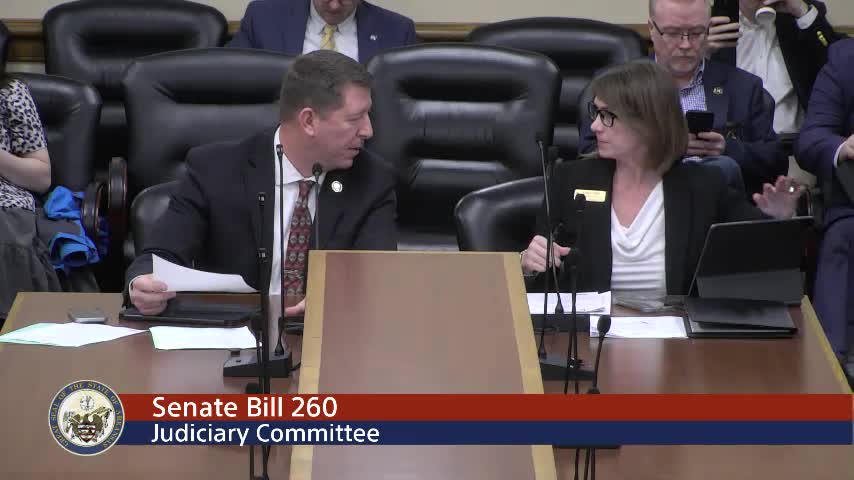
The Senate Judiciary Committee voted to advance Senate Bill 260, a bill clarifying that, upon the court’s order, courts may intercept a defendant’s state income tax refund to collect unpaid restitution, fines, fees and court costs.
Senator Joshua Bryant (Senate District 32), sponsor of the bill, said its purpose is to “clarify what a lot don’t know they can or cannot do.” Bryant told the committee he consulted with the Department of Finance and Administration (DFNA) and local judges and that the proposed language is modeled on procedures used to collect unpaid restitution in civil matters. “This language will give them clarity that upon their order or their motion, they can intercept the state tax return under the procedures that they would to collect unpaid restitution in a civil matter,” Bryant said, calling it “another tool in my toolbox.”
Kristen Clark, director of the Legal Division at the Administrative Office of the Courts, said the provision is intended to address collection after a defendant defaults on payment. Clark told the committee that fines, fees, court costs and restitution already are being collected through various means and that SB 260 clarifies the procedure for tax intercepts after default. Clark noted the legislature’s recent focus on alternatives to incarceration and characterized this measure as an additional civil collection option the court may use when defendants stop paying.
Committee members pressed for detail about scope and interaction with other legislative work. Senator Gilmore asked why the draft adds “fees” to the existing language that referenced fines and costs; Bryant and Clark answered that the term “fine” is defined elsewhere in the fine-enforcement subchapter to include fines, fees and court costs, and that the bill explicitly authorizes collection of all components as a single judgment amount. Senator Stubblefield asked whether the bill ties into a broader study of court fees and the salaries of district judges; Bryant said the bill is not part of that study and that future legislation could still change fee structures.
Committee members asked practical questions about timing and process. Clark explained judges already can reset fines, waive some amounts, and must make ability-to-pay determinations before installment plans. She and Bryant said the tax-intercept procedure would be available after a defendant is in default; the clerk and the court would use existing procedures for civil restitution intercepts. Committee members also asked who currently can intercept state income tax refunds; Clark said many state entities can, including child-support enforcement and DFNA, and that cities and counties have used similar mechanisms.
Sarah Moore, who identified herself as representing the Arkansas Justice Reform Coalition, testified in opposition, saying she was “mild against at this point” and raising concerns about the impact on low-income working Arkansans who rely on tax refunds to buy necessities such as vehicles to get to work. Moore said many people on payment plans are poor and that pursuing tax refunds could disproportionately harm families and public safety by removing funds used for basic needs.
Senator Bryant closed by urging passage, saying judges would not immediately or indiscriminately use the authority and describing it as a tool for cases where defendants “rack up” thousands of dollars in fines and fees. The committee approved a motion to “do pass,” moved by Senator Deese and seconded by Senator Gilmore; the motion carried by voice vote. The transcript does not record a roll-call tally.
The committee discussion noted potential legislative overlap with other bills addressing fines and fees; sponsors and members said they would continue conversations outside the hearing.