Get Full Government Meeting Transcripts, Videos, & Alerts Forever!
Get email alerts on the Alternative Education topic
No spam. Unsubscribe anytime.
Credit-recovery staff and students warn closing Student Achievement Center would push vulnerable students out of school
Summary
Teachers, students and program staff at the Student Achievement Center described how the district lternative school helps students make up multiple credits and re-engage; they said Period 10 and online-only recovery are insufficient for many students and urged the board not to close the program.
Students, teachers and administrators described the Student Achievement Center (SAC) at the March 24 public hearing as the district—acility that helps credit-deficient students recover multiple classes and re-engage in school, and they warned that closing or eliminating the program would increase dropout risk.
Speakers explained how SAC differs from in-home school credit recovery or single-period recovery options: SAC gives students in-person instruction, smaller classes, and access to Edgenuity with four semesters available in a year rather than the two-semester structure at many schools. "Period 10 is only making up two credits; summer school four. We can give students four semesters in one whole year, giving them well over eight credits to make up that they need to," SAC teacher Jamie Lynn Riesch said. Joshua Zalesnick, the SAC librarian and union building representative, said small class sizes and staff relationships enable rapid credit recovery for students who otherwise would not graduate on time.
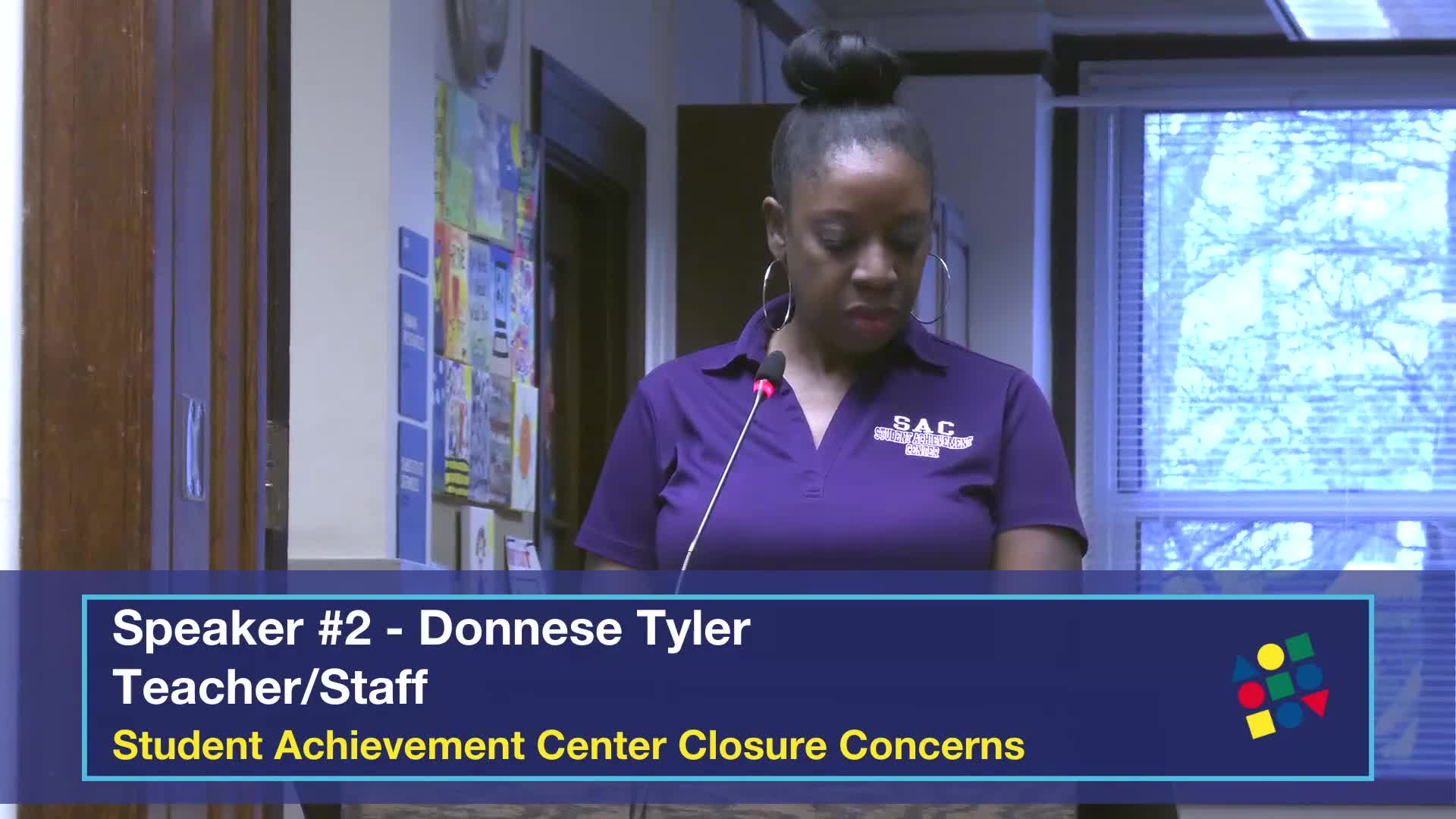
Multiple speakers also said SAC enrolls students who are behind for many reasons—truancy, homelessness, extended absences, administrative reassignments and behavioral safety needs. Donyce Tyler said the district's executive recommendation did not call for closing the only credit-recovery alternative school and warned that some students have stopped attending school for years and return only because SAC can re-engage them.
Alternative education staff with decades of experience warned eliminating SAC would increase dropouts. Dennis Boyce, an alternative education assistant with more than 30 years' experience, said the program is a "catalyst" to helping students return to the academic track and cautioned that relying only on home-school period 10 and Ingenuity online courses would be insufficient for many students with double-digit credits to make up.
Speakers asked the district to provide historical enrollment data tied to bus service (several said SAC attendance rose when buses were available) and to model the likely change in the number of students who would be displaced and the effect on graduation rates if SAC closed.
Ending: SAC teachers, staff and students asked the board to preserve the center or at least provide a fully funded relocation and transportation plan that preserves small-class instruction, staffing ratios, and supports for students who need multiple semesters of credit recovery.