Get Full Government Meeting Transcripts, Videos, & Alerts Forever!
Get email alerts on the Water Authority Funding Cap topic
No spam. Unsubscribe anytime.
Carbon County staff recommend 30% cap on county funding for municipal water-authority conservation easements
Summary
County staff told the Open Space advisory board that commissioners are considering a policy to limit county matching funds for conservation easements on municipal water authority land to 30% of a project’s cost; staff said commissioners would retain authority to make exceptions and no formal board action was taken.
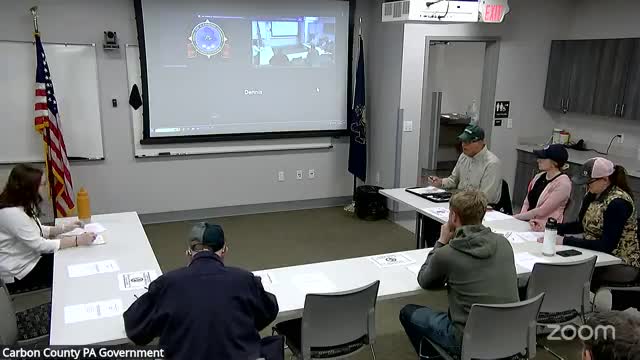
Anna, a county open-space staff member, told the Carbon County Open Space Advisory Board that county commissioners have asked for feedback on a proposed limit on county matching funds for conservation easements on municipal water-authority land.
Anna said the advisers "recommend doing a 30% funding cap on projects submitted from municipalities or municipal authorities." She clarified the recommendation applies to conservation easement projects on municipal water authority land rather than acquisition projects.
The proposal discussed by staff would either cap county assistance at 30% of each eligible project’s cost or, alternatively, set a dollar cap on the bond referendum earmarked for water-authority projects (staff offered $2 million to $3 million as an example). Anna said the program manual currently notes "the applicant's ability to leverage county funding with matching funding or donation value" but does not include a fixed percentage.
Board members and staff discussed practical implications and unknowns. Anna said there are roughly "22,000 acres" of water-authority-owned land in Carbon County, and that about "11,000 acres of that, I think, was Bethlehem Water Authority," meaning a few large authorities account for most of the acreage. Board members observed that most smaller tracts would be unaffected by a 30% cap, while larger projects could be more affected.
Multiple participants emphasized that the commissioners — not the advisory board — have final authority. Anna and other staff described the 30% figure as guidance the commissioners were asking the board to review; she said the commissioners could choose to make exceptions or to leave the program manual unchanged. Anna said the board did not need to take formal action and that staff would relay the discussion to the commissioners.
No motion or vote on the funding cap was taken at the meeting. The item concluded with staff agreement to communicate the board’s discussion to the commissioners and to return with any further direction.
Ending: Staff will present the board’s comments to the county commissioners; commissioners may adopt a written cap, leave the manual unchanged, or grant exceptions on a case-by-case basis.