Get Full Government Meeting Transcripts, Videos, & Alerts Forever!
Get email alerts on the Education Budget topic
No spam. Unsubscribe anytime.
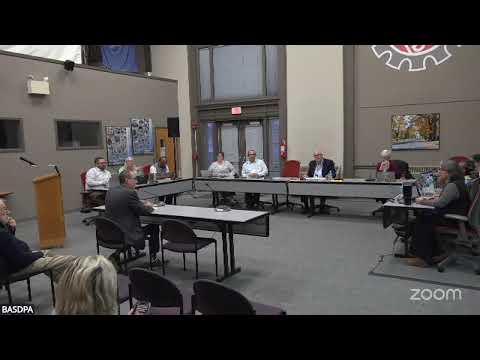
Bethlehem Area School District outlines cuts, freezes and contingency plans as 2025-26 budget gap persists
Summary
Bethlehem Area School District officials told the finance committee on April 14 that they still faced a multi-million-dollar gap for 2025-26 and outlined attritional staffing cuts, a temporary spending freeze, transportation consolidations and other measures to narrow the shortfall.
District officials told the finance committee on April 14 that the Bethlehem Area School District continues to confront a multi-million-dollar budget gap for the 2025-26 school year and outlined a range of measures to reduce that shortfall while preserving classroom services where possible.
"At the last budget meeting for the '25-'26 school year, we still had a $9,900,000 budget to close," a district presenter said. The administration reviewed three broad budgeting tools — expenditure reductions, revenue increases and use of fund balance — and said staff and the executive cabinet are refining proposals to strike an acceptable mix.
Officials outlined specific proposals and financial assumptions discussed with the board: using attrition to reduce headcount where possible, a proposed reduction of five non-instructional (coaching/support) positions, consolidating underused after-school activity bus runs, exploring health-care rebate and prior-authorization savings, delaying or scaling capital projects and instituting a temporary spending freeze with limited exceptions.
District staff emphasized that people costs drive the budget. One presenter said attritional reductions of five professional positions could save between $400,000 and $500,000 (salary and benefits), while consolidating after-school runs could save about $70,000. Health-care changes and prior-authorization strategies were estimated to yield approximately $400,000 and $350,000 respectively if fully implemented.
Officials also flagged external risks: federal actions have reduced some COVID-era funding nationally and the U.S. Department of Education rescinded certain COVID dollars that the state had relied upon; state-level funding deliberations over basic education funding (BEF) and adequacy investments remained unresolved. The administration noted that state proposals could reduce the district's projected gap in some scenarios (one illustrative governor99s-proposal scenario reduced the preliminary gap to about $7.68 million), but outcomes were uncertain.
Special education and Medicaid-related reimbursements also drew attention. Officials said the Intermediate Unit (IU) anticipated higher contract costs (from 2.5–3 percent up to 3.5–4 percent), and that Medicaid reimbursements (about $908,000 referenced in staff materials) could be at risk, which would increase pressure on the general fund.
District financials presented at the meeting showed an unassigned general-fund balance of about $16.6 million and an overall general-fund balance of approximately $72 million; staff said they currently plan to use roughly $6.5 million of fund balance in next year99s budget as part of the balancing plan. Presenters repeatedly underscored the multi-year nature of budgeting and warned that year-over-year pressures such as PSERS (Pennsylvania School Employees' Retirement System) contribution growth will continue to affect future budgets.
Board members urged caution about reductions that would affect students directly. Board member Mr. Alozie said: "We're talking about cutting services to kids... we might have to increase class sizes. We might have to cut programs, we might have to cut sports teams, we might have to cut jobs." Another board member stressed that extracurriculars help attendance, reduce chronic absenteeism and develop employers99 desired skills.
The finance committee did not adopt final cuts at the meeting. Staff said they will return with detailed savings estimates and a proposed final budget on May 12 and aim for final board approval on June 16. The administration said it will begin submitting federal reimbursement requests more frequently to reduce the risk of losing funds and will continue to refine attrition targets, grant decisions (including whether to pursue a project tied to a CFA award), transportation efficiencies and the scope/timing of capital projects.
The district described the budget discussion as a multi-year planning exercise: align staffing to enrollment, consider life-cycle adjustments for capital and equipment, maintain credit strength, and pursue private-public partnerships to offset some discretionary services.
No formal votes were taken at the committee meeting; the session was an informational and direction-setting discussion to guide the coming budget cycle.