Get Full Government Meeting Transcripts, Videos, & Alerts Forever!
Get email alerts on the Constitutional Amendments topic
No spam. Unsubscribe anytime.
Committee advances measure requiring majority of registered voters for citizen-initiated constitutional amendments; opponents warn it would block ballot access
Summary
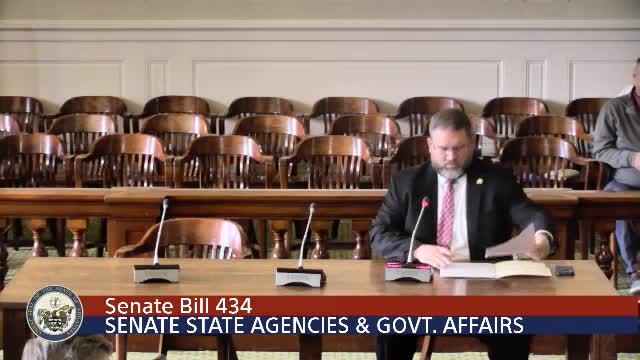
Senate Bill 434 would raise the approval threshold for citizen-initiated constitutional amendments to a majority of all registered eligible voters, not merely a majority of votes cast, Sen. Dawson said; the committee passed the bill after lengthy public opposition.
Sen. Dawson told the Senate State Agencies & Governmental Affairs Committee that Senate Bill 434 would require a constitutional amendment proposed by citizen initiative to win a majority of all registered eligible voters in order to pass, rather than a majority of those casting ballots. "If we're going to amend the initiated constitutional amendment process, it has to have buy-in from a majority of the electorate," Dawson said, and described the proposal as a way to ensure broad-based support for changes to the state constitution.
The sponsor and several committee members debated the measure's legal and practical effects. Dawson cited an Attorney General opinion (No. 2024-024) and argued the General Assembly can change the process by statute. He acknowledged the measure would not affect legislatively referred amendments in the same way and said the bill only applies to measures "voted on by the people," as he read Article 5, Section 1 of the Arkansas Constitution.
The committee heard extended testimony from citizens and civic groups in opposition. Kristen Stewart, who trained volunteers on ballot initiatives, said the proposal would "make it impossible" for citizen-initiated amendments by counting nonvoters as effective no votes and noted Arkansas's existing signature and county distribution requirements for initiatives. Dr. Gail Cho, an educator and civic-engagement advocate, called the change "an obstruction of the people's ability to shape their own constitution" and said it would disproportionately affect marginalized communities. Carol Egan, an Arkansas voter, and several others urged the committee to preserve existing thresholds, saying high-turnout presidential elections are the only time many citizen measures reach broad participation.
Sen. Tucker and others asked practical questions and offered arithmetic examples in committee debate; Dawson responded that the constitution should be difficult to change and that historically some initiatives that voters had approved would not have met the proposed new standard. After public comment, Dawson closed and the committee voted to pass SB 434 on a motion by Sen. Dodson, seconded by Sen. Peyton. The committee recorded the motion as passed by voice vote; no roll-call tally was provided in the hearing record.
Opponents warned of likely litigation if the law were enacted. Supporters framed the bill as restoring a higher bar for constitutional change because the constitution should not be amended lightly. The hearing included multiple speakers and more than an hour of public comment and questioning.