Get Full Government Meeting Transcripts, Videos, & Alerts Forever!
Get email alerts on the Land Use Extraterritorial Jurisdiction topic
No spam. Unsubscribe anytime.
Senate committee advances bill limiting cities' extraterritorial planning authority
Summary
The Senate City, County & Local Affairs Committee passed House Bill 1510, which would remove cities' automatic planning and regulatory authority beyond their corporate limits, a change supporters framed as restoring property rights and critics warned could weaken subdivision and infrastructure standards.
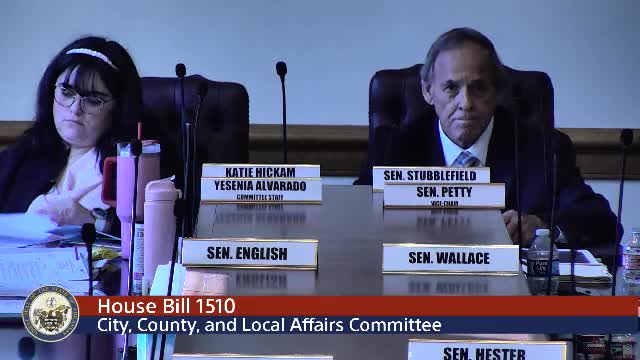
The Senate City, County & Local Affairs Committee on Thursday voted to pass House Bill 1510, a measure that would remove a city's extraterritorial planning authority beyond its official boundaries.
Supporters said the bill protects private property owners from long-standing planning designations that can encumber land without notice or compensation. "This bill ... basically boils down to property rights for those outside the cities," said Sen. Jim Petty (R.), who described constituents whose land was affected by a long-range road plan and who later discovered the road lay on their property, reducing the land's sale value.
Proponents told the committee the measure does not stop cities from annexing land; it removes the automatic regulatory reach that can impose zoning or subdivision requirements on owners who were not given notice. "They can continue to plan," Petty said, "they just don't have by-right the ability to encumber the property owners." He and other supporters urged the committee to side with individual landowners and allow cities to annex if they want to control an area.
Planning professionals and some municipal representatives urged a slower approach. James Walden of the Arkansas chapter of the American Planning Association said the statute governing extraterritorial jurisdiction is complicated and that the bill, as drafted, would be a total repeal of the authority rather than a targeted reform. "When it takes away that extraterritorial jurisdiction ... it, in fact, does take away planning. It takes away also any ordinances that are designed to carry that out," Walden testified, warning of downstream consequences for street, water and other infrastructure standards.
Walden gave examples of inadequate development standards outside city control resulting in early failures that later become the responsibility of taxpayers. He asked the committee for amendments: phased sunsets, more time for study, and mechanisms for cities and counties to cooperate on standards and notification requirements.
Committee members raised competing concerns about property rights and municipal planning. Sen. English said many mayors told her losing a one-mile planning buffer would harm their ability to plan for fire safety and infrastructure; Sen. Rice and others emphasized the need for better notification and said the bill grew from landowners' grievances who learned late of planned roads or master street plans.
The committee recorded a motion to pass the bill. The motion carried and the chair declared the bill passed on the committee's vote. The committee discussion indicated remaining interest in targeted amendments and in preserving cooperative tools for cities and counties.
The bill's passage in committee advances it to the full Senate for further consideration.