Get Full Government Meeting Transcripts, Videos, & Alerts Forever!
Get email alerts on the Insurance Consumer Protection topic
No spam. Unsubscribe anytime.
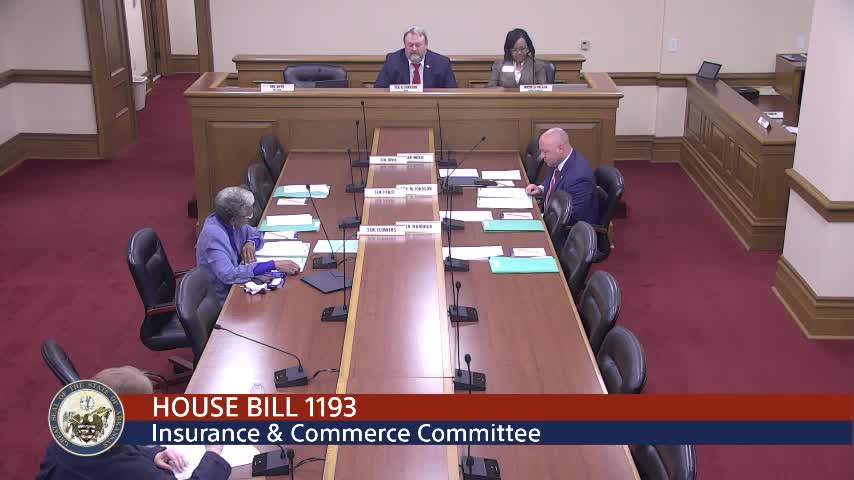
Committee considers House Bill 1193 amendment to lienholder payment rules for vehicle repairs; vote unclear on record
Summary
House Bill 1193 received committee consideration on an amendment that would allow insurers to omit a perfected lienholder's name from vehicle property damage payments under three conditions.
House Bill 1193 was brought before the Senate Insurance & Commerce committee with an amendment that narrows when a perfected lienholder must be named on an insurance payment for vehicle property damage.
Representative Kavanaugh presented the amendment, saying the change clarifies that a lienholder without a physical presence in the state need not be named on a payment and that the lienholder's name is not required when damages to a motor vehicle are less than $2,500 or when a payment is made directly to a repair facility for the amount of repairs.
"This bill will just require that when an insurance claim is made on property damage on a vehicle and there is a perfected lienholder, unless the lienholder doesn't have a physical presence in the state of Arkansas, if the claim is less than $2,500 or the payment is made directly to a repair facility for the amount of the repairs, then the lienholder's name doesn't need to be on the payment," Representative Kavanaugh said.
Senator Stephanie Flowers said she had been contacted by auto repair shop owners but expressed concern that the $2,500 threshold is low. "That's not a lot of money when you talk about a repair," Flowers said, and she noted that a direct repair payment could be much higher than $2,500 if the shop bills for full repairs.
Representative Kavanaugh and supporters said the amendment was intended to allow routine small payments to be paid directly to repair shops and to protect repair shops from administrative delays. The sponsor described examples in which insurers issue checks to customers that can create downstream disputes with lienholders — for instance, when an insurer pays $10,000 to a customer and later determines a total loss at $20,000, leaving a lienholder unpaid and potentially leading to litigation.
"Most [insurance companies] won't like it because they don't wanna have to put the lienholder's name on the check under certain circumstances, but lienholders in the state of Arkansas are now experiencing losses because their names are not on the check on certain instances, and they're taking losses because checks are being issued to people," the sponsor said, describing the lienholders' concern about unpaid amounts when vehicles are totaled.
Committee members discussed mechanics and consumer protection. Representative Kavanaugh said the insured's name can still appear on a check; the amendment only creates narrow exceptions for when the lienholder's name need not be included. Senator Flowers said the change could leave consumers exposed to lawsuits from lienholders after they have already cashed insurance payments.
The committee adopted an amendment and later moved to adopt the bill as amended. A voice vote in committee earlier recorded "Aye." A subsequent roll call was ordered; the partial roll-call transcript recorded Senator Matt McKee voting "Aye," Senator Stephanie Flowers "No," and Senator Missy Irvin "Aye." The transcript does not record a full roll-call tally or the committee's final disposition of the bill on the record. One participant said afterward that the representative would "do this again and pass it next time," suggesting the measure did not secure final approval in committee, but the transcript does not explicitly state the bill failed.
Because the transcript does not provide a full roll-call tally or an explicit final outcome for House Bill 1193, this report limits its account to the amendment text, the substantive concerns raised in committee, and the partial roll-call entries that appear in the record.
Supporters framed the amendment as protecting repair facilities and streamlining routine payments; opponents warned of consumer exposure and potential lawsuits if lienholders are not named on payments in appropriate cases.