Get Full Government Meeting Transcripts, Videos, & Alerts Forever!
Get email alerts on the Emergency Department Wait Times topic
No spam. Unsubscribe anytime.
Maryland HSCRC outlines statewide plan to cut emergency department wait times; Prince George’s County hospitals flagged for capacity gaps
Summary
The Maryland Health Services Cost Review Commission told a Prince George’s County task force that a new statewide commission and a mix of hospital best practices, data sharing and funding actions are intended to reduce emergency department wait times.
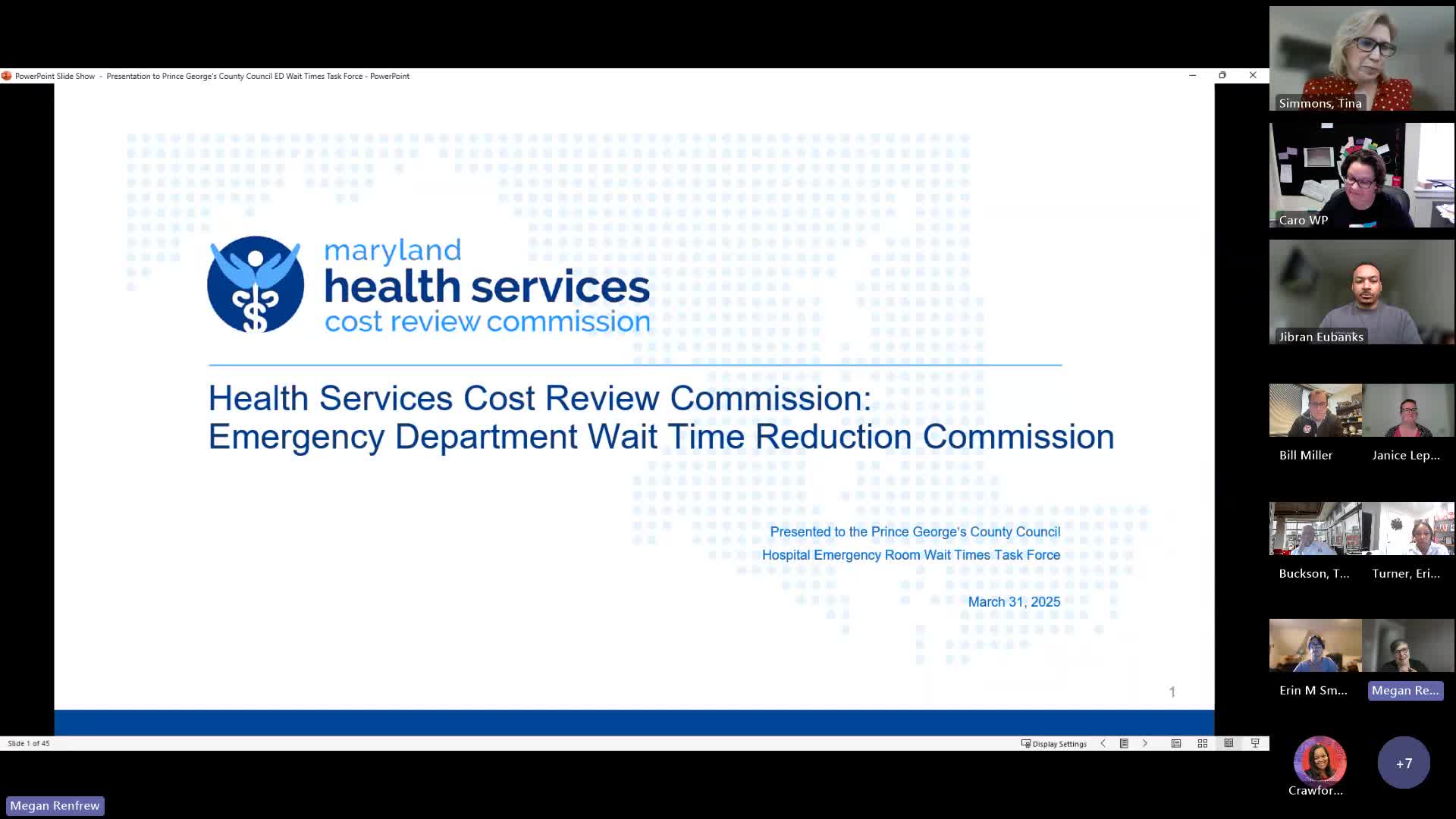
The Maryland Health Services Cost Review Commission (HSCRC) told the Prince George’s County Emergency Department Task Force on a virtual call that a newly created statewide commission will pursue data-driven, cross-system changes to reduce emergency department wait times.
"Our vision for health care in Maryland is guided by trying to achieve equity and excellence in our health care delivery system to improve the health of all Marylanders," HSCRC deputy director Megan Renfrew said at the Oct. 2024–style presentation to the county task force. Renfrew introduced HSCRC colleagues who outlined the commission’s scope, priorities and near-term deliverables.
The commission, created by statute and effective July 2024, is charged with recommending strategies to ensure patients are seen in the most appropriate setting, improve hospital throughput, expand post-discharge resources and improve data collection and sharing across hospitals, state agencies and community providers. HSCRC associate director Tina Simmons, the commission project manager, said the panel will produce an initial report "this November" and a second report in November 2026, and will continue meeting through June 2027.
HSCRC officials framed the problem as multi-causal. Tina Simmons said ED boarding and inpatient occupancy are central drivers of long ED stays and that solving them requires hospital operational changes plus better community and post-acute resources. "ED boarding, is a significant opportunity," Simmons said, noting that staffing, bed management, teaching-hospital complexity, inpatient length of stay and limited access to nursing homes, palliative care and home health all contribute to delays.
To address those issues, HSCRC said it has layered quality incentives, direct financial supports and a new commission structure. HSCRC highlighted recent actions that include: - A quality-based reimbursement (QBR) program that, collectively, places 2% of inpatient hospital revenue at risk based on performance measures that include ED length-of-stay metrics; the financial penalties or rewards tied to performance will apply in fiscal year 2026. - A $79,100,000, five-year investment to expand behavioral health crisis services statewide, which HSCRC said supported openings such as the Dyer Center in Prince George’s County. - Short-term surge funding totaling $50,000,000 for calendar year 2025 and an additional $140,000,000 approved at the end of 2024/early 2025 to support 22 hospitals most affected by a respiratory surge.
Simmons described an HSCRC-led set of six hospital best practices the commission favors to improve throughput. Hospitals are required to select at least two to implement and report on during the first performance year. The six practices are: - Interdisciplinary rounds and early discharge planning (documentation of discharge planning within 48 hours, screening for social needs and documented referrals when appropriate). - Standard daily shift huddles with multidisciplinary participation and escalation pathways. - Bed-capacity alerts (a standardized surge activation tied to quantitative capacity triggers). - An "expedited care bucket" (choices include nurse expediter roles, discharge lounges, observation units, provider screening/triage and dedicated ED social-worker/case-manager resources). - Clinical pathways and observation management (standardized clinical protocols for conditions such as COPD, heart failure and diabetes that can reduce unnecessary admissions). - A patient-flow/throughput council led by hospital leaders that meets at least monthly and shares performance data with frontline staff.
HSCRC staff emphasized data collection and collaborative learning. The commission and HSCRC are developing a more robust hospital case-mix data feed and daily occupancy dashboards (publicly available through HSCRC and partner dashboards) to quantify capacity shortfalls and to model the impact of reduced length of stay on bed availability. Simmons described a "capacity calculator" being validated with hospital partners that would estimate the bed-hours freed if average lengths of stay for certain discharges were reduced.
Local task force members pressed HSCRC on Prince George’s County specifics: whether county hospitals have been at risk under QBR; how hospital global budgets and reimbursement compare with other jurisdictions; workforce issues; and what local governments can do. Renfrew and Simmons said performance varies by hospital, that HSCRC’s global-budget system builds in payments for uncompensated care and population-health investments, and that some Prince George’s hospitals have room for improvement on the ED-length-of-stay measures. Renfrew said HSCRC can pull and publish data for specific hospitals and that HSCRC and its partners are preparing regional capacity/occupancy reports and an access map intended to be available in April.
Task force members and labor representatives stressed workforce and ancillary staffing (environmental services, pharmacy, discharge staff) as critical constraints; HSCRC said a capacity and staffing subgroup will begin work to standardize how those staffing limits are tracked and to explore models such as telehealth and virtual nursing to extend capacity.
HSCRC also said the commission will examine the subset of "complex" patients who experience long post-acute placement delays and seek to quantify "avoidable days" created by prior-authorization delays or lack of placement. The commission’s access-to-non-hospital-care subgroup will prioritize post-acute and palliative-care solutions and explore partnerships with data vendors and the state health information exchange to enable real-time placement alerts.
During Q&A, local participants requested hospital- and county-level breakdowns, AIM statements from hospitals (HSCRC and the Maryland Hospital Association presentations and slides were noted as public), and follow-up contacts. HSCRC staff offered to provide hospital-level length-of-stay data that is already posted monthly on HSCRC public pages and said the forthcoming capacity and regional occupancy reports will provide additional county/regional detail. Task force members asked HSCRC to help connect counties, hospitals and payers around expanded home health protocols, hospital-at-home pilots and other interventions.
The meeting closed with HSCRC inviting continued questions and participation: commission meetings, subgroup sessions and site visits are public and HSCRC said it will post slides, recordings and meeting materials on its website.
Ending HSCRC officials told the Prince George’s County task force that reducing ED wait times requires simultaneous action on hospital operations, post-acute capacity and community supports. HSCRC staff said early deliverables—monthly hospital performance data, an April capacity/occupancy report and a November commission report—will inform recommendations to state and local agencies and hospital systems.