Get Full Government Meeting Transcripts, Videos, & Alerts Forever!
Get email alerts on the Education Funding topic
No spam. Unsubscribe anytime.
Denton ISD officials describe multi‑million‑dollar shortfalls, urge state increase to basic allotment
Summary
Denton ISD leaders told a joint meeting that attendance-based funding, rising costs, and unfunded state mandates have created multi‑million‑dollar gaps in areas including special education, transportation and safety; they urged the legislature to raise the basic allotment so local districts retain discretionary control.
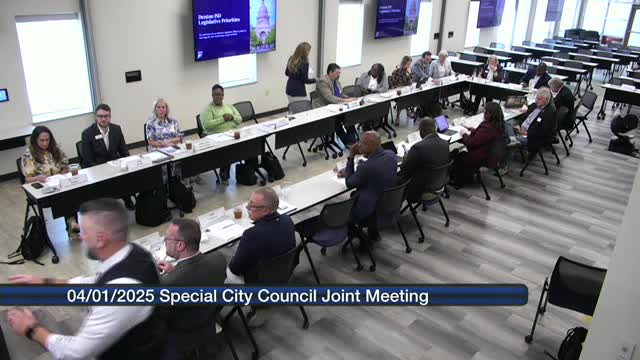
Jeremy Thompson, deputy superintendent of Denton ISD, and Darren Robinson, the district's general counsel, presented the district's legislative priorities and a fiscal briefing to the joint meeting on April 1, warning that state funding rules and recent cost pressures have produced sizable budget gaps.
"The size of our bucket only grows if we have more students, or if we have more weighted students," Thompson said, using the district's analogy for how state and local revenue combine to fund operations. He explained that Texas funds districts on average daily attendance and on weighted attendance (WADA) for special programs rather than on enrollment.
Thompson and Robinson described three broad causes of Denton ISD's budget shortfall: stagnant base funding, rising mandated costs, and declines in attendance. The district said the basic allotment per student remains $6,160 — a figure set in 2019 — and that inflation since then has reduced buying power. Thompson said Denton ISD's enrollment is roughly 33,400 students, average daily attendance is about 94.5 percent (roughly 31,000), but weighted average daily attendance used for funding behaves like about 41,000 to 42,000 because of program weights.
Robinson and Thompson listed specific deficits the district is trying to fill: about $6.5 million lost in reimbursements for school-health related services; roughly $7.5 million in transportation funding shortfalls; and about $4.5 million to cover required safety and security costs tied to 2023 legislation. They also said rising utilities and property-casualty insurance costs have contributed to the gap and that a one-time board salary increase of about $20 million created a recurring budget obligation.
"We worked really hard to get our budget deficit for this year under $20 million," Thompson said, adding that continuing cost pressures and the timing of promised state funds mean the district must make additional reductions and examine revenue options.
Thompson and Robinson said increasing the state's basic allotment is the district's preferred remedy because it broadens local discretion and automatically raises several funding streams that support staff pay, special education and safety. "The quickest and easiest way to get everybody paid to make up for special education, and to, of course, get school safety is to increase the base block," Thompson said. They noted that some legislative proposals aim to boost the base allotment; committee drafts under discussion would raise the allotment to roughly $6,500 per student or increase it by several hundred dollars, though officials said the final amounts and details remained uncertain.
The district also discussed other levers it is examining: increasing class-size ratios for budgeting (planning next year on elementary 24:1 and secondary 28:1), cutting or consolidating programs based on student opt-ins, and potentially pursuing a voter approval tax ratification election (TRE) to add local maintenance-and-operations pennies. Robinson explained that Denton ISD currently has its maximum compressed rate plus several "golden pennies" authorized; two additional golden pennies (not subject to recapture) could yield roughly $5–6 million, and the first copper penny could yield another ~$6 million though some of that might be recaptured by the state.
Board members and council representatives asked for clarification about attendance accounting, school-building needs on the U.S. 380 corridor and transportation eligibility. Thompson said the district is required to be prepared to serve students who live in its attendance zone even if attendance funding is based on daily presence; he confirmed the district is continuing planned construction authorized in prior bonds (including a fifth high school) because of ongoing growth in parts of the district.
Why it matters: Denton ISD officials said their funding shortfalls are not unique to the district and that increases to the state's basic allotment or other statewide funding adjustments will change how much local control districts retain when spending to meet mandates. The district requested that city leaders and representatives understand that targeted increases to the basic allotment both expand teacher compensation and help offset mandated program costs that otherwise reduce classroom resources.
The district offered resources from its 19–25 committee and pledged further outreach as legislative proposals develop.