Get Full Government Meeting Transcripts, Videos, & Alerts Forever!
Get email alerts on the Land Use Development topic
No spam. Unsubscribe anytime.
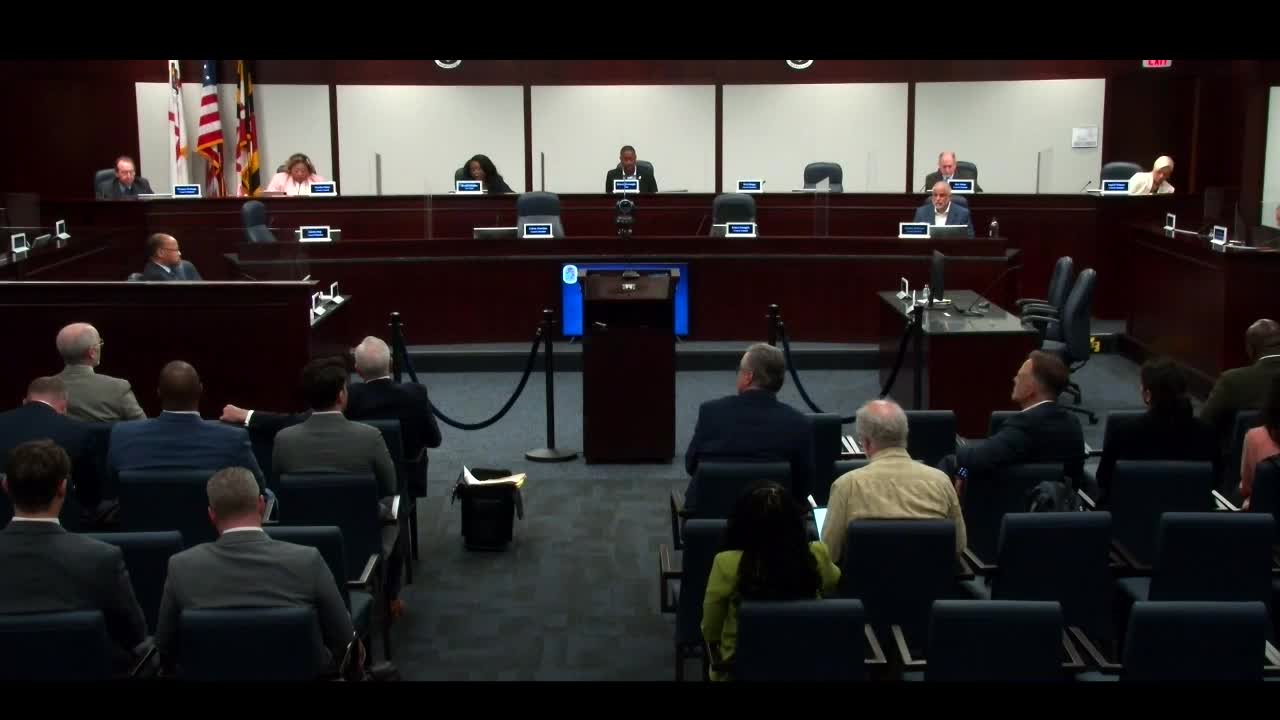
Prince George’s County council hears arguments, community opposition on proposed McDonald’s at Ager Road; decision taken under advisement
Summary
The Prince George’s County District Council heard oral arguments April 1 on Detailed Site Plan DSP‑22001, a proposal to build a 3,683‑square‑foot McDonald’s with drive‑thru at Green Meadows Shopping Center (MD‑410/Ager Road/Van Buren Street); the Planning Board had approved the plan with conditions, but residents and school representatives urged further review because of traffic and health concerns.
The Prince George’s County District Council heard oral arguments April 1 on Detailed Site Plan (DSP) DSP-22001, a proposal from McDonald’s USA LLC to demolish a small building at the southern end of the Green Meadows Shopping Center and replace it with a 3,683‑square‑foot McDonald’s with drive‑thru on a 4.16‑acre parcel at the northeast quadrant of East‑West Highway (MD‑410) and Ager Road/Van Buren Street.
Planning staff and the Prince George’s County Planning Board supported approval of the DSP with conditions. Jill Kozak of the county’s Urban Design Section summarized the plan, saying the larger existing building at the north end of the shopping center would remain while the southern free‑standing building would be replaced by the proposed McDonald’s. Kozak noted the planning board approved the DSP with conditions on Jan. 16, 2025, and that the site is subject to the prior CSC zone standards, the 2010 Landscape Manual and a required Type 2 tree conservation plan.
Edward Gibbs, counsel for McDonald’s, told the council the applicant withdrew a previously filed departure and that the DSP conforms to the prior zoning ordinance’s site design requirements. Gibbs said applicant experts performed multiple supplemental reviews—including queuing analyses and transportation adequacy tests—and that a consultant archaeologist found no evidence requiring archaeological investigation. “We have a site plan that conforms in every respect to the zoning ordinance,” Gibbs said.
Opponents, including parents and residents, urged the council to deny or remand the DSP. Ilse Catalan, president of the Cesar Chavez Dual Spanish Immersion Elementary PTO, said the site is about a third of a mile from the school and described the intersection as hazardous. “Adding a McDonald’s drive‑thru would actually be detrimental to the safety precautions that we have been able to win for our community and our children,” Catalan said, citing pedestrian safety concerns, air quality and local health statistics for childhood asthma.
Other speakers from the community and public‑interest groups echoed concerns about traffic, pedestrian and bicycle safety at the five‑point intersection, the adequacy and timing of traffic counts, the scope of outreach (noting no Spanish‑language outreach early in the process), stormwater and cumulative public‑health impacts in a community opponents described as already overburdened.
Applicant traffic consultant Michael Lenhart said the queuing exhibit shows 12–14 vehicles can stack between the order board and the drive‑thru entrance and an additional 5–6 vehicles between the pickup window and the order board, and that his analyses used SHA (State Highway Administration) counts from SHA’s database. He said the site produces more queuing capacity than the measure in the new zoning ordinance and that the on‑site queue would be located behind the building away from pedestrian circulation.
Community members and other speakers disputed the adequacy of off‑site traffic analysis for this intersection, urged a fuller health impact review and said Spanish outreach was insufficient for a neighborhood in which many residents speak Spanish. Residents also questioned whether increased lighting or tree trimming would address loitering and public‑safety concerns at the shopping center.
Councilmembers asked for documentation and clarifications. Councilmember Olson described the intersection as a “complete disaster” during morning commute hours and pressed whether State Highway Administration could or should change turn movements there; counsel and consultants said SHA was consulted and had requested consolidation of two southern driveways into a single right‑in/right‑out driveway in front of the proposed restaurant. Councilmember Fisher asked for traffic study dates and stormwater details; applicant consultants said counts were obtained from SHA’s database and that stormwater will be treated with micro‑bioretention and underground storage sized to avoid increasing existing site runoff.
No final district council vote was taken. Councilmember Fisher said she would take the matter “under advisement” for further review.
Votes and formal actions discussed during the hearing were primarily prior decisions by the Planning Board (approval with conditions) and referrals to agency reviews; the district council held the case for further consideration rather than rendering an immediate decision.
Why it matters: The council’s decision will determine whether the McDonald’s drive‑thru moves forward where residents and a nearby school say safety, air quality and outreach need more review. The case raises questions about how on‑site detailed site plans intersect with off‑site traffic, pedestrian safety and community health concerns.