Get Full Government Meeting Transcripts, Videos, & Alerts Forever!
Get email alerts on the City Budget topic
No spam. Unsubscribe anytime.
Houston finance offices report diverging year‑end projections; controller includes $100.3M drainage transfer
Summary
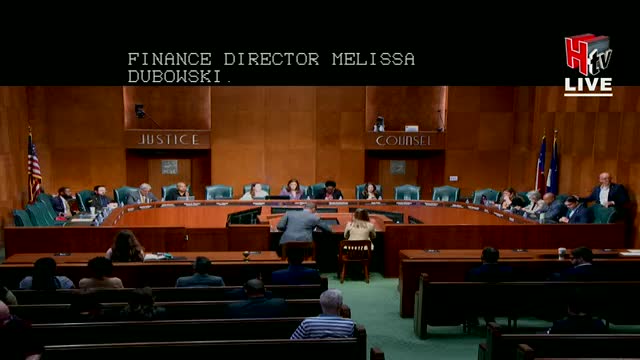
Controller Chris Hollins and Finance Director Melissa Dubasky presented differing projections for the city—s fiscal 2025 ending fund balance, a gap driven largely by the controller—s inclusion of a required transfer for drainage projects and differing revenue and expenditure assumptions.
Controller Chris Hollins told the Budget and Fiscal Affairs Committee that his office is "projecting an ending fund balance of $228,000,000 or 8.8% of expenditures less debt service and pay as you go for fiscal year 2025." He said that figure was about $121.2 million lower than the finance department's projection.
The gap between the two projections stems, Hollins said, from different revenue and expenditure forecasts and from the controller—s inclusion of a roughly $100.3 million required transfer from the general fund to finance city drainage projects this fiscal year. Finance Director Melissa Dubasky said the finance department—s 8+4 report shows a higher projected fund balance of $349,200,000, or 13.5% of estimated expenditures excluding debt service and pay‑as‑you‑go.
The difference does not mean the city is out of reserve; both presenters said the fund balances exceed the city's target of holding 7.5% in reserve. But the divergence matters for the FY2026 budget discussions under way: Dubasky described the 8+4 report as the staff estimate produced "immediately preced[ing] the general appropriations, which we'll be bringing to council at the end of this month." Hollins and Dubasky both noted that many estimates will still change as more revenue and expenditure information becomes available.
Both offices reported net increases to revenues and expenditures since the January report. Revenue upward revisions called out by the controller include an additional $32.3 million from sale of capital assets tied to TxDOT condemnation of the HPD South Central substation and roughly $18 million from higher‑than‑anticipated ambulance fees. On the expense side, both offices listed large upward adjustments for public safety: Hollins and Dubasky reported an increase of about $54.6 million in the fire department (overtime, special pay, phase‑down and storm response costs) and roughly $20.4 million in the police department (overtime and funding for a sixth cadet class).
Other amounts cited in the presentation include: a $3.7 million transfer from the combined utility system tied to consolidation of 311 services; increases in licenses and permits (about $1.55 million); and a $9.1 million projected decrease in intergovernmental revenues tied to lower municipal service fees from a local tax increment area. Enterprise funds showed mixed results: aviation operating revenues were down about $14.9 million, while combined utility system operating revenues rose about $53.3 million.
Committee members pressed staff on several items during the question period. Council Member Abby Kamen asked whether reimbursements for firefighter deployments typically exceed actual expenditures; Dubasky said reimbursements generally cover the costs and, in some cases, produce a net gain. Council Member Julian Ramirez asked for more detail on the $9.1 million intergovernmental shortfall; Dubasky said about half of that shortfall was driven by the Uptown TIRZ not transferring its full municipal service amount based on updated taxable‑value projections. Dubasky agreed to provide the committee with more detail on the formula used to allocate that charge.
On disaster spending, Dubasky told the committee that, as of Feb. 28, the city had paid $93.1 million in debris removal invoices and received $99.7 million in funding, including $77 million from FEMA and $22.7 million in state reimbursements.
As the meeting closed, both Hollins and Dubasky emphasized that the reports represent a snapshot ahead of the FY2026 budget and that estimates will be refined. Dubasky noted capital and operating timing effects that can create month‑to‑month shifts in projections. The committee will consider the general appropriations ordinance and budget materials later in the month.