Get Full Government Meeting Transcripts, Videos, & Alerts Forever!
Get email alerts on the Waterman Village Affordable Housing topic
No spam. Unsubscribe anytime.
City Council upholds approval of Waterman Village affordable-housing project, denies appeal
Summary
San Luis Obispo City Council voted 5-0 to deny an appeal and uphold Planning Commission approval of the Waterman Village project, clearing the way for rehabilitation of the Rosa Bertrand Adobe and construction of 20 low/very low-income homes, subject to financing and lease milestones.
San Luis Obispo City Council voted 5-0 on March 4 to deny an appeal of the Planning Commission’s December decision approving the Waterman Village project at 466 Dana Street, a proposal that would rehabilitate the historic Rosa Bertrand Adobe and add 20 low- and very low‑income housing units on the site.
The council’s action upholds the Planning Commission’s adoption of an initial study/mitigated negative declaration under CEQA and approval of land‑use entitlements, including a parking reduction requested under the California density bonus law. Staff and the city attorney recommended denying the appeal, saying the project honors the donor’s request that the adobe and trees be maintained for park or recreational purposes and does not violate the grant deed.
The case mattered because the property was conveyed to the city in 1989 by Mary Gail Black with a grant deed that asks the city to “maintain the adobe and two adjoining wings … and the trees on that property … for park or recreational purposes.” The appellant, represented by members of the San Luis Obispo Property and Business Owners Association, argued the deed imposes an enforceable restriction that disallows the proposed residential use. City staff and the city attorney told council the grant deed contains a mix of binding covenants and nonbinding requests; on its face the “request” language is not an express material restriction. City legal staff reviewed precedent cited by the appellant and concluded those cases were not analogous.
Project details and approvals
The applicant, Smart Share Housing Solutions, proposes 20 permanent homes targeted to very low- and low-income households, with units described in staff materials as roughly 220 to 264 square feet each, plus rehabilitation of the adobe. The project also calls for removal of 12 trees with a compensatory planting plan, and includes an investment in interpretive and historical signage reflecting periods of significance for the site. The Cultural Heritage Committee reviewed the project and voted 4–3 in favor with recommendations; the Architectural Review Commission recommended design changes such as sequencing the adobe rehabilitation before new construction and adding site furnishings; the Planning Commission adopted the mitigated negative declaration and approved the project unanimously with modified conditions (including utility submeters as a possibility and e-bike charging at long‑term bike parking).
Staff noted the site is city‑owned and that an exclusive negotiating agreement requires Smart Share to secure planning approvals and to demonstrate full project financing before a lease is executed. Among pre‑lease milestones listed by staff are: obtaining an accurate cost estimate, demonstrating financing commitments equal to 50% of project costs in cash or committed financing, and a plan to obtain the remaining financing; before construction the lessee must hold 100% of the project budget and an operating reserve and satisfy all lease and environmental conditions stated by the city.
Public comment and council hearing
Council heard extended public testimony. Opponents—including an appellant who identified himself as a nearby property owner and a number of family members asserting donor intent—argued the deed and council resolutions require the property be used exclusively as a park and that converting most of the site to housing would breach donor intent and the public trust. Appellants presented a historical report and legal analyses they said supported their position.
Supporters, including Smart Share staff, board members and a range of community organizations and residents, argued the project restores an at‑risk historic structure, creates permanently affordable homes close to transit and services, preserves much of the site’s trees and front yard area as public park space, and advances nonprofit stewardship of a property that has been vacant and deteriorating for decades. Smart Share’s executive director, Ann Wyatt, and board and partner speakers described the project as a community‑driven effort that can both restore the adobe and provide affordable housing.
Council decision and next steps
After council questions and deliberations, Vice Mayor Boswell moved to adopt a draft resolution denying the appeal and upholding the Planning Commission decision; the motion passed on a 5‑0 roll call. The resolution rejects the appellant’s claim that the grant deed contains an exclusive restriction that would bar the project, finding instead that the deed’s language is a request regarding park or recreational use and that the project would preserve the adobe, retain the majority of mature trees on site, and provide historical interpretation and public engagement opportunities.
If the council’s action stands, Smart Share must still meet the exclusive‑negotiating‑agreement milestones before a lease is executed. Staff told council the lease and real‑property negotiations, including specific public access arrangements for the adobe, will come back to council for approval at a later public hearing. Staff expects the lessee to demonstrate financing and obtain building permits before construction begins.
Speakers
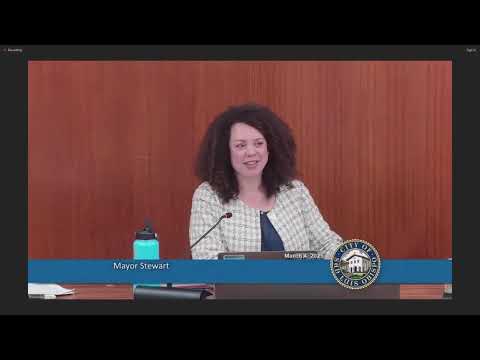
Key speakers at the hearing included: City staff Teresa McClish and David Amini (planning/housing staff); City Attorney (public counsel); appellant Steven Barish (San Luis Obispo Property and Business Owners Association); Smart Share representatives Ty Green (applicant representative) and Ann Wyatt (executive director); attorneys and advocates including Sara Rizzo; and dozens of residents who spoke in favor or opposed. The council’s roll call included Mayor Erica A. Stewart, Vice Mayor Schorzmann, and council members Marks, Francis and Boswell.
Ending
The council’s action resolves the land use appeal; lease terms and implementation details remain to be negotiated and will return to council for future public hearings. Staff told council it intends to incorporate Cultural Heritage Committee and Architectural Review Commission recommendations into conditions of approval and to work with the applicant on public access to the rehabilitated adobe.