Get Full Government Meeting Transcripts, Videos, & Alerts Forever!
Get email alerts on the Strategic Planning topic
No spam. Unsubscribe anytime.
Hemet council workshop prioritizes city cleanup, public safety and street projects for 2025
Summary
At a March 14 strategic planning workshop, Hemet city leaders reviewed 2024 accomplishments and agreed to prioritize code enforcement and street-safety efforts, shovel-ready park and fire station projects, and policy inventory and transparency for the next fiscal year.
Hemet city leaders met March 14 for a goal‑setting workshop that opened the fiscal‑year planning cycle and identified short‑term priorities, placing the highest emphasis on improving neighborhood cleanliness, public safety visibility and street infrastructure.
City Manager Mark opened the workshop by framing the session as the first step in a sequential process to set the organization’s priorities and monitor progress. "This is the day where we're going to begin working on setting priorities for the coming year," he told the council, underscoring that staff will align the final work plan with projected budget constraints.
The council began with a look back at accomplishments from the prior 12 months. Staff reported hiring and retention gains (70 new hires, 47 promotions), completion of seven street capital improvement projects, an inaugural Hemet Beautiful beautification program and growth in outreach—social media followers rose by roughly 3,000 on Instagram and about 7,000 on Facebook. Public safety achievements cited included a new mobile command center, the police aero team and the city’s collaborative ambulance placement with AMR, plus progress on Fire Station 1 remodel and plans for an expanded Station 2.
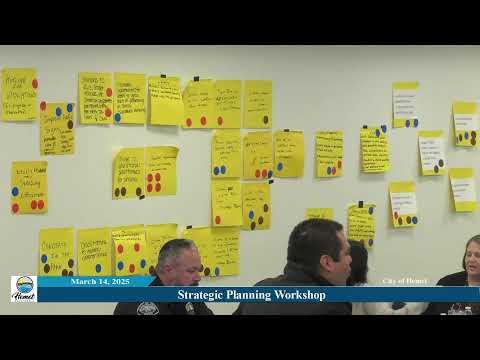
After the recap, councilmembers placed emphasis on a handful of areas to carry into the next fiscal year. Top priorities that emerged from the dot‑voting exercise were: (1) cleaning the city through stepped‑up code enforcement and targeted signage; (2) a street‑sweeping and parking enforcement program tied to abandoned vehicle and RV removal; (3) completing shovel‑ready designs for DVL soccer fields and a fire‑training complex; and (4) an inventory and public posting of council‑adopted policies to improve transparency.
On cleanliness and code enforcement, several councilmembers pressed for more aggressive enforcement tools and clearer signage. Mayor Peterson and others proposed consolidated signage at major corridors addressing litter and panhandling and adding safety warnings (for fire stations and road dips). Councilmembers also urged creating a unified approach to abandoned cars and oversized vehicles, including exploring new towing and disposal procedures for derelict RVs; staff noted the issue is constrained by available tow yards and legal procedures but said it will be researched as part of a combined street‑sweeping and parking enforcement proposal.
Public safety and parks were another cluster of priorities. Councilmembers supported continuing investments in police technology, community cameras and the aero team, and they asked staff to pursue a weekend aero capability if feasible. On parks, members urged completion of the Brubaker Park field lighting and shade structures, design and bidding work for Weston Park reimagining and prioritized splash pads or play upgrades to encourage safe family activities.
Capital projects and grants were discussed as part of the three‑year direction. City staff described ongoing capital projects (a water treatment plant design‑build, sewer replacements requiring Caltrans permits, and identified sites for future fire stations). The manager identified shovel‑ready projects—DVL soccer fields and a Station 2 expansion among them—as the kinds of projects staff will pursue to match with grant opportunities. Staff highlighted grant successes from the last year, including an ASICS award (reported by staff as $35,000,000) and completed obligations of ARPA funds.
Council and staff also discussed administrative and organizational items. The city manager proposed a policy inventory project to post all council‑adopted policies publicly and to identify gaps. The council endorsed adding transparency and financial sustainability language to organizational effectiveness objectives, and several members volunteered to work with staff on refining measurable action items and on building ad hoc groups to support economic development and nonprofit partnerships.
Library services, youth programming and community engagement received attention. Staff noted expanded library programming, a new day of library service, a youth council with recruitment open for a new year and the Hemet Economic Summit scheduled next week. Councilmembers asked that library security not be left entirely to grants and suggested staff identify local funding if needed.
No formal council votes or ordinances were adopted at the workshop; the session was advisory and intended to produce a prioritized one‑year work plan and follow‑up reporting. The manager told council that staff will convert the workshop results into a draft work plan, estimate implementation costs for recurring items, and present updates in upcoming meetings and at the April 8 quarterly update.
The meeting concluded with staff committing to: prepare a draft work plan aligned to the council’s dot‑voting priorities; research legal and operational steps for towing, RV removal and enhanced parking enforcement tied to street sweeping; produce a public inventory of adopted policies; and develop cost estimates to inform the FY26 budget process. The council scheduled follow‑up reporting and additional opportunities to form ad hoc teams for implementation.