Get Full Government Meeting Transcripts, Videos, & Alerts Forever!
Get email alerts on the Corrections Budget topic
No spam. Unsubscribe anytime.
Puerto Rico corrections chief asks House finance panel for larger budget to cover payroll, health care and rehabilitation programs
Summary
Secretary Francisco Quiñones told the House Committee on Hacienda the Department of Correction and Rehabilitation seeks higher funding to replace expiring ARPA pay supplements, hire hundreds of officers, expand health services including hepatitis treatment and invest in contraband detection and canine units.
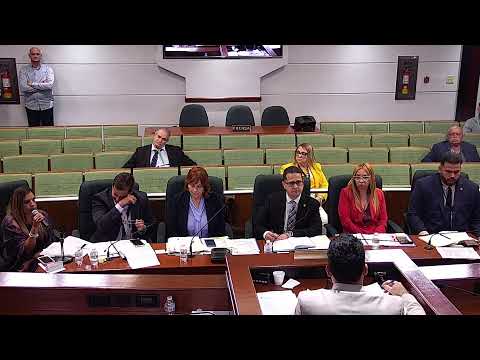
San Juan — The Department of Correction and Rehabilitation asked the Puerto Rico House Committee on Hacienda on April 1 for additional funding to cover payroll, health care and rehabilitation programs as federal COVID-era (ARPA) supplements end and as the agency seeks to boost staffing and medical services.
Secretary of Correction and Rehabilitation Francisco Antonio Quiñones Rivera told the committee the department currently receives about $418,153,746 from the general fund and is seeking a larger budget for the 2025–26 fiscal year. He said the request reflects recurring payroll needs after a $500 monthly supplement for custody staff — funded with federal ARPA dollars for several years — is set to expire June 30.
"Tengo el privilegio, el enorme privilegio de servir como secretario de corrección y rehabilitación," Quiñones told the committee as he opened the agency's presentation. He later described unannounced visits to institutions and said "cada vez que nuestros oficiales hacen registros en las instituciones no están buscando contrabando, están salvando vida."
Why it matters
The department said payroll is its largest budget item and that replacing nonrecurring ARPA funds with recurring local funds is the primary driver of its request. The agency also flagged health costs, including an administration priority to mass-test and treat hepatitis among people in custody and an ongoing evaluation of the private contract that provides medical services inside institutions.
Major details
- Current general-fund allocation: $418,153,746 (agency figure presented to the committee). - Agency request discussed for the 2025–26 cycle: roughly $515 million (presented as the larger consolidated request for the fiscal period under review). - Payroll: the department said more than half of its budget goes to payroll, and listed a requested payroll allocation of $264,471,759 for a key salary line to fund recruitment and promotions. The department told the committee it plans recruitment drives for 500 correctional officers (estimated cost $10,695,813) and 120 juvenile services officers (estimated cost $3,498,484). - Health program budgets: the department reported the current health-correctional program is funded at about $54 million; it requested roughly $79.6 million for FY2025–26. The Fiscal Oversight Board (Junta de Supervisión Fiscal) proposed a lower figure — about $55 million — creating a near-$24 million gap the department said is largely tied to funding a hepatitis-treatment initiative. - Hepatitis initiative: agency officials said approximately $21 million of the contested $24 million would fund hepatitis testing and treatment across the custodial population; the department scheduled mass testing for May 19 and said treatment will be scaled up if funding is secured. - Federal reimbursements and recovery funds: the department reported $30.9 million in pending disaster reimbursements (FEMA and related accounts), including about $18 million for capital repairs and $1.3 million for force-account labor from Hurricane Fiona. - Contract for medical services: committee members were told the contract with the medical-services vendor runs about $11.3 million per year (part of a longer-term contract). The secretary said the department commissioned legal and operational analyses of that contract and is reviewing next steps. - Recruitment, retention and pay: the secretary and deputies stressed attrition and geographic transfer issues; the department said the basic salary for a correctional officer is about $2,350 after recent increases and that prior to the supplement base pay was lower. Officials described retention steps such as offering reassignments closer to employees' homes. - Contraband detection and canine unit: the agency reported deployment of 26 detection dogs and recent acquisition of 26 handheld chemical trace detectors ("itemisers") and larger screening technology (compared to airport-style RapiScan). The department said it is evaluating the cost of expanding canine coverage to cover all 23 institutions 24/7 and is coordinating with the National Guard and federal partners.
Discussion and committee follow-up
Committee members pressed for documentary detail. The department agreed to provide a breakdown of state versus federal funding within three business days and additional supporting documentation about the hepatitis funding request and the submission it made to the Office of Management and Budget (OGP) and the Fiscal Oversight Board. The secretary said the department will ask OGP and the Fiscal Oversight Board to reconsider the $21 million hepatitis allocation, and asked the committee for help monitoring those requests.
Officials also described pending capital needs such as facility repairs funded with disaster recovery monies and listed $13.4 million owed to the Public Buildings Authority as part of older debts the department is addressing.
What the department said about safety and investigations
Secretary Quiñones described operational changes and interagency work with federal partners including the DEA and U.S. Marshals. He named Pedro Vargas as the assistant secretary for legal and investigative affairs and said Vargas will coordinate internal investigations; Quiñones emphasized that the department will not shy from investigations that affect any employee at any level.
Selected direct quotes (Spanish, verbatim)
"Cada vez que nuestros oficiales hacen registros en las instituciones no están buscando contrabando, están salvando vida." — Francisco Antonio Quiñones Rivera, Secretary of Correction and Rehabilitation
"De esos veinticuatro millones que se piden adicional son veintiún que estamos trabajando para el tratamiento de hepatitis." — Lineth Pérez O'Neill, Subsecretary (on the hepatitis funding component)
Next steps
Committee members requested the department deliver specified budget support documents within five days and signaled the panel will use that information in its written report to the full legislature. The agency said it will continue recruitment, press OGP and the Fiscal Oversight Board for additional health funding, and complete internal contract reviews for the health-services vendor.
— Reporting from the April 1 hearing of the House of Representatives, Comisión de Hacienda; the account draws on presentations and exchanges recorded in the committee transcript.