Get Full Government Meeting Transcripts, Videos, & Alerts Forever!
Get email alerts on the Housing Affordability topic
No spam. Unsubscribe anytime.
Senate committee advances housing omnibus with technical fixes, schedules full markup
Summary
The Senate Committee on Housing and Homelessness Prevention adopted two amendments to the housing omnibus (SF 2298), walked through program funding changes that meet the committee's $3 million general fund target for FY25–27, and laid the bill on the table ahead of a full markup and vote on April 3.
St. Paul — The Minnesota Senate Committee on Housing and Homelessness Prevention on Monday adopted two amendments to its housing omnibus, Senate File 2298, and laid the bill on the table for full discussion and a markup scheduled for Thursday, April 3.
The measure, described to the committee as a package of policy provisions and budget changes for Minnesota Housing programs, was presented with an A2 author’s amendment (a DE to conform bill form) and an A4 technical amendment that adjusts transfer and appropriation language so appropriations to Minnesota Housing are from the general fund and conform with budget rules. Both amendments were adopted by voice vote.
Committee fiscal staff walked members through a spreadsheet that showed how the bill meets the committee’s general fund target. "This committee received a general fund target of 3,000,000 for fiscal years '25 through '27 and 1,000,000 in the tails biennium of fiscal years '28–'29," said Mr. Olofsson, the committee fiscal analyst, describing the changes that produce a net $3 million target for 2025–27 and $1 million for 2028–29.
The fiscal presentation credited a mix of new one-time and base changes across programs. Notable line items Mr. Olofsson described include: - $10,150,000 one-time from the general fund in FY2026 for the Family Homelessness Prevention and Assistance Program (FHPAP). - $2,000,000 one-time in FY2026 and $500,000 ongoing beginning FY2028 for the Greater Minnesota Housing Infrastructure Grants Program. - $2,000,000 one-time in FY2026 and $450,000 ongoing beginning FY2028 for the community-based first-generation homebuyer down payment assistance program administered through a community development financial institution (CDI/CDFI). - A $10,000,000 savings in FY2025 from reducing or canceling the single-family housing portion of the community stabilization program. - Repeal of a transfer to the housing support account producing savings of $450,000 in FY2025 and $900,000 in subsequent biennia.
Those changes, Mr. Olofsson said, produce a $10,450,000 general fund savings in FY2025 and $13,450,000 in FY2026, with the net effect meeting the committee’s $3,000,000 target for FY2025–27 and the $1,000,000 target for FY2028–29.
Policy provisions in Article 2 of the bill were outlined by committee staff. The provisions add or amend MHFA authorities and program rules, including a new annual financial-stability report requirement for the housing industry, required convenings between Minnesota Housing and local governments with high cost-burden rates, changes to award formulas and redistribution authority for rent assistance, expansions of eligible recipients for certain programs (including tribal contract schools and nonprofits contracted by schools), clarification of officers or principals for disqualification purposes, codification and funding changes to the community-based first-generation down payment assistance program, and creation of a task force to study homeowners insurance affordability.
Jennifer Ho, commissioner of Minnesota Housing, told the committee the agency appreciates the inclusion of its policy and technical language and expressed concern that the funding still falls short of total need. "This isn't flashy stuff, but it helps us be responsive and be better partners with our community partners," Ho said. She noted the first-generation down payment assistance program was launched with $50,000,000 in one-time funding in 2023 and that current annual state appropriations for first-time homebuyer assistance are "less than $1,000,000 per year." Ho said her agency will assist with implementation.
Advocates and stakeholders who testified described the bill’s priorities and urged additional or sustained funding. Libby Murphy of the Minnesota Housing Partnership and the ERASE campaign urged the committee to support the $10,000,001 (one-time) increase to FHPAP, citing cost comparisons she said were offered earlier in hearings: that it costs about $45,000, on average, to move a family out of homelessness but about $3,500 to keep a family stably housed. Ben Helvick Anderson of Beacon Interfaith Housing Collaborative and Roxanne Young Kimball of the Minnesota Homeownership Center praised provisions that would improve coordination and support first-generation homebuyer assistance; Kimball said the First Gen program supports homebuyer choice and has partnered with more than 100 mortgage products.
Representatives of labor and manufactured-housing advocates also testified. Lucas Franco, identifying himself on behalf of construction workers in Minnesota and North Dakota, said the bill’s investments in workforce housing and infrastructure were important and urged continued attention to lowering per-unit development costs. Jason Bushell of North Country Cooperative Foundation asked the committee to include funding from separate bills (SF 2681 and SF 1775) to support resident ownership and manufactured-home community infrastructure, saying Minnesota has "over 800 manufactured housing communities providing nearly 45,000 units" and that resident ownership programs have saved families an average of $720 per year in places that have converted.
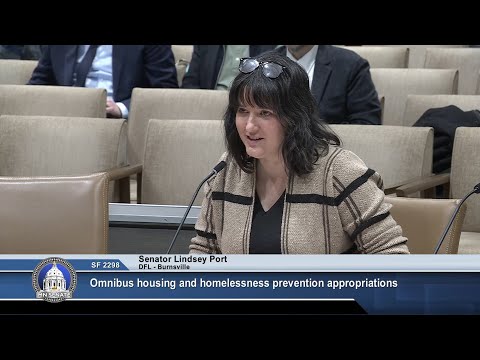
Committee author Senator Port framed the bill as a modest package in a constrained budget year and said investments in FHPAP, Greater Minnesota infrastructure, and permanent support for first-generation down payment assistance were priorities intended to increase stability for households and to sustain homeownership opportunities.
Senators asked technical and clarifying questions during the hearing about terminology and funding sources. Mr. Olofsson and other staff clarified that the changes in the bill are funded from the general fund and walked members through the base funding amounts for Minnesota Housing.
No final passage vote on SF 2298 occurred; the committee laid the bill on the table for full discussion and a markup and vote on Thursday, April 3. Committee staff and the bill author noted the bill includes an insurance task force provision that must still go to the state government committee before moving forward.
Votes at a glance A2 author’s amendment adopted — voice vote (motion carried) A4 technical amendment adopted — voice vote (motion carried) Senate File 2298 — laid on the table for full discussion and markup on April 3 (no final vote recorded at this hearing)
The committee’s record and staff spreadsheet will be used for the scheduled markup. The author and staff said they will continue discussions with leadership and House counterparts to seek additional housing resources as the session proceeds.