Get Full Government Meeting Transcripts, Videos, & Alerts Forever!
Get email alerts on the Pet Store Sales Ban topic
No spam. Unsubscribe anytime.
Committee considers HF 2627 to bar new pet stores from selling dogs and cats; bill would grandfather existing sellers with disclosure rules
Summary
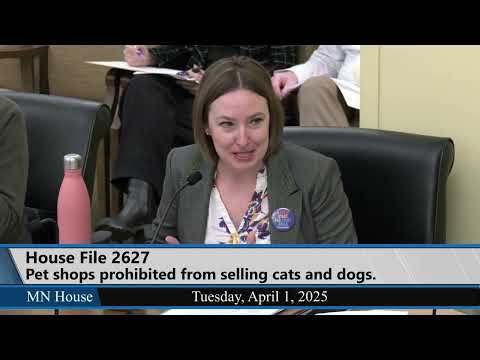
The House Commerce, Finance and Policy Committee on an unspecified date heard testimony on House File 2627, a bipartisan proposal that would prohibit new pet stores from selling dogs and cats in Minnesota while allowing stores currently selling those animals to continue under a grandfather clause and new transparency requirements.
The House Commerce, Finance and Policy Committee on an unspecified date heard testimony on House File 2627, a bipartisan proposal that would prohibit new pet stores from selling dogs and cats in Minnesota while allowing stores currently selling those animals to continue under a grandfather clause and new transparency requirements. Chair Herr moved to lay the bill over for possible inclusion in an omnibus bill; the measure was subsequently laid over.
The bill’s author, Representative Norris, described HF 2627 as “designed to protect consumers and prevent animal cruelty while avoiding shuttering anyone's business,” and said the measure “prohibits any stores that don't currently sell dogs or cats from doing so” while grandfathering existing sellers that provide disclosure about where they source animals.
Nut graf: Supporters said the bill will reduce consumer deception and limit demand for puppy-mill supply chains, while opponents — including owners of longstanding pet stores — argued the measure and some of its provisions could make family businesses unsalable and expose breeders to harassment. Committee members questioned the scope of the measure, its grandfathering language, and whether related problems such as backyard breeders are addressed.
Testimony and key provisions Aaron Zellhofer, Minnesota state director for Humane World for Animals, told the committee HF 2627 is “a compromised legislation that prevents any additional pet shops from selling puppies while allowing existing stores to do so as long as they adhere to common sense sourcing and transparency requirements.” He said the state currently has “only 3 puppies selling pet stores” and urged disclosure of breeder sources to prevent deceptive sales and health problems in purchased animals.
Consumer witness Megan Helling described the health problems of a dog she purchased and said the system “hides the origins of these puppies, allowing stores to deceive customers.” Helling urged support for the bill as a step toward “a future where no dogs suffer for profit.”
Opposition testimony came from Michael Swanson, owner of 4 Paws and a Tail, a locally owned pet store operating for more than five decades. Swanson said HF 2627’s grandfather clause (section 3.3) and a provision he cited as “section 4D” would prohibit relocating his store and would make his business “an unmovable, unsalable asset.” He also said the bill’s advertising and public-disclosure requirements — listing breeder license numbers or breeder location information — would add paperwork and could expose breeders to harassment.
Lauren Kelmette of the Pet Advocacy Network argued bans historically drive pet sales into unregulated channels: “Underground markets emerge. Puppies are sold out of parking lots, online classifieds, and unregulated channels, often with no health guarantees, no consumer protections, no oversight.” She urged the committee to oppose HF 2627, saying bans can eliminate transparent, regulated sellers and push consumers toward worse options.
Committee discussion and clarifications Members asked a range of questions. Representative Catiza Wooten noted that Eden Prairie and other cities already prohibit retail animal sales and asked how HF 2627 would work in practice; Representative Norris said the bill is intended to add “sunlight” through required disclosure so the public can verify breeder practices. Representative Chow (transcript: “Cha”) raised backyard breeders as a concern not fully addressed by the bill; Norris and Zellhofer replied that the bill’s disclosure requirements would show where dogs are coming from, including backyard breeders.
Representative Finke asked why the bill’s effective date is August 2026; Representative Norris said the delayed effective date and a one-year-in-operation threshold are intended to ensure existing businesses in operation for a year are eligible for the grandfather clause. Testimony indicated disagreement about business participation in drafting the bill: Swanson said he was not invited to the drafting meetings; prior testimony said some conversations had occurred.
Other issues raised included whether pet stores already provide breeder information at point of sale (Swanson said Minnesota consumer-protection law requires disclosure at sale), whether allowing adoption space without charging a fee could be abused as a workaround (the bill would prohibit fees for providing adoption space), and concerns that the bill could reduce the resale value of businesses that currently sell dogs and cats.
Action and next steps Chair Herr moved that “House File 2627 be laid over for possible inclusion in an omnibus bill.” The committee laid the bill over; no committee vote on final passage was recorded in the transcript. Representative Norris offered closing remarks that the bill “strikes that balance,” allowing responsible operators to continue while adding transparency to protect animals and consumers.
Ending: The bill will be held for further consideration and potential inclusion in omnibus legislation in a future committee or floor process.