Get Full Government Meeting Transcripts, Videos, & Alerts Forever!
Get email alerts on the Vehicle Advertising Pricing Disclosure topic
No spam. Unsubscribe anytime.
Dealers and consumer advocates back bill letting dealerships say online a lower showroom price may be available; manufacturers oppose
Summary
Proponents told the Economic Matters Committee that Senate Bill 834 would allow Maryland car dealers to say on their websites that a lower price may be available in the showroom despite manufacturers’ minimum advertised price rules; automakers urged an unfavorable report, saying the change would undermine cooperative advertising programs.
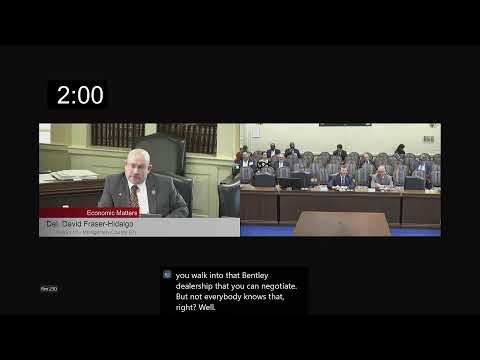
Proponents of Senate Bill 834 told the Economic Matters Committee that modest website disclosures would improve price transparency for car buyers and help dealers who compete on price. Franz Schneiderman of Consumer Auto Maryland and Rob Smith, president of Fitzgerald Automalls, testified that manufacturers’ minimum advertised price (MAP) or minimum allowable advertised price (MAAP) restrictions often force dealers to display online prices that are $1,000 to $1,500 higher than actual transaction prices available on the showroom floor.
"This bill is about transparency and price competition and access to better information about price discounts," Franz Schneiderman said. Rob Smith said Fitzgerald Automalls’ practice is "the price you see is the price you pay," and described MAP rules as an Internet-specific constraint that can force dealers to advertise a higher online price while permitting different in-showroom negotiation.
Josh Fisher and Bill Kress, representing the Alliance for Automotive Innovation, urged an unfavorable report, saying manufacturers and dealers often participate in cooperative regional advertising programs in which manufacturers contribute money and expect uniform advertising rules in return. Fisher said the Alliance proposed an amendment that would let dealers disclose a lower showroom price except when they have signed an agreement to receive advertising benefits under a program, in which case the dealer must follow that program’s rules. Witnesses said the amendment was proposed but the sponsor rejected it.
Committee members asked a range of questions: whether the bill contains criminal penalties (a committee member identified language in the draft appearing to create a misdemeanor with up to two months’ jail time), how cooperative advertising agreements function, whether dealers that accept advertising funds could still advertise different prices, and how the change could affect small dealerships. The sponsor’s representative said she would relay the committee’s concern about criminal penalties back to the sponsor.
Neither side presented a committee vote in the hearing record. Supporters said the bill does not prevent manufacturers from maintaining MAP rules or punish fraud and that it narrowly allows dealers to indicate that lower prices may be available in person. Opponents warned that if manufacturers end cooperative advertising programs in response, small dealers could lose advertising support and be disadvantaged. The hearing concluded with no recorded committee action in the transcript.