
Olmsted County approves ordinance regulating low‑potency hemp edible cannabis products
Get AI-powered insights, summaries, and transcripts
Sign Up Free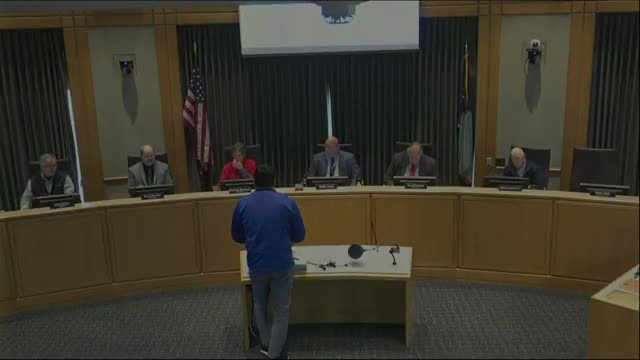
Summary
The Olmsted County Board approved an amendment to county code Chapter 2,150 to register and regulate low‑potency hemp edible retailers, add age‑compliance penalties, and prohibit smoking in retail establishments; enforcement will be handled locally for ordinance violations and by the Office of Cannabis Management for product compliance.
Olmsted County commissioners approved a change to Chapter 2,150 of the county code to regulate the sale, display and on‑site consumption of low‑potency hemp edible cannabis products at a county board meeting (date not specified). The ordinance requires registration of low‑potency retailers, establishes age‑compliance penalties and clarifies indoor smoking prohibitions in retail establishments.
The proposal was presented by Sagar Choudhury, Associate Director at Olmsted County Public Health, who said the update ‘‘is really around low potency and we’re updating our language and our ordinance to encompass some of those requirements.’’ He told commissioners the county will register about 120 retailers that sell low‑potency products, excluding the cities of Byron and Pine Island, which opted to regulate on their own behalf.
Choudhury said the county’s Environmental Health Unit will handle local ordinance enforcement and age‑compliance checks, drawing on the unit’s existing tobacco‑compliance work. He said other product compliance checks and complaints will be handled by the state Office of Cannabis Management. The ordinance sets graduated fines and suspensions for age‑compliance failures within a 36‑month period: a first violation at $300, a second at $600, a third at $1,000 plus a seven‑day suspension, and a fourth at $1,000 plus a 30‑day suspension.
The ordinance also prohibits on‑site consumption by retailers except when three conditions are met: the product is purchased within the establishment, all consumers are 21 or older, and retailers do not serve obviously impaired consumers. Choudhury said the language builds on the Clean Indoor Air Act and Olmsted County’s tobacco‑free workplace ordinance and ‘‘prohibits all smoking within the retail establishments.’’ He noted that product use can include vaping or smoking despite state limits and that the ordinance seeks to clarify local expectations.
During the public hearing, Jesse O’Driscoll, a Rochester resident and member of the Citizens Advisory of Transit, urged the board to recognize the difficulty of the local/state regulatory relationship, saying the 2023 state legislation created unexpected local mandates. ‘‘If you ever feel like you don’t want to do everything that you feel pressured to do, there is lots of support for you,’’ O’Driscoll said, urging the board to consider local options.
A motion to close the public hearing carried on a voice vote; a subsequent motion to adopt the ordinance also passed on a voice vote. The transcript records verbal ‘‘ayes’’ and the chair declaring the motions carried; exact roll‑call tallies were not specified in the meeting record. After the vote, a board member thanked Choudhury and Public Health staff for their work on the ordinance.
The ordinance delegates local ordinance violation enforcement and age‑compliance checks to county public health staff and assigns product compliance and complaint investigations to the Office of Cannabis Management. The record also notes that denial of a registration by the County Director of Public Health may be appealed through the county’s administrative enforcement and appeals procedures; staff described an administrative appeals process that routes denials to contract hearing officers for an appeal hearing.
The ordinance text, associated registration procedures, and enforcement timing were discussed during the meeting; commissioners asked for clarification about the appeals route and staffing for compliance checks. No additional implementation dates or effective dates were specified in the meeting transcript.
Votes at a glance: the board voted by voice to close the public hearing and then to adopt the ordinance amending Chapter 2,150 to regulate low‑potency hemp edible cannabis products. The transcript indicates both motions carried; exact numeric vote counts were not provided.