Get Full Government Meeting Transcripts, Videos, & Alerts Forever!
Get email alerts on the Education Budget Sf2255 topic
No spam. Unsubscribe anytime.
Minnesota governor’s 2025 education proposal trims several programs, draws concern from senators
Summary
The Minnesota Department of Education and the Department of Children, Youth and Families outlined the governor’s 2025 education budget proposal at a Senate Education Finance Committee hearing, laying out reductions to multiple targeted aid streams while proposing funding for anti‑fraud work and legal costs.
The Minnesota Department of Education and the Department of Children, Youth and Families outlined the governor’s 2025 education budget proposal at an informational hearing of the Minnesota Senate Education Finance Committee, laying out proposed cuts and targeted investments that agency officials said are intended to help close a projected budget shortfall.
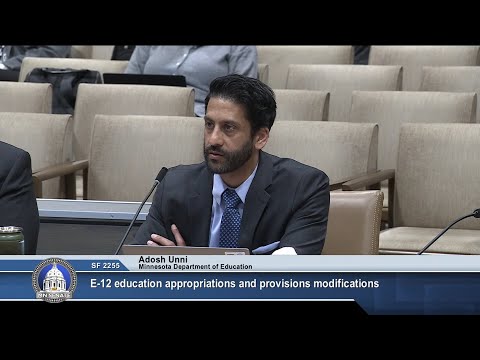
The proposal, presented by department staff including Ado Shuni, director of government relations for the Minnesota Department of Education, and Kathy Erickson, director of school finance, would reduce or eliminate a number of targeted aid streams — including nonpublic pupil transportation and nonpublic pupil education aid, parts of QComp (alternative teacher compensation), and several special‑education reimbursements — while adding funds for fraud prevention, legal services and one‑time supports to help with implementation.
Committee members and agency staff stressed the package is a starting point for negotiation. "This is a starting place for a conversation around this incredibly important and difficult task," Ado Shuni told the committee. Senators from both parties raised questions about the effects of proposed cuts on students, charter schools and teacher compensation.
Most significant reductions in the governor’s package, as the department described them:
- Nonpublic pupil transportation: The governor proposes eliminating the state aid for transporting nonpublic (private) pupils beginning in fiscal year 2026. Kathy Erickson told the committee the change would reduce state spending by about $57.5 million in the first affected biennium (fiscal 2026–27) and about $61.3 million in the following period; the bill would also remove the statutory obligation for districts to provide that transportation.
- Nonpublic pupil education aid: The budget would eliminate state aid that helps pay textbook, testing and certain health and counseling services for nonpublic pupils. Erickson said that change would lower state spending by about $52.5 million in fiscal 2026–27 and about $57.7 million in the subsequent biennium; it would also remove the related 10% reconciliation payment for fiscal year 2025.
- Compensatory revenue and pilots: The governor proposes a one‑year, modified hold harmless for compensatory revenue for fiscal year 2026 that would use the greater of certain pupil counts and would require a one‑time investment of about $55 million (roughly $50 million in FY26 plus a $5.5 million cleanup payment in FY27). The package would also eliminate a seven‑district compensatory pilot, saving roughly $6.59 million in FY26–27 and about $14.6 million in the following biennium.
- QComp (alternative teacher compensation): The proposal would close QComp starting in fiscal year 2027. The department estimates the change would reduce general fund spending by roughly $79 million in fiscal year 2027 (the second half of the first biennium) and about $174 million in the next biennium; it would also reduce levy authority by about $40 million beginning in FY27. The department cited participation of roughly 111 districts, 71 charter schools and other entities under the program (about 39,400 educators appear in the most recent PELSB report referenced by staff).
- Special education: The governor would eliminate the charter school tuition adjustment (reducing the state share of charter special‑education costs and shifting additional costs to charters) and reduce special‑education transportation reimbursement from 100% to 95% in FY26 and to 90% thereafter. Erickson said the transportation change would save roughly $58.9 million in the first affected biennium and about $60.2 million in the next.
- Charter school facilities and other targeted reductions: The package would eliminate long‑term facilities maintenance (LTFM) funding for charter schools (estimated savings roughly $19.93 million in FY26–27 and $22.19 million in the following biennium), reduce school library aid by approximately 32% (about $7.5 million saved in 2027 and about $15 million in the second biennium) and reduce telecommunications equity aid by about $750,000 per biennium.
- Other program adjustments: The governor would end the computer science education advancement grants and a related supervisor position (about $1 million per biennium), reduce the Grow Your Own teacher pipeline by $8 million annually beginning in FY26, and restructure literacy and certain integration program administration. The administration also proposed extending full‑service community schools grant cycles to three years and making a no‑cost technical transfer to locate Reading Corps grants at the Department of Education for oversight.
- Unemployment insurance for hourly school workers: Erickson described a request to add about $30 million in FY26 so the state could meet estimated unemployment reimbursements and fully fund an expected FY26 cost of roughly $63 million. Department staff said reconciliation of FY24–25 payments indicates about $102 million of $135 million set aside in prior law will be spent, leaving an estimated $33 million remaining at the end of FY25.
- Anti‑fraud, legal and agency operating requests: The package includes a one‑time $6 million request for legal services and litigation costs, and an annual anti‑fraud and program‑integrity proposal of about $550,000 per year to fund three FTEs and software for fraud detection and investigations; the department also requested modest operating adjustments for personnel and rent costs.
Committee reaction and concerns
Some senators warned that eliminating nonpublic aid and transportation could move students back into the public system and potentially increase costs rather than save them. "I don't think it's going to save the amount of money that the governor thinks," Senator Farnsworth said during questioning, describing constituent concern about the proposed elimination of nonpublic pupil aid.
Multiple senators also objected to reductions that they said would harm students served by charter schools and special‑education programs, and raised questions about the consequences of closing QComp for teacher pay structures. Senator Gustafson and others asked whether the package contains alternative strategies to address charter funding disparities.
Agency officials repeatedly characterized the proposal as a starting point driven by the state’s fiscal picture. "The governor, MDE, and all the staff welcome other balanced solutions that also maintain the important strides we have made," Ado Shuni said.
Votes at a glance
- A1 amendment to the committee engrossment: adopted by voice vote (committee chair called for ayes; transcript records "Aye" and the chair stated "The A1 is adopted.").
- A25 (forecast adjustment) amendment: adopted by voice vote (committee chair called for ayes; transcript records "Aye").
What happens next
Committee members said the package will be the starting point for negotiation; no final committee vote on Senate File 2255 was recorded in this hearing. Department staff told the committee that many provisions depend on technical adjustments, approvals from Minnesota Management and Budget for transfer authorities, and future legislative decisions. Senators signaled they would weigh mandate relief, alternative savings and the statewide budget picture as negotiations continue.
(Reporting based on testimony and exchanges at a Minnesota Senate Education Finance Committee informational hearing on the governor’s 2025 education budget; agency presenters included staff from the Minnesota Department of Education and the Department of Children, Youth and Families.)