Get Full Government Meeting Transcripts, Videos, & Alerts Forever!
Get email alerts on the Drug Paraphernalia Enforcement topic
No spam. Unsubscribe anytime.
Philadelphia council committees hold hearing on enforcement of stores selling drug paraphernalia
Summary
A joint hearing of Philadelphia City Council committees examined enforcement gaps around stores selling drug paraphernalia, describing inspection processes, legal limits on confiscation, repeat-offender “shell games,” coordination with police and health, and potential new legislation.
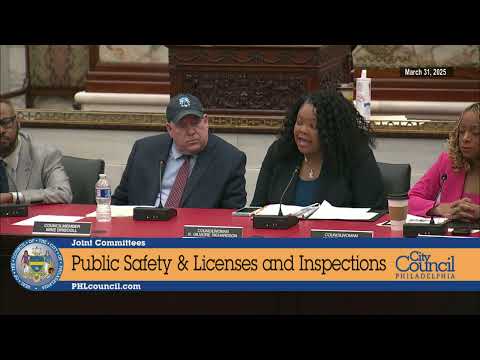
Philadelphia City Council’s committees on Licenses and Inspections and on Public Safety convened a joint public hearing on resolution number 250,052 to review enforcement against stores selling drug paraphernalia.
The hearing, sponsored by Council Majority Leader Catherine Gilmore Richardson, drew testimony from Licenses & Inspections (L&I), the Philadelphia Police Department nuisance unit, the Department of Public Health and community leaders who described stores selling paraphernalia, alleged illegal drug sales and impacts on neighborhoods and children. No formal votes were taken at the hearing.
City L&I officials described how enforcement is initiated and carried out. Commissioner Bridget Collins Greenwald said most complaints come through 311, which triggers an inspector visit to verify zoning and items on site. Renee Reinhardt, Director of Code Enforcement, said inspectors can issue partial cease-operations orders that prohibit sale of paraphernalia while allowing other lawful retail activity to continue, and that inspectors typically return within 30 days to confirm removal before lifting the cease order. Greenwald said the department has conducted “hundreds” of inspections since the drug-paraphernalia enforcement program began after bill 210,159 became law in 2021 and that the city has issued notices of violation and cease orders when warranted.
Police testimony described how the city treats locations tied to violence or repeated disturbances. Deputy Commissioner Frank Healy said the nuisance statute (discussed in the hearing as §9-4400) distinguishes “critical nuisances,” where a single violent incident can prompt an immediate nuisance investigation and a notice of intent to cease operations, from “chronic nuisances,” which generally require repeated violations (commonly three within a year) before elevated action. Healy described the neighborhood nuisance enforcement unit’s role in determining whether a location had a nexus to incidents and in coordinating actions with L&I and the law department.
Officials and council members discussed a recurring enforcement obstacle: businesses that change corporate ownership to evade past violations. L&I staff said they have identified roughly 30 repeat offenders whose locations reappeared under new business names; council members and police called this a “shell game” of LLCs. Multiple speakers urged exploring legal approaches to link liabilities across successive corporate entities and to treat the location’s record as part of the enforcement calculus.
The administration and council members also discussed limits to confiscation. L&I officials, citing guidance from the law department, said the city does not currently seize paraphernalia from brick-and-mortar stores in the same way it may seize counterfeit items from transient vendors; the distinction, as described at the hearing, rests on how possession versus sale is treated under existing ordinances. Council members and community witnesses said that difference undermines compliance because paraphernalia can be removed during inspections and placed back when inspectors leave.
Capacity and timing of inspections were another focus. Council members and community leaders described stores that open late and said some inspections must occur after business hours. L&I said it maintains a nuisance property unit that does weekend and night inspections and that the department has done outreach and education, including pamphlets in multiple languages. L&I reported conducting district tours with council members and other city agencies (12 tours since June was referenced) and said the tours produced dozens of cease operations (L&I estimated roughly 60–70 cease orders issued through enforcement and tours). Community leaders said results vary by neighborhood and called for sustained coordination across L&I, health and police.
Community testimony highlighted public-safety and public-health concerns. Testifiers from Queen Village, Society Hill and Winfield described stores that they said operated as thinly veiled illegal drug markets, sometimes using basement areas or curtained sections for sales, and reported sales to youth and laced products (testifiers recounted instances of THC gummies contaminated with benzodiazepines). Witnesses asked for clearer, faster enforcement and better public education so residents and business owners know what is allowed.
Council members and the lead sponsor said they plan to pursue additional legislation. Gilmore Richardson said she has at least one administrative-code bill drafted and intends to introduce a package of bills to address enforcement gaps, including potential changes to the nuisance/abatement framework and to reduce legal delay caused by appeals. Council members raised several legislative ideas on the record: strengthening location-based accountability, revising municipal code language that creates criminal-process complications in older provisions, and options to prevent rapid transfer of liabilities across newly formed corporate entities.
No formal actions or votes were recorded at the hearing; the committees took testimony and heard public comment. Council members and city officials directed follow-ups including sharing a city-maintained complaint drive with council offices, continuing district tours that include L&I, health and police, and exploring legal options with the law department to address repeat offenders and confiscation authority.