Get Full Government Meeting Transcripts, Videos, & Alerts Forever!
Get email alerts on the Water And Sewer Bond Extension topic
No spam. Unsubscribe anytime.
Senate committee approves bill to extend Arkansas water and sewer bond authority, raise total cap to $500 million
Summary
The Senate Agriculture, Forestry and Economic Development Committee voted to advance Senate Bill 421, which would continue the state's long-standing general obligation bond program that leverages federal funds for local water and sewer projects and would increase the program cap to $500 million while keeping a $60 million biennial issuance limit.
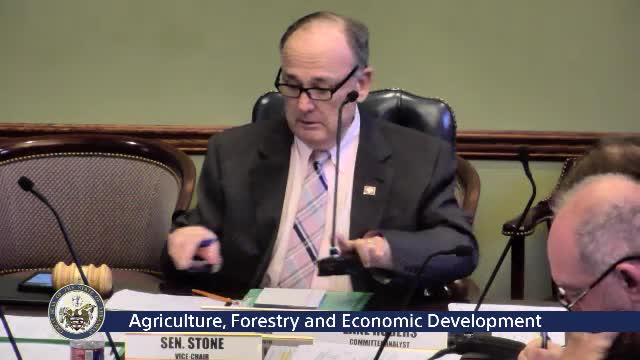
State Sen. Bart Hester asked the Senate Agriculture, Forestry and Economic Development Committee to advance Senate Bill 421, a measure to extend Arkansas’ general obligation bond authority for water and sewer projects and increase the program’s total ceiling to $500 million. The committee voted to pass the bill on a voice vote after lawmakers' questions and a brief public comment period.
The bill would continue a program Hester described as one “we've been doing for 40 years,” using general obligation bonds to leverage federal resources for local water and sewer projects. Hester said the measure is not a constitutional amendment and “it will be on the ballot, the whole, all the people of Arkansas have to vote on it,” noting the proposal would go to voters in November 2026 and — if approved — not take effect until July 1, 2027.
Why it matters: the program is the state's primary tool for financing local water and wastewater needs by combining state bond authority with federal resources. Committee discussion focused on the proposed increase from $300 million to $500 million in total bond authority, the program’s structure, and the fiscal implications for state general revenue.
Lawmakers and staff pressed on fiscal mechanics. Secretary Ward (referred to in the hearing as Secretary Ward) confirmed that recent bond funding has primarily been issued as low-interest loans, with some forgivable loans in special cases, and that “the funding has increased from 300,000,000 to 500,000,000, but it still has the maximum of 60,000,000 per biennium.” Hester told the committee the program’s annual debt service tied to existing bonds is about $14.8 million per year and said the bill “would just continue that” and “doesn't add any additional general revenue costs” beyond what is already being paid for existing debt service.
Several senators asked whether increasing the total authority could lead to higher general revenue exposure in future years. Senator Hickey said the larger cap “looks like to me ... there could be an increase in GR in the future,” and Hester and Secretary Ward replied that any increase in state general revenue obligations would depend on future legislative decisions, the biennial work plan, and review by the governor and the state’s chief fiscal officer. Hester also noted that the bill preserves legislative and executive oversight: after voter approval the projects would return to the legislature for review and approval of biennial work plans.
Senator Gilmore and others sought clarification about bond terms and whether the bill changed the authorities used in prior bond issues. Hester said the bill’s authorities are largely the same as prior legislation and that bond counsel helps ensure compliance with existing law. Hester said there remains roughly $72 million in bond authority under the current authorization that would bridge the period before a voter-approved extension would take effect.
Public comment came from Dennis Sternberg, CEO of the Arkansas Rural Water Association, who told the committee the program is essential. “We got about 680 some public water systems, 300 and some, wastewater systems. This money is essential,” Sternberg said, adding that prior bond issues have been “a tremendous help” and that the state will need more funding going forward.
Committee action: after discussion Hester asked for a vote; a motion was seconded by Senator Gilmore. The committee approved the bill by voice vote. The transcript records no roll-call tally; the committee chair declared, “Congratulations, bill passes.”
Next steps and timeline: if passed by the full legislature in its process, SB 421 (as presented to the committee) would go on the statewide ballot in November 2026. If voters approve it, the authorization would not become effective until July 1, 2027. Before any bonds are issued under the authorization, project lists and biennial work plans would return to the legislature and the governor for review and approval, and issuance would be subject to the $60 million-per-biennium limit contained in the bill.
Limitations: the committee discussion and the public remarks indicate that, over the past five years, most assistance under the program has been structured as loans rather than principal forgiveness. Hester and Secretary Ward said principal-forgiveness amounts have not been widely used during that period; whether future issuances include forgivable loan components would affect general revenue exposure and would be determined through later budget and legislative action.
The committee advanced SB 421 to the next legislative step after the hearing.