Get Full Government Meeting Transcripts, Videos, & Alerts Forever!
Get email alerts on the Lake Access Appeal topic
No spam. Unsubscribe anytime.
Lake Oswego council votes down motion authorizing appeal of Oswego Lake access ruling
Summary
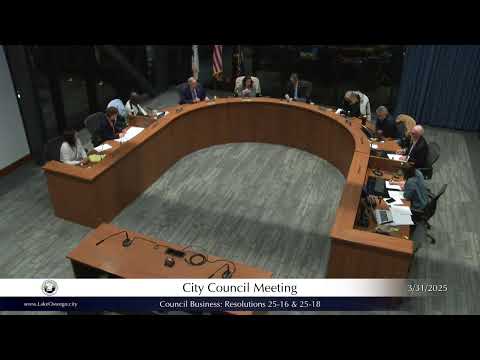
On March 31, 2025 the Lake Oswego City Council voted 5-2 against a motion to authorize the city attorney to appeal a Clackamas County judgment that ruled lake water public and ordered public access at Millennium Plaza.
The Lake Oswego City Council on Monday declined to authorize the city attorney to appeal a Clackamas County judgment that found the water of Oswego Lake is public and ordered public access at Millennium Plaza, voting 5-2 against Resolution 25-16.
The motion to adopt Resolution 25-16 — which would have authorized the city attorney to file an appeal in Kramer v. City of Lake Oswego — was moved by Councilor Raff and seconded by Councilor Wendland. After a lengthy public-comment period and almost three hours of deliberation, the roll call vote was Mayor Buck: no; Councilor Afgan: no; Councilor Boot: no; Councilor Wendland: yes; Councilor Verdict: no; Councilor Corrigan: no; Councilor Raff: yes. The motion failed 2-5.
Why it matters: The trial court judgment, issued by Judge Steele, concluded that the lake's water is public. Council debate centered on whether an appeal could secure a stay of the order long enough for the city and stakeholders to draft time, place and manner rules intended to protect safety, water quality and private property interests. The city attorney advised the council that, in her opinion, the odds of obtaining a stay on the access determination from the Oregon Court of Appeals were low.
Public comment at the special meeting was extensive and sharply divided. Speakers representing community groups, homeowners with easement rights and the Lake Oswego Corporation urged the council to authorize an appeal. Jeff Edelson, an attorney and Lake Oswego Corporation board member, argued an appeal was necessary to preserve local decision-making and to avoid ‘‘immediate public access . . . without giving the city, the Oregon Marine Board adequate time to promulgate necessary safety rules.’’ Several residents and advocacy groups urged the council not to appeal and to implement safer, more inclusive access at Millennium Plaza. Patrick Gutierrez, who identified himself as a resident and co-chair of the parks board (speaking as a private citizen), said, “I urge you not to appeal the court order,” and urged the council to follow the parks board recommendation.
Council discussion reflected competing concerns. Supporters of an appeal said the city needs time to convene stakeholders, sort jurisdictional responsibilities and adopt rules before an influx of users could affect safety, water quality and property values. Opponents said further litigation would consume limited public funds, was unlikely to succeed and would delay implementing safety and access rules. The city attorney told council that the city had received legal analysis indicating an appeal would be challenging and that a stay was unlikely because overturning the trial court’s factual findings presents a high bar on appeal.
Key figures and numbers discussed in the meeting included commenters’ descriptions of Lake Oswego Corporation operating costs (roughly $2.5 million annually, including about $1 million for safety and water-quality work), Lake Corporation dredging and drawdown expenses approaching $1 million, and a reported estimate that an appeal could cost in the low hundreds of thousands of dollars (outside counsel estimated roughly $100,000, with a conservative range noted up to $250,000). Council members also referenced a city estimate that frontage-related payments to the lake corporation have been modest compared with lake maintenance costs.
Next steps after the failed motion: Because the council declined to authorize an appeal, the city did not direct the city attorney to file on the city’s behalf. The Lake Oswego Corporation has separately indicated it would pursue its own appellate remedies. The council moved later in the meeting to adopt a separate resolution directing the city manager to coordinate safety and access rules (Resolution 25-18), which passed unanimously.
Votes at a glance: Resolution 25-16 — Motion to authorize the city attorney to file an appeal in Kramer v. City of Lake Oswego; mover: Councilor Raff; second: Councilor Wendland; vote: yes — Councilor Wendland, Councilor Raff; no — Mayor Buck, Councilor Afgan, Councilor Boot, Councilor Verdict, Councilor Corrigan; outcome: failed (2-5).
Community reaction at the meeting and in written comments ranged from calls to preserve private easement rights and the lake’s current stewardship model to requests for the city to embrace broader public access with safety and environmental safeguards. The council’s vote kept the city from joining a pending appeal by other defendants and left the process of implementing access rules to the subsequent unanimous passage of Resolution 25-18.