Get Full Government Meeting Transcripts, Videos, & Alerts Forever!
Get email alerts on the Local Government Finance topic
No spam. Unsubscribe anytime.
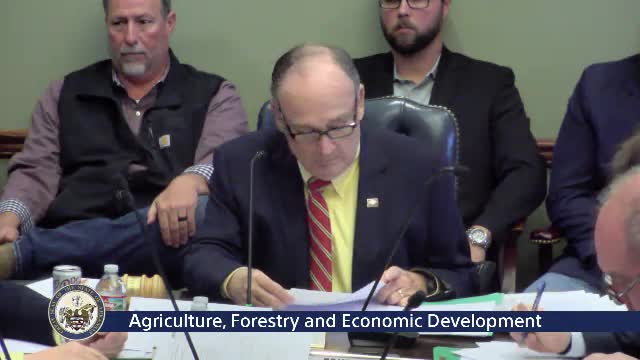
Committee debates accountability and continuing‑education changes in county fair funding bill
Summary
Senate Bill 400 would require county fair organizations that receive public funds or use county facilities to submit a financial statement, plan and certificate of good standing; the measure prompted extended testimony and opposition focused on removal of a continuing‑education requirement for fair managers.
Senate Bill 400, presented to the Senate Agriculture, Forestry & Economic Development Committee by Sen. Missy Irvin, would add a short set of accountability and transparency requirements for entities receiving state funds for county and district fairs. Irvin described the bill as a relatively small set of requirements — a financial statement, an annual plan and a certificate of good standing — intended to ensure tax dollars are tied to nonprofit organizations and to create a local review step when county facilities or county funds are used.
Under the bill, a county extension agent would serve ex officio on county fair boards, exhibitors could choose one district fair to participate in, and fairs that use county facilities or county funds for livestock shows would submit documentation to the quorum court for review before filing with the Department of Agriculture. The sponsor said the intent is simple local accountability, not to create an administrative grant application process.
Testimony drew sustained opposition from representatives of the Arkansas Fair Managers Association and several county fair boards, who focused on the bill’s removal of a continuing-education requirement that had been used as an eligibility condition for some fair funding. Andrea Vogue, on the Arkansas Fair Managers Association Board of Directors and Sharp County Fair, said continuing education has helped small, rural fairs recover and expand exhibitor participation; she urged the committee not to accept the bill if it eliminates education requirements. Karen Vaughn of Pike County described seminars and conferences that yield practical training and scholarships for young people involved in agriculture.
White County Fair Board president Clayton Edwards told the committee his board is a self-funded 501(c)(3) that receives minimal county support in kind and expressed concern that requiring quorum-court approval before the Department of Agriculture review could obstruct access to legislative audit and complicate operations for fairs that do not routinely receive county funds.
Irvin responded to concerns by offering to remove the word "approve" so the quorum court would review rather than approve plans; she said she would accept a written amendment that also addresses continuing-education language. Committee members and witnesses discussed how legislative audit would obtain access to records if local review were required. Irvin repeatedly emphasized the bill’s aim: taxpayer dollars should support education for exhibitors, especially youth, and local extension agents and the Department of Agriculture would continue to provide expertise.
Committee discussion lasted through public testimony. Multiple fair managers asked the lawmakers to retain continuing-education requirements or to ensure funding could not be used to pay for ineligible activities. Senate committee members asked clarifying questions about who pays for continuing-education attendance and whether dues and registration might be restructured.
At the close of testimony, Sen. Irvin said she might offer or accept an amendment to change the quorum-court language from “approve” to “review” and acknowledged concerns about continuing-education removal. The transcript records that the sponsor said she would evaluate committee sentiment on the continuing-education provision and later indicated she would pull the bill down rather than move forward with a change she did not support. The committee did not take a final passage vote during the hearing; the bill is being held for further work.