Get Full Government Meeting Transcripts, Videos, & Alerts Forever!
Get email alerts on the Staffing Plan topic
No spam. Unsubscribe anytime.
Kirkwood presents 300‑page comprehensive staffing plan, including position management rollout and hiring SOPs
Summary
District HR presented a comprehensive staffing plan that includes nine components: staffing standards, job‑description update process, staffing ratios, a position management system using PowerSchool, hiring standard operating procedures and budget implications. The plan is informational and was not voted on March 31.
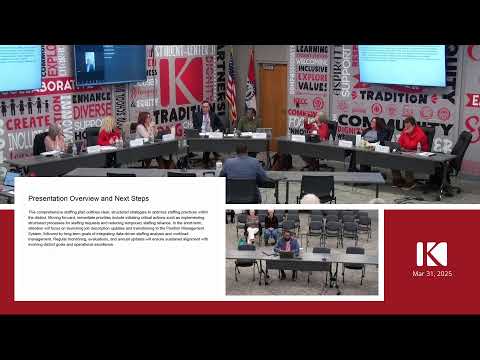
Dr. Fields and district staff presented a comprehensive staffing plan to the Kirkwood School District Board of Education at the March 31 meeting, describing a nine‑component framework for staffing standards, job descriptions, position management, hiring procedures and monitoring.
The presentation — supported by a roughly 300‑page document available on BoardDocs — described components including staffing standards, a process for updating and approving job descriptions, staffing levels and ratios, staffing recommendations, a position management system, budgetary implications, updated hiring standard operating procedures, an implementation timeline and monitoring procedures. Dr. Fields said the document includes updated data, explains the difference between positions and full‑time equivalents, and recommends an annual review cycle as well as a five‑to‑seven‑year comprehensive update.
A notable operational recommendation is activation of PowerSchool's ERP position control module as the district's position management system. District staff said the module will integrate human resources, payroll and finance to give real‑time tracking of authorized and occupied positions, FTE calculations, integration with fund accounting and historical record maintenance. "It integrates with our human resources, our finance, and our payroll functions," Dr. Fields said, adding the district has an existing but dormant PowerSchool setup that would be configured and licensed for active use.
The staffing recommendations include a temporary pause on additional staffing with three criteria for exceptions: an identified critical instructional or operational need, alignment with state mandates/DESE compliance or district strategic priorities, or enrollment/course demand requiring immediate adjustment. Several board members pushed back on the phrasing of a blanket "pause," asking that the language make clear that decisions would continue to follow established review criteria and that the board would be informed of any staffing requests during the budget process.
Board members and staff discussed use of data to inform workload and staffing decisions, reductions in temporary staffing through better tracking, and the goal of linking quarterly administrator feedback and workload measures to the position management system for planning and budgeting. Dr. Fields described next steps including finalizing licensing, system configuration, staff training and phased implementation; he said HR, finance and payroll would complete setup and provide implementation timelines.
The board did not vote on the plan at this meeting; members asked for clarifications and for the plan's implementation steps to be integrated with the district's strategic planning and 2025–26 budget process. Administrators committed to returning with details on how proposed changes will be surfaced to the board during budget development and how temporary staffing reductions will be tracked and reported.
The presentation included cited benchmarks and third‑party work on job descriptions; administrators noted that updating job descriptions does not automatically change compensation and that substantial revisions would trigger HR, superintendent and board review.