Get Full Government Meeting Transcripts, Videos, & Alerts Forever!
Get email alerts on the Attendance Policy topic
No spam. Unsubscribe anytime.
Santa Fe ISD staff propose tighter attendance coding, say thousands of period absences are costing district funding
Summary
An information item by attendance administrators proposed changing how the district codes absences — marking only state-specified reasons as 'excused' — and highlighted large period-level absence counts and related funding losses tied to current practices.
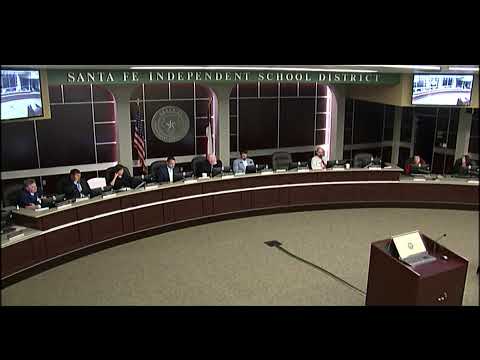
At the March 30 Santa Fe Independent School District meeting, staff delivered an attendance and accounting update and recommended narrowing the district's use of the label “excused” so it aligns more closely with state rules, citing confusion among parents and a material funding impact.
“There's a great deal of misunderstanding and miscommunication when it comes to the definition versus the meaning of an excused absence,” Miss Rachel Harris, who led the presentation, told trustees. Harris said state law and district policy already list many categories that the state considers excused — including observance of religious holidays, court appearances, Department of Family and Protective Services-required absences, the U.S. naturalization oath, some higher-education visits (with limits), armed-service enlistment, early voting clerk duties and learner's permit or driver's license activities — but that local practice has expanded the use of the “excused” label beyond those categories.
Harris presented absence counts and funding consequences that she said motivated the recommendation. She said Santa Fe High School recorded 47,831 total absences in the referenced year and that 25,545 of those were excused by parent notes; she said the number of unexcused absences at the high school was more than 100,115. Harris and trustees clarified that high-school absence counts are taken by class period (the high school uses multiple class periods per day), and she noted the period-based counts inflate the raw totals compared with one-count-per-day elementary attendance. She also told trustees the district has roughly 4,300 students and that the recorded absences average out to about 28 absences per student when calculated as presented — a figure she said shows the problem is widespread rather than isolated to a very small group of students.
Harris proposed that the district: (1) align the label “excused” strictly with the categories spelled out in state law and district policy, and (2) otherwise mark non‑qualifying absences simply as “absence” in Skyward and other records so families better understand the district's 90-percent attendance expectation. Harris noted state rules require students attend at least 90 percent of class time to receive credit — which she summarized as a student missing about eight to nine days per semester, or roughly 16 to 17 days per school year. “Our goal next year is to really preach that an absence equals an absence,” Harris said.
Trustees and staff asked clarifying questions. Board members asked whether excused versus unexcused status affects students' ability to make up work; Harris said teachers generally allow make-up work regardless of coding but committed to double-check district policy. Trustees also asked how funding is affected; Harris explained the district receives state funding only for the day a student was present in seat or partially present (for example, a student who attends part of a day and then leaves with a doctor's note may produce funding for that day but not for subsequent days the student misses without other qualifying documentation). Harris said long-term medical situations can be handled through homebound processes with physician certification and Attendance Committee review.
Board members who spoke in the discussion praised the attendance team and emphasized learning-loss concerns tied to chronic absences. Trustees voiced support for clearer communication to parents and for implementing the committee-driven approach Harris described; no formal action was taken at the meeting because the item was informational.
Harris and other district administrators said staff will work with principals and the attendance committee over the coming months to finalize how parent notes and doctor notes will be recorded in Skyward and how the district will communicate the change to families and staff ahead of the next school year.