Get Full Government Meeting Transcripts, Videos, & Alerts Forever!
Get email alerts on the Wildfire Preparedness topic
No spam. Unsubscribe anytime.
Solvang forum urges Santa Ynez Valley community wildfire protection plan
Summary
Local officials, the Fire Safe Council and county fire leaders urged neighborhoods to form Firewise/Fireways groups and sign up for a community wildfire protection plan (CWPP) to coordinate fuels work, unlock grant funding and improve evacuation planning.
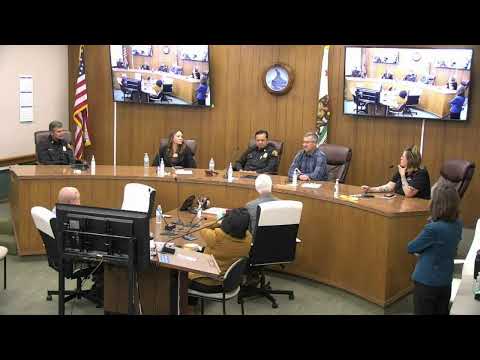
City Councilmember Liz Arona and Santa Barbara County Supervisor Joan Hartman on Tuesday convened a wildfire-preparedness forum in Solvang that drew municipal leaders, county fire officials and representatives of the Fire Safe Council to press for neighborhood-level action and a valleywide community wildfire protection plan.
Organizers told roughly two hours of participants that the valley’s patchwork of private property, agricultural land and public open space requires coordinated planning to reduce fuels, harden homes and improve evacuation routes. “Resilience is built on relationships,” Supervisor Joan Hartman said, urging neighborhoods to organize and volunteer for Fireways/Firewise activities.
A community wildfire protection plan is a locally developed blueprint that evaluates fire hazard and risk on a community scale, prioritizes hazardous-fuel treatments, and recommends measures such as structure hardening and improved access, consultant Rob Hazard said. Hazard, who has worked on several county CWPPs, said the plans do not themselves authorize projects or substitute for environmental review; they are intended as frameworks that make communities more competitive for grant funding.
County Fire Marshal Fred Tan described the state’s new fire hazard severity zone maps and how they relate to local CWPPs. He said the maps function “kind of like a flood map for fire,” because the state’s modeling uses vegetation, topography and historic fire behavior to estimate hazard across broad areas. The county, he said, is reviewing the state maps and will provide local context before releasing jurisdiction-specific versions under the state’s 30‑day review period.
Speakers from the Fire Safe Council and its Fireways USA outreach outlined steps for neighborhoods to qualify for Firewise-style recognition: form a local committee, complete a three‑year action plan, hold at least one education event per year, report volunteer hours (one minimum volunteer hour per household is requested), and submit periodic risk assessments every five years. Anne Marie Parkinson, executive director of the Fire Safe Council, said the council now helps with free defensible-space assistance for low‑income residents, free chipping, grazing programs and community buffer plantings designed to use fire‑resistant or hydrated species.
County officials and the Fire Safe Council also described larger vegetation-management efforts, including recent prescribed burns such as the Spalding/Midland project (about 1,600 acres) and planned projects such as the Sedgwick burn (roughly 1,500 acres, funding dependent). Fred Tan said those treatments create multiyear buffers that can reduce the size and spread of fires near communities.
Panelists stressed action at multiple scales: homeowner parcel work (home hardening and defensible space), neighborhood Firewise organization and valleywide CWPP coordination to align projects across jurisdictions and landowners. Rob Hazard noted that a CWPP requires local government approval — for example, signatures from city councils and the county board of supervisors and review by state fire agencies — and that having a CWPP makes applications for state and federal mitigation grants more competitive.
Supervisor Hartman closed by saying she will collect names of residents interested in supporting a valleywide CWPP and urged attendees to form or strengthen Firewise groups in their neighborhoods. Anne Marie Parkinson and the Fire Safe Council offered to assist communities with application and planning work.
For contact and next steps, organizers said Fire Safe Council staff were available after the meeting and sign-up sheets were being collected.