Get Full Government Meeting Transcripts, Videos, & Alerts Forever!
Get email alerts on the Parking topic
No spam. Unsubscribe anytime.
McKinney council gives consensus to restrict on-street parking in downtown core to improve circulation
Summary
City staff proposed removing unmarked parking on narrow downtown streets, citing circulation, safety, and emergency-access concerns; council members signaled unanimous informal support and directed staff to implement a staged plan including striping, signage and a pilot parking-occupancy system.
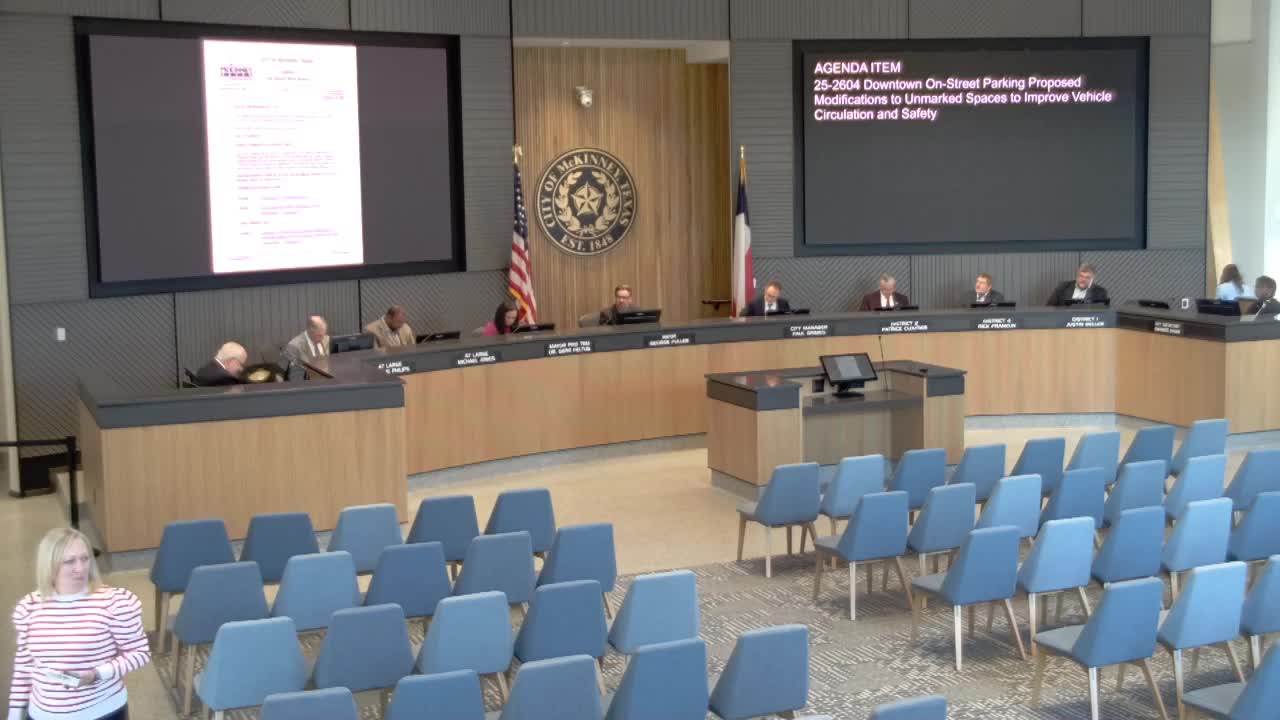
In a March 2025 work session, city staff presented proposed changes to on-street parking in McKinney's downtown core and the City Council voiced consensus to proceed with a staged plan to improve vehicle circulation, sight lines and pedestrian safety.
City staff member Gary, presenting engineering recommendations, said the proposal targets narrow, unmarked streets around the square — including Lamar, Davis, Church, Chestnut and Hunt — and would remove parking where the roadway is less than 30 feet wide unless bump-outs or marked spaces exist. Gary said staff found a total of 33 unmarked spaces currently used on the streets affected and that many of the downtown streets are 24 feet or narrower.
"We want to enhance circulation in and around the square," Gary said. "We're gonna put double yellow stripes down first...If we have a problem, we'll supplement with no parking signs, but we'll try this first." He also described coordination with the fire department, Main Street and planning staff and noted upcoming infrastructure changes — including Highway 5 reconstruction, planned Lamar Street improvements and the Lower 5 Plaza project — that will affect traffic patterns.
Why it matters: Staff said parked cars on narrow streets create pinch points that impede two-way traffic, reduce sight distance at driveways and slow emergency-vehicle access. The council and staff said reducing the number of vehicles circulating the square should improve visitor experience and pedestrian safety, and reduce driver frustration that leads to informal parking in residential side streets.
Council members raised concerns about impacts on nearby residents. Councilman Miller asked whether the earlier change on Church Street applied north and south of Virginia; Gary confirmed the December change removed parking on the west side of Church between Virginia and Hunt. "That was the change that we made in December," Gary said. Council members noted townhome residents near Lamar may shift parking to other nearby lots; Gary said some residents already use the city lot behind the fire station but acknowledged the change "is going to put an impact on them."
Members discussed event-day dynamics and temporary controls. One councilmember suggested temporary one-sided street closures or signage on event days (for example, Home for the Holidays or Oktoberfest) to manage overflow; Gary said staff and Main Street already use temporary no-parking signs during events and can coordinate extended limits where needed.
Staff described additional measures to reduce parking-search "angst": enhanced wayfinding signs to direct drivers to garages and lots, and a planned pilot with a private vendor to monitor space occupancy using sensors so the city can show real-time availability via an app or the city website. "They have an app that we can now distribute out to people," Gary said, describing a green/yellow/red occupancy display tied to live sensor data.
The proposal emphasizes a staged approach: initial double-yellow striping on circulation roads, followed by targeted no-parking signage where issues persist, and further changes coordinated with fire and Main Street. Gary said staff tested field observations, collected 24-hour weekday and weekend traffic counts and logged existing parking restrictions to support the recommendations.
At the end of the discussion, Mayor George Fuller asked for consensus. "Do we have consensus?" he asked. Council members responded in the affirmative and staff said they would move forward with the proposed plan and further coordination.
Next steps: Staff will proceed with the staged implementation (striping, signage and pilot parking monitoring), coordinate with the fire department and Main Street, and adjust plans as needed to account for Highway 5 reconstruction and Lamar improvements.