Get Full Government Meeting Transcripts, Videos, & Alerts Forever!
Get email alerts on the Zoning topic
No spam. Unsubscribe anytime.
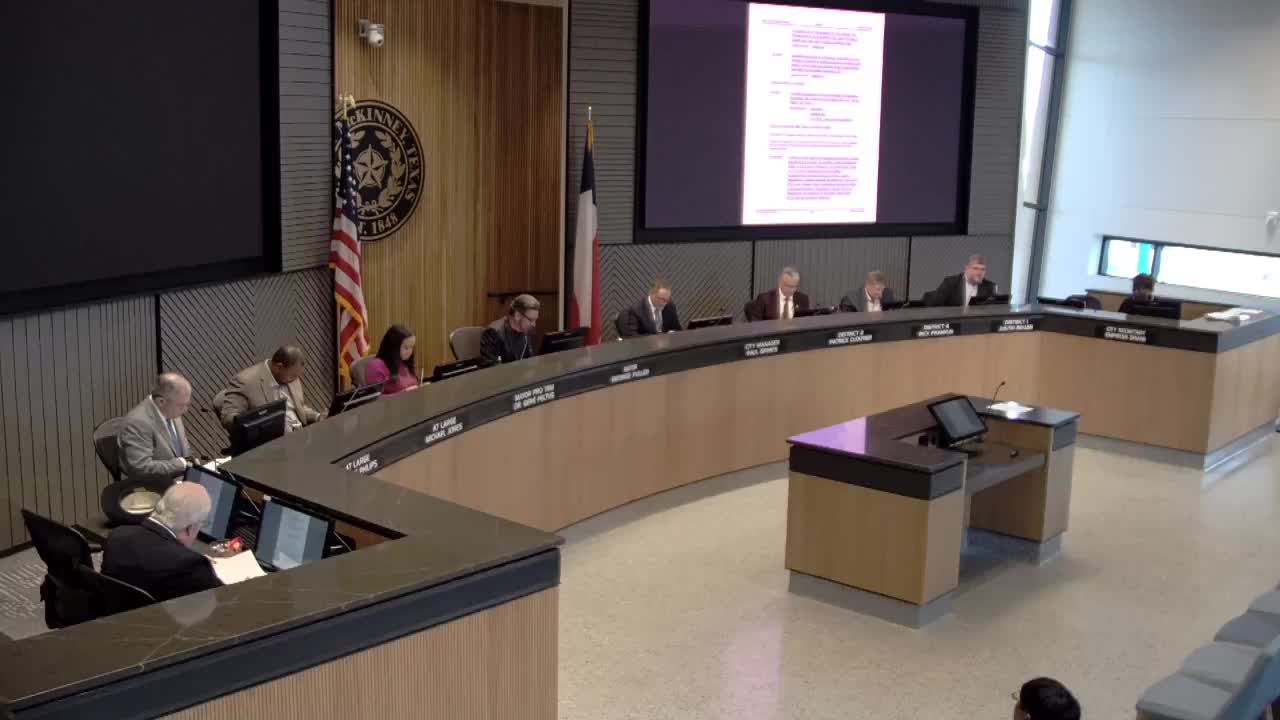
McKinney council approves McKinney Town Center zoning updates, creates "craft consumables" land use
Summary
The McKinney City Council on March 31 approved changes to the city's Unified Development Code for the McKinney Town Center, consolidating small-scale beverage and food production into a new "craft consumables" category, adding community gardens, warming stations and EV charging, and setting standards for commercial amusement and indoor entertainment.
The McKinney City Council on March 31 approved changes to Chapter 150 of the city's Unified Development Code that amend the McKinney Town Center (MTC) zoning district, city planning staff said.
Kate Strickland, planning manager for the city of McKinney, said the package is intended to "make it easier to use" the code and to harmonize outdated MTC language with the 2022 UDC update. "MTC is our McKinney Town Center District. That is our beautiful downtown," Strickland said, summarizing the district and the goals of the amendments.
The adopted changes consolidate multiple small-scale production uses (previously listed as separate brewery, microbrewery, winery, distillery and cidery uses) under a single new use called craft consumables. The code also adds community gardens, warming stations and electric-vehicle charging stations as permitted uses in the MTC. The ordinance creates new standards for commercial amusement and indoor/outdoor entertainment, and specifies separation and permitting criteria for certain entertainment uses.
Under the new language, indoor commercial entertainment would generally be permitted only where it is at least 300 feet from residential uses in the MTC, though the code includes a special-use-permit path so the council may permit exceptions when appropriate, Strickland said. She told council that the 300-foot figure "is in line with a lot of the items that are within our UDC" and that staff had increased the standard somewhat because of the close mix of residential and commercial in the MTC.
Strickland said the draft includes both non-substantive "fine-tuning" edits (typo fixes and clarifications) and substantive modifications that change permitted uses and standards. She gave the example that several winery/brewery/distillery categories were consolidated to allow small-scale, on-site production with retail and restaurant components under one craft consumables use; buildings less than 2,000 square feet will generally be covered by the existing criteria unless a restaurant component expands the footprint.
In response to a council question about creating new nonconforming uses, staff said they had specifically avoided amendments that would convert existing lawful uses into nonconforming uses because state law would require additional notice and processes. "We were very, very strict in making sure that any changes under this kind of noticing were not gonna be changed that way," a staff member said.
No members of the public spoke during the public hearing on this item. A council member moved to close the public hearing and approve the ordinance; the motion carried.
The updates become part of the city's Unified Development Code and will govern development in downtown McKinney and adjacent historic properties, including the Cotton Mill area.
The city's planning staff said the amendments were drafted beginning in December, were discussed at Planning and Zoning, and returned to council with staff recommendations and no changes since the last discussion.