Get Full Government Meeting Transcripts, Videos, & Alerts Forever!
Get email alerts on the Sustainability Climate Commission topic
No spam. Unsubscribe anytime.
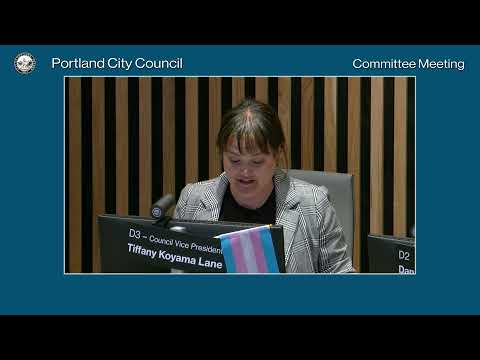
Committee reviews ordinance to codify Sustainability and Climate Commission; deliberations continued
Summary
The governance committee heard a presentation on an ordinance to add a Sustainability and Climate Commission to city code (chapter 3.136), discussed membership, staffing and scope, and agreed to carry the item to a subsequent meeting for amendments and final consideration.
The Governance Committee heard a detailed presentation on an ordinance to add a Sustainability and Climate Commission to Portland city code and to remove references to that commission from the Bureau of Planning and Sustainability’s code. Committee members asked questions about membership, powers and duties, staffing and budget; after extended discussion the committee carried the item over for additional amendments and to preserve the commission’s planned appointment timeline.
Vivian Satterfield, chief sustainability officer, and Elaine Viska Livingstone, the sustainability and climate commission coordinator, presented the ordinance text and the two exhibits: Exhibit A would add chapter 3.136 to city code to establish the Sustainability and Climate Commission’s purpose, membership, powers and duties, and staffing; Exhibit B would remove the commission language from BPS code chapter 3.33.
Satterfield described the commission as “the highest level advisory body” on climate matters and said it would advise the mayor, council and the city administrator and help create and evaluate the city’s next climate action plan. She told the committee the commission’s code would set a maximum membership of 20, including at least four youth seats (ages 16–24), and require members to have climate expertise or lived experience and acceptance of human-made climate science.
Viska Livingstone summarized the engagement and recruitment process behind the commission’s design: an open application period from November 2024 through January 2025 produced 245 applications; staff panels and interviews followed and Satterfield said she had submitted recommendations to the mayor in March.
Public testimony included remarks from Terry Harris — who said he supports the proposal and offered drafting suggestions, including specifying membership counts, staggering terms, avoiding overly prescriptive staffing language in code and giving the commission latitude beyond enumerated duties.
Committee members pressed presenters on several points. Councilor Clark asked for clearer language to require an outcomes focus in the commission’s purpose and suggested district-based distribution among members to ensure geographic representation. Councilor Dunphy asked whether labor should have a designated seat; Satterfield said city staff will have nonvoting, ex officio seats to support the commission. Councilor Pertel Guinee and others asked about budget implications; Satterfield said first-year staffing was supplemented by grant funding from a Memorial Trust and that long-term budget needs will be addressed in future budget cycles.
After more than an hour of questions and public comment, Chair Grama Lane closed discussion and the committee agreed to carryover deliberations: Satterfield said returning the item to committee the next week would not impede the mayor’s planned appointment timeline.
The committee did not adopt the ordinance at this meeting; members signaled areas for potential amendments (membership counts and distribution, staffing language, clarifying powers and an outcomes requirement) and asked for budget and PROSPER analysis to be completed prior to a final vote.