Get Full Government Meeting Transcripts, Videos, & Alerts Forever!
Get email alerts on the Early Childhood Support topic
No spam. Unsubscribe anytime.
Hearing held on bill to fund temporary at-home infant care for qualifying Montana families
Summary
Representative Vail Durham presented House Bill 835 to create an at-home infant-care subsidy for qualifying parents, proposing roughly $2 million to serve about 200 families and a maximum of 36 months of support per family.
Representative Vail Durham opened the hearing on House Bill 835, a proposal to provide a temporary at-home infant care subsidy for qualifying Montana families. The sponsor said the proposal was intended to expand parental choice and support early childhood development by enabling primary caregivers to remain at home during infants’ critical early months.
Durham described the program as targeted to about 200 families, with an appropriation of $2,000,000 that the sponsor said would translate to an estimated $800 per month per family under current assumptions. The bill’s text as discussed at the hearing included eligibility tied to work history (for example, full-time employment in the three months prior to the child’s birth) and a program maximum of 36 months of at-home infant-care support per family.
Pediatricians and early-childhood advocates highlighted developmental research on 0–3 brain development and described targeted financial support to families as a health intervention that can reduce childhood toxic stress. Witnesses described the program as another “tool in the toolbox” for family supports; proponents also recalled a prior pilot and urged the committee to consider implementation pathways and rulemaking timelines.
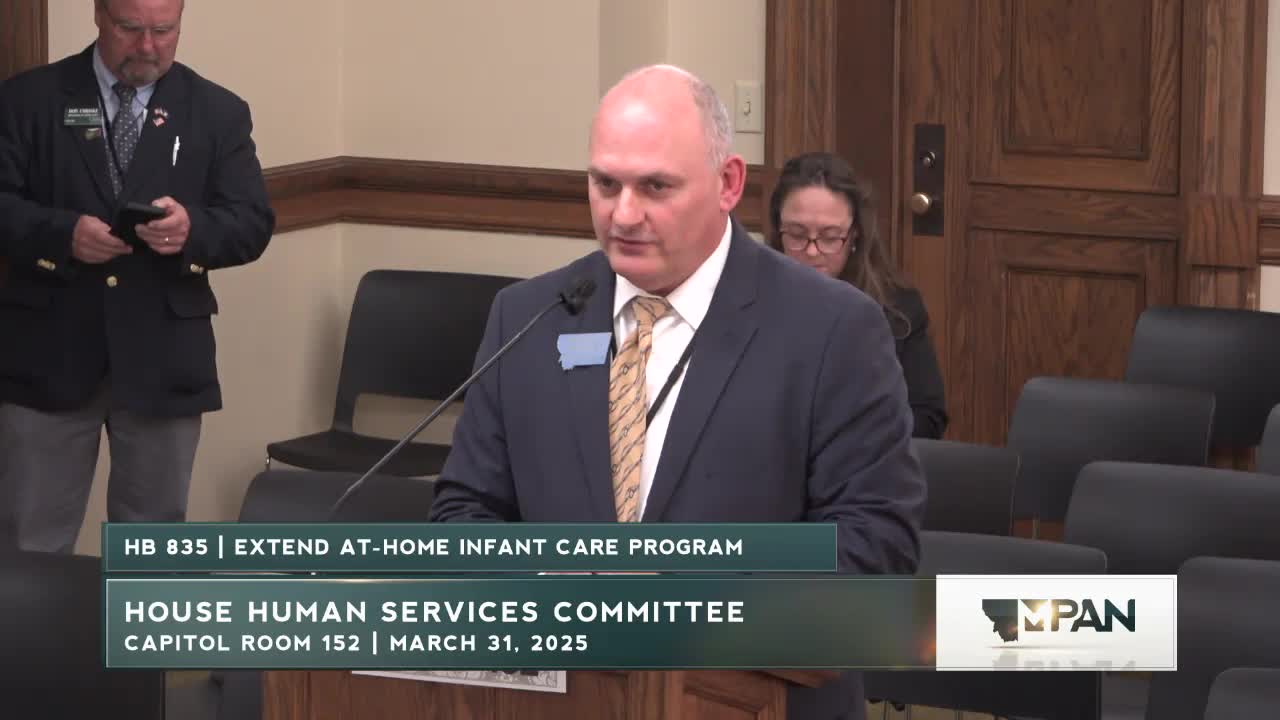
Tracy Moseman, administrator for the Early Childhood and Family Support Division at DPHHS, testified that the department could administer the program but would need rulemaking time; she said getting rules in place by July 1 would be a “big lift” and suggested an October 1 implementation target would be more realistic. Committee members asked about eligibility details and whether DPHHS could meet an early start date; the department requested further consultation on rule timing and administrative capacity.
The hearing closed without a committee vote recorded.