Get Full Government Meeting Transcripts, Videos, & Alerts Forever!
Get email alerts on the Forensic Mental Health Facility topic
No spam. Unsubscribe anytime.
Bill would direct planning and funds for a new forensic mental-health facility to relieve jail backlog
Summary
House Bill 912 would authorize planning and initial funding for a new forensic mental-health facility of at least 70 beds to reduce forensic-bed waits and county jail backlogs.
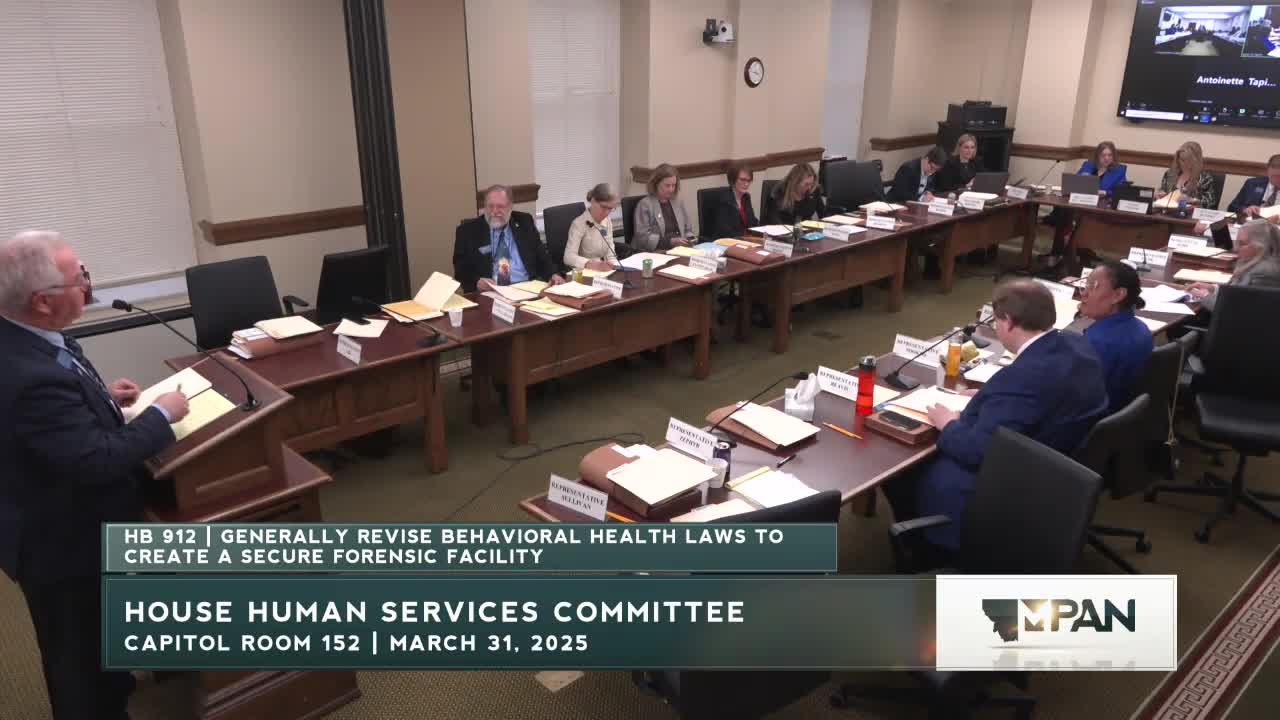
Representative Kelly opened the hearing on House Bill 912, a proposal to direct the construction of a new forensic mental-health facility (minimum 70 beds) intended to reduce waits for fitness evaluations and restoration of competency currently handled at the Galen/Warm Springs forensic unit and Montana State Hospital.
Missoula County Attorney Matt Jennings, testifying for the Montana County Attorneys Association, urged the Legislature to act and described a long-term trend he linked to reduced inpatient bed capacity: more people with serious mental illness end up in local jails. He said some defendants wait months or more than a year for a forensic bed and that delays have led to dismissed cases for speedy-trial reasons. Jail commanders and sheriffs from several counties described operational strain: inmates waiting for forensic beds occupy jail capacity, sometimes requiring long transports to access evaluation beds many hours away.
Witnesses from rural counties and law enforcement said the lack of regional forensic capacity forces long trips — in some cases 300–500 miles one way — and that transports and delays degrade patient condition and consume local law-enforcement time. Jail staff described detainees who have deteriorated while held in county facilities and the limits local jails face in providing psychotropic medication and sustained mental-health treatment.
Supporters framed the proposed $60 million appropriation as a means to break that bottleneck and urged building additional beds on the eastern side of the state so counties outside western Montana would face shorter transports. The Department of Administration’s architecture and engineering representative said the agency had not been involved in developing the $60 million estimate and would supply more specific fiscal information in the fiscal note.
Informational testimony noted different patient types and turnover rates: court-ordered 60-day evaluations, restoration patients who may require weeks to months, and long-stay GBMI (guilty but mentally ill) patients who occupy beds for many months. Committee members asked about bed allocation and operational costs; witnesses said allocation policy and bed-use rules would determine how much backlog the new facility could eliminate.
The hearing closed with no committee vote recorded.