Get Full Government Meeting Transcripts, Videos, & Alerts Forever!
Get email alerts on the Regulation topic
No spam. Unsubscribe anytime.
Senate concurs in bill creating contingent litigation fund for occupational licensing boards amid debate over fairness
Summary
House Bill 227 would establish a contingent litigation fund, financed by licensees, for occupational licensing boards; supporters said it stabilizes license fees, opponents argued it forces licensees to bankroll litigation and may raise constitutional concerns.
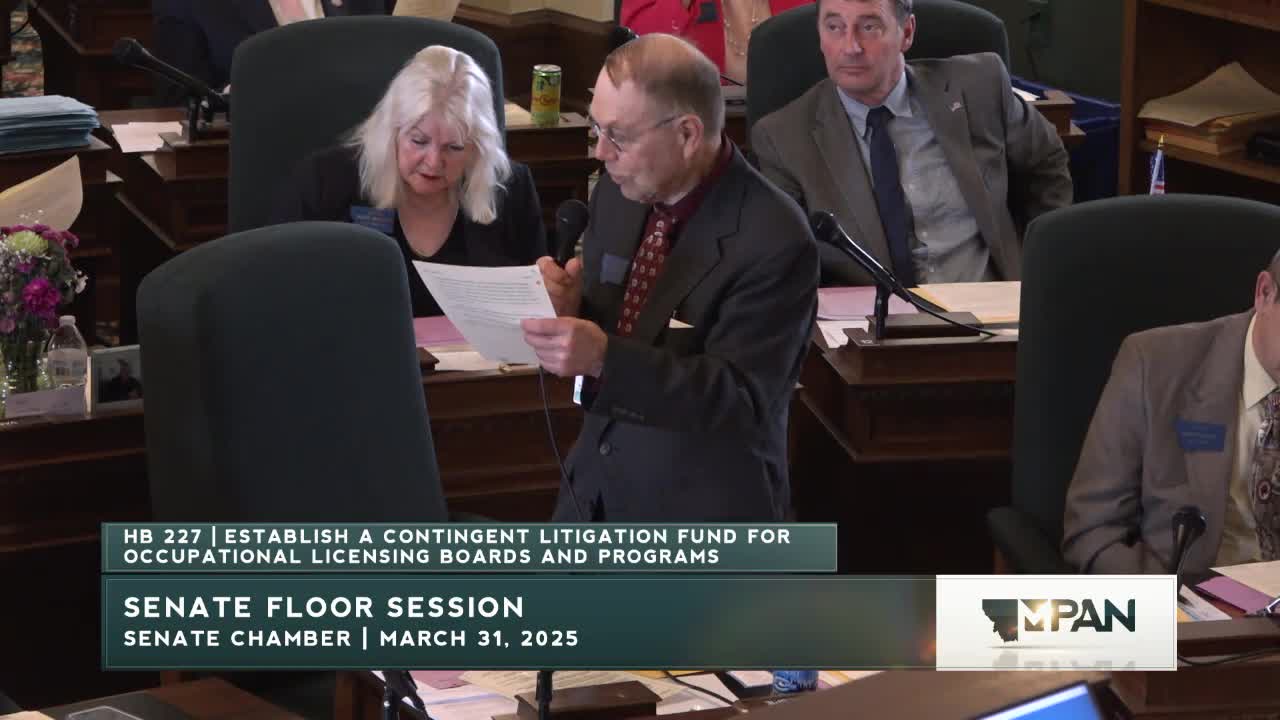
House Bill 227, which creates a contingent litigation fund for certain occupational licensing boards and programs, was concurred in by the Montana Senate on March 31 after floor debate about its structure and fairness.
Senator Gillespie, carrying the measure, described it as a modest, pre‑funded insurance mechanism: the bill authorizes a contingency fund to be used for litigation costs above a threshold (for example, litigation that exceeds $15,000) and allows boards to assess up to $25 per license per year to maintain the fund. Gillespie said the fees are intended to be a low-cost way to prevent sudden spikes in license fees when a board must incur high litigation costs.
Opponents questioned whether it is appropriate to require licensees to fund potential litigation that may be used to discipline licensees, raising concerns about forcing subjects of potential enforcement to pay to support that enforcement. Senator Glenn characterized it as effectively creating money to be used by boards to defend or pursue litigation against licensees and urged caution. Senator Emmerich and others expressed constitutional and fairness worries about requiring licensees to underwrite litigation that may be adverse to them.
Proponents responded that boards already face litigation costs that ultimately get passed through to licensees; the fund is intended to stabilize fees and reduce sudden increases. Senator Lance argued the fund helps smooth supplemental fee volatility and noted some associations representing license holders supported the approach. The floor vote was recorded at 35 senators voting aye and 15 voting nay; the Senate concurred in the bill.
If enacted, the bill establishes a mechanism for boards to contribute to and draw from the fund, sets rulemaking authority and statutory appropriation language, and specifies termination and implementation timelines in the bill text.