Get Full Government Meeting Transcripts, Videos, & Alerts Forever!
Get email alerts on the Land Use Development topic
No spam. Unsubscribe anytime.
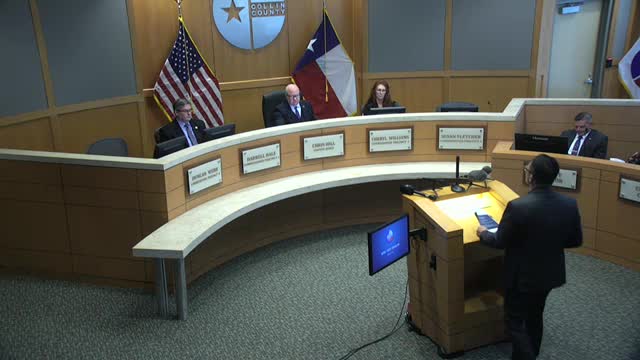
Public hearing draws large turnout as Collin County examines proposed "Epic City" development
Summary
County staff and developer representatives said no application has been filed yet for the 402‑acre planned community called Epic City. Staff explained county limits on land‑use control while residents raised concerns about exclusionary marketing, water, infrastructure, public safety and ongoing state investigations.
Collin County held a public hearing and lengthy public comment period on a proposed 402‑acre development promoted as “Epic City,” a planned community the ownership group has described in promotional materials as including about 1,000 homes, a K–12 school, a mosque, senior living and retail. County staff and representatives for the property told the court no plat or development application had been submitted to the county as of the meeting; developer representatives said they are still in due diligence and conducting studies.
County role and regulatory limits
County Administrator Eun Kim briefed the court on the county’s authority for development in unincorporated areas. Kim said the site — which spans unincorporated Collin and Hunt counties near Josephine — is outside city limits and the extraterritorial jurisdiction and therefore subject to county subdivision and infrastructure regulations, not municipal zoning. Kim told the court the county can regulate plats, roads, drainage, floodplain compliance, on‑site sewage and inspection of construction; however, she emphasized that the county does not have municipal zoning power and “for residential lots the county cannot regulate the density of residential lots.” If a plat meets applicable state and county requirements and infrastructure is installed to county standards, Kim said final plat approval by commissioners is largely a ministerial act.
Developer representatives: no application yet
Representatives for the landowner and developer — David Califfer and Matt Lee of Westwood Professional Services and Aaron Ragsdale (public relations) — appeared and told the court they are in a due‑diligence phase. Califfer said the group has completed a water study, flood study and traffic analysis and is assessing sewer and water options with potential providers. He said the land has been acquired and that the team anticipates submitting applications “sometime this year” but gave no specific timetable.
State investigations cited in presentation
Kim and staff acknowledged state‑level activity concerning the project and affiliated entities. Kim told the court Representative Jeff Leach had referred materials to Texas Attorney General Ken Paxton; Paxton’s office issued a civil investigative demand, and the governor’s office has publicly stated concerns and directed the Texas Rangers to investigate affiliated entities. Kim said the Texas State Securities Board and the Texas Workforce Commission have opened inquiries, and she cited press releases from state agencies and from the governor’s office. Kim emphasized that the county has not received a development application from Community Capital Partners or EPIC as of the hearing.
Public comments: themes and examples
More than 60 members of the public spoke during the hearing and overflow room sessions. Many speakers expressed opposition, citing a range of concerns: potential exclusionary marketing and home‑sales practices, questions about whether the development would operate under religious governance, water availability and pressure, emergency services capacity, traffic and road wear, environmental impacts including floodplains and endangered species, and ongoing state investigations.
- Brandon Burton, a Frisco pastor and licensed real estate broker, told the court he was concerned about potential violations of the federal Fair Housing Act and state licensing rules for real estate agents if marketing or sales limited ownership based on religion.
- Jasmine Bayless, a Collin County resident, read a passage she said was posted on EPIC’s website describing limits on sales to “persons who believe…will contribute to the overall makeup of our community,” and urged the court to consider potential fair‑housing and legal implications.
- Many other speakers cited water and infrastructure concerns for Josephine and nearby towns. Terry Wilson and other residents noted municipal water limitations and low evening water pressure in nearby jurisdictions; multiple speakers urged the court to pause development approvals until water and emergency‑services impacts are resolved.
Supporters and developer statement
A smaller number of speakers urged tolerance and respect for religious freedom and urged the county to administer its rules without bias. Jeremy Sitka, chair of the Collin County Democratic Party, urged the court to protect religious liberty and warned against singling out a faith community for scrutiny that would not be applied to other faith‑based projects.
Erin Ragsdale, who identified herself as a public‑affairs representative for the ownership group, told the court the development team’s stated intent is to build an inclusive, multigenerational community. She said anyone could buy land or build a business in the proposed master plan and characterized the project as an effort to create housing, schools and services that could serve multiple generations. Ragsdale and Westwood staff reiterated that no application had been filed with the county as of the hearing.
County reaction and next steps
Court members repeatedly emphasized that any formal plat or infrastructure the applicant seeks to record must comply with state and county laws and rules. Judge Hill said local officials would not approve any application that violates federal or Texas law, and staff reminded the public that MUD approvals, sewer connections and any TCEQ permits would be required before large‑scale residential development could proceed. Commissioner comments also noted that municipal utility district (MUD) formation and TCEQ approvals normally precede the kind of sewer and water systems a project of that density would need.
Kim and staff committed to keep the court and the public informed of any formal application filings; the court reiterated that no vote on the development was before the commissioners that day. Commissioners encouraged the public to monitor state agency filings and TCEQ applications, which will be the venue for review of MUD and water‑supply plans.
Why this matters
If an application is submitted, the project’s size and location — near Josephine and spanning two counties — would raise typical infrastructure and public‑safety questions for the county: water capacity and pressure, sewage and environmental permitting, fire‑protection and EMS coverage, road impacts and long‑term maintenance, and school capacity. State inquiries into the financing and marketing practices of affiliated entities add legal and regulatory uncertainty.
Proper names and numbers recorded at the hearing included the ownership name Community Capital Partners (developer), East Plano Islamic Center (EPIC), Westwood Professional Services (planner), the land purchase date referenced as September 2024, and the parcel size cited by staff (approximately 402 acres). County staff noted that none of the filings required for a MUD or for sewer were on file with county staff at the time of the hearing.